Stuck in the Middle: Why Your Organic Traffic Has Plateaued
You’ve outgrown the scrappy, do-it-all-yourself SEO tactics that got your business off the ground. You’re no longer a startup. But you don’t have the nine-figure marketing budget of an enterprise giant, either. You’re in the challenging, yet opportunity-rich, mid-market. And if you’re like many businesses at this stage, your organic traffic growth has hit a frustrating plateau. The old playbook isn’t working, and the next level of growth feels just out of reach.
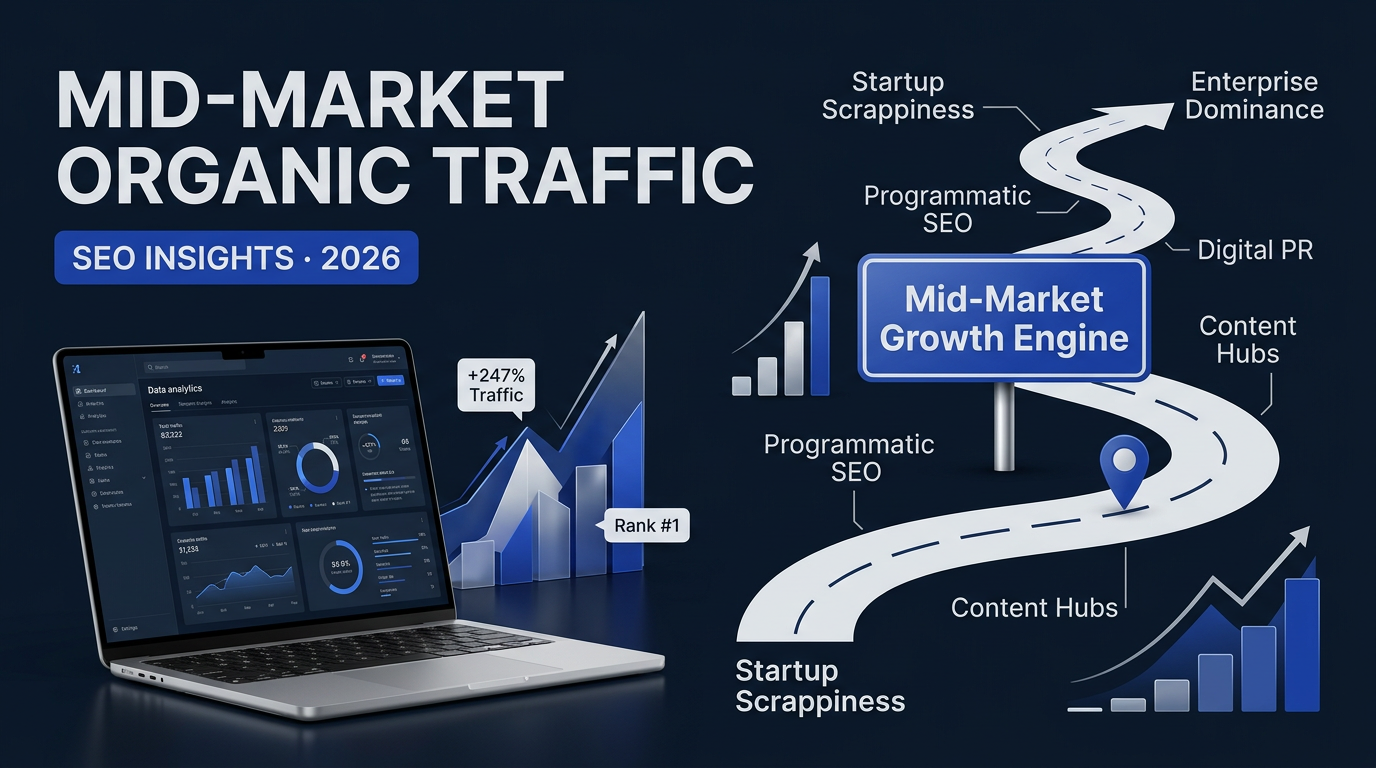
This is a common growing pain. The strategies that generate your first 10,000 monthly visitors are not the same ones that will scale you to 100,000 and beyond. To achieve significant mid-market organic traffic growth in 2026 and beyond, you need a more sophisticated, systematic, and scalable approach. It's time to transition from random acts of SEO to building a predictable growth engine. These five proven strategies are your new playbook.
1. Systematize High-Intent, Bottom-of-Funnel (BOFU) Content
Too many mid-market content strategies are obsessed with top-of-funnel (TOFU) blog posts that attract huge traffic numbers but few qualified leads. While brand awareness is important, the fastest path to revenue is capturing users who are actively looking to make a purchase decision. This means systemizing the creation of content that targets high-intent, commercial keywords.
As B2B marketing expert Sam Dunning points out, focusing on product landing pages and sales-focused content can drive insane results because it attracts an audience ready to buy. For a mid-market company, this is your lowest-hanging fruit for demonstrating clear ROI from SEO. This isn’t just about your main product pages; it's about building a web of pages that intercept buyers at the final stages of their research.
Your BOFU Content Hitlist for 2026:
- Competitor Alternative Pages: Create detailed pages for keywords like "[Competitor] alternative." Break down features, pricing, and support, positioning your solution as the superior choice.
- "Vs." Comparison Pages: Develop pages that directly compare your product against a key competitor, such as "[Your Product] vs. [Competitor]." Control the narrative and highlight your strengths.
- Use Case & Integration Pages: Target long-tail keywords like "best accounting software for construction firms" or "project management tool that integrates with Slack." These pages attract highly qualified, niche traffic.
- Pricing and ROI Pages: Don't be shy about discussing cost. A clear pricing page, perhaps coupled with an ROI calculator, can be a massive conversion driver and a powerful SEO asset that ranks for terms like "[Your Product] pricing."
2. Launch a Programmatic SEO Playbook
Programmatic SEO (pSEO) is the secret weapon for scaling content creation beyond what any human team can manage manually. It involves creating hundreds or even thousands of unique, high-value pages by leveraging a database and a set of templates. For a mid-market business, this is how you compete with enterprises on the sheer volume of keywords you can target, but with surgical precision.
Forget the old-school, spammy idea of doorway pages. Modern pSEO is about identifying user needs at scale and programmatically generating helpful, specific content to meet them. For example, a real estate software company could create pages for every major city, state, or even neighborhood, targeting terms like "real estate marketing tools in [City]" or "CRM for realtors in [State]." Each page would pull unique data (e.g., market stats, local regulations) from a database to provide genuine value.
Getting Started with Programmatic SEO:
- Identify Your Scalable Keyword Pattern: Find the "head" term (e.g., "electrician software") and the "modifier" (e.g., a city, state, industry, or job title). Your pattern might be "[Head Term] for [Modifier]."
- Build Your Database: This is the core of pSEO. Collect the unique data points for each modifier. This could be market size, average project cost, specific integrations, or customer testimonials relevant to that segment.
- Design a High-Quality Page Template: Create a template that will house the data. It must be well-structured, user-friendly, and optimized for search. The goal is for each programmatically generated page to be as good as, or better than, a manually created one.
- Launch, Monitor, and Iterate: Start with a small batch of pages (e.g., the top 50 cities). Monitor their performance in Google Search Console, analyze user engagement, and refine your template and data before scaling further.
3. Build Topical Authority with Pillar Pages & Content Hubs
To win in 2026, Google needs to see you as an undeniable expert in your niche. Publishing one-off articles on random keywords is no longer enough. The key to building this level of trust and authority is to structure your content around core topics using a pillar page and cluster content model (also known as a hub-and-spoke model).
A pillar page is a comprehensive, long-form guide on a broad topic central to your business (e.g., "Employee Onboarding"). Cluster content consists of more specific, shorter articles that delve into subtopics related to the pillar (e.g., "employee onboarding checklist," "remote employee onboarding best practices," "first day welcome kits"). These cluster posts all link back up to the main pillar page, and the pillar page links out to them. This creates a powerful internal linking structure that signals your deep expertise on the entire topic to search engines.
By organizing your content this way, you're not just ranking for individual keywords; you're ranking for the entire topic. This creates a moat around your organic presence that is difficult for competitors to replicate.
This strategy is perfect for mid-market teams because it focuses resources. Instead of chasing dozens of disconnected keywords, you concentrate your efforts on owning 3-5 core topics that are most valuable to your customers. Use AI tools for research and outlining, but ensure every piece is enriched with your team's unique experience and insights—this is the human element that AI cannot replicate and that Google's EEAT guidelines increasingly reward.
4. Execute Digital PR That Builds Authority, Not Just Links
Backlinks are still a critical ranking factor, but the game has changed. For mid-market companies, chasing low-quality directory links or paying for guest posts is a waste of time and money. Your link building strategy must evolve into a Digital PR strategy focused on earning high-authority links that also build your brand's credibility.
Instead of asking "how can I get a link?" ask "what can I create that journalists, bloggers, and industry leaders would want to cite?" This flips the model from outreach-heavy to asset-heavy. You create something so valuable that it naturally attracts attention and links from top-tier publications—the kind of links that truly move the needle on your rankings and establish you as a thought leader.
High-Impact Digital PR Assets:
- Proprietary Data Reports: Survey your customers, analyze your internal product data (anonymously, of course), or conduct industry research to publish a unique report with new statistics. Journalists love citing fresh data.
- Free Tools & Calculators: Build a simple, genuinely useful tool that solves a common problem for your target audience. Think mortgage calculators, salary estimators, or ROI projectors. These are natural link magnets.
- Expert Commentary & Newsjacking: Position your internal experts to comment on trending news in your industry. Use services like HARO (Help a Reporter Out) or build relationships with key journalists so they come to you for quotes.
5. Master Advanced Technical SEO for a Competitive Edge
As your website grows from hundreds to thousands of pages (especially with pSEO), technical SEO becomes exponentially more important. Small, overlooked technical issues can accumulate and severely hamper your ability to rank. Mid-market companies that invest in mastering technical SEO gain a significant—and often invisible—advantage over less sophisticated competitors.
This goes beyond running a basic site audit. It's about proactively managing your site's health and ensuring search engines can crawl, render, and index your content with maximum efficiency. By the time you reach the mid-market stage, you should have a dedicated resource or agency partner focused on these more advanced areas.
Technical SEO Priorities for Mid-Market Sites:
- Crawl Budget Optimization: Use your server log files to see exactly how Googlebot is crawling your site. Are they wasting time on low-value pages? Block unnecessary pages with robots.txt and use parameters correctly to guide crawlers to your most important content.
- Internal Linking Automation: As your site scales, manually adding internal links becomes impossible. Implement systems that automatically suggest or insert relevant internal links within your content. This can be done with plugins or custom scripts to ensure link equity flows efficiently.
- Schema Markup at Scale: Go beyond basic organization schema. Implement more advanced types like `FAQPage`, `HowTo`, `JobPosting`, or product schema with structured `offers` and `reviews` across all relevant pages to enhance your SERP visibility and earn rich snippets.
- Core Web Vitals and Page Experience: With a larger site, maintaining performance is a challenge. Invest in ongoing monitoring of your Core Web Vitals (LCP, INP, CLS) and ensure your site provides a seamless experience across all devices. This is no longer a suggestion; it's a critical ranking factor.
Key Takeaways for Mid-Market Growth
Scaling organic traffic from a mid-market position requires a strategic shift. Outdated tactics won't deliver the next level of growth. To build a predictable and scalable SEO engine for 2026, you must focus your efforts.
- Prioritize BOFU Content: Stop chasing vanity traffic. Focus relentlessly on creating comparison, alternative, and use-case pages that convert.
- Scale with Programmatic SEO: Use data and templates to programmatically create hundreds of high-value pages targeting long-tail keywords.
- Build Topical Authority: Move from single posts to content hubs. Own entire topics to build a defensible SEO moat.
- Invest in Digital PR: Create data reports and free tools that earn high-authority links and build your brand's credibility.
- Master Technical SEO: Optimize your crawl budget, automate internal linking, and perfect your site's performance to gain a hidden competitive edge.