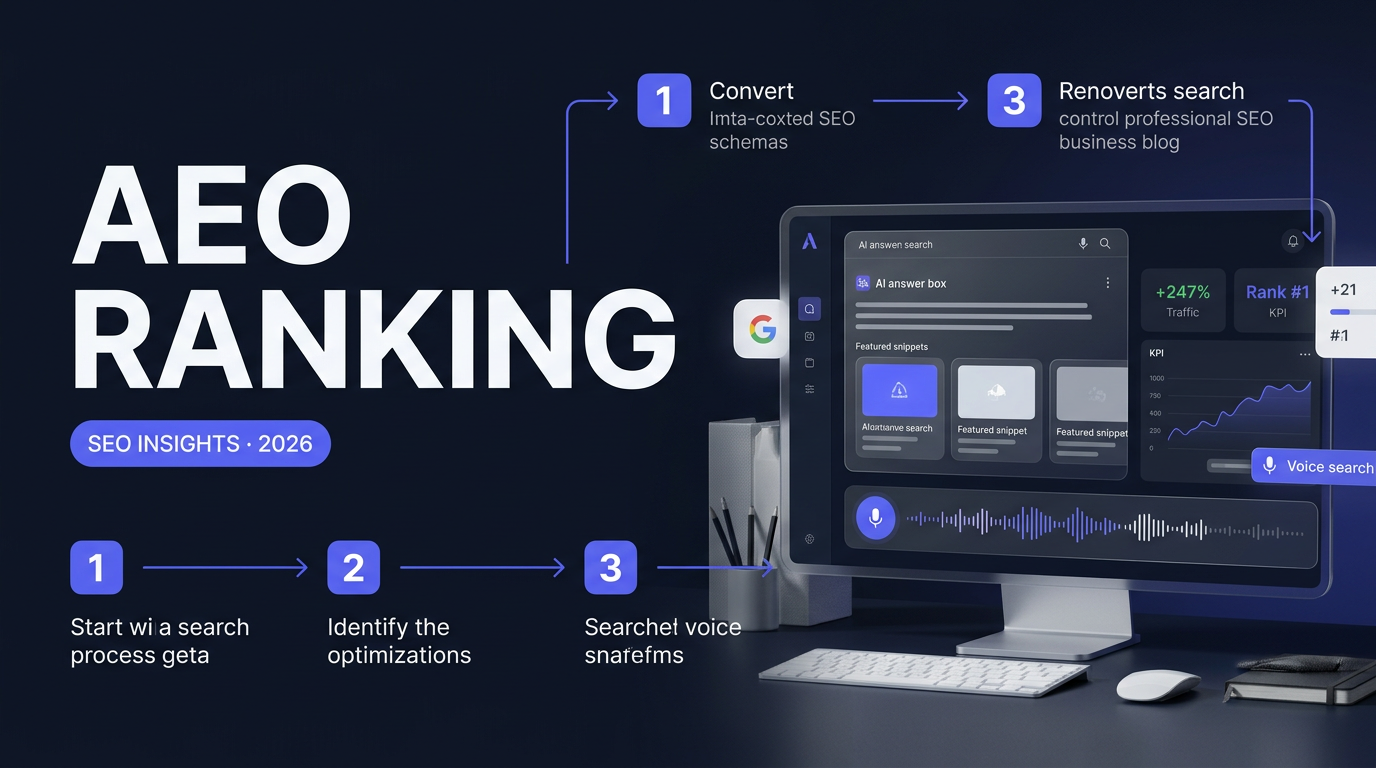
The click-through rate on Google search results has been falling for years — accelerated by AI Overviews, ChatGPT, Perplexity, and Claude. In 2026, more product research decisions are made inside an AI conversation than on a traditional SERP. Answer Engine Optimization (AEO) is how you become the source those AIs quote. Here is the complete guide.
What AEO actually is (and is not)
AEO is the practice of structuring content so it is easy for large language models to extract, attribute, and cite as an answer to a user question. It is not "trick the AI into recommending you." AI answer engines rank sources by clarity, authority, factual density, and structural extractability. AEO is technical and editorial hygiene applied to those criteria.
Why AEO is the new #1 ranking signal
Consider the funnel: a user asks Perplexity "best CRM for a 15-person agency," gets a synthesized answer citing 4-6 sources, then clicks through only to the source that most convinced them. If you are not in that citation list, you never had a shot. Traditional SERPs are becoming a discovery layer for AI answer engines, not the endpoint. Being cited by AI is now the single highest-leverage brand distribution channel.
The seven signals AI answer engines reward
(1) Clear, extractable answers — a definitive sentence within the first paragraph. (2) Structured content — H2/H3 hierarchy, lists, tables. (3) Factual density — real numbers, dates, named entities. (4) Schema markup — FAQ, HowTo, Article, Product. (5) Authoritative citations — you cite credible sources; AIs then trust you. (6) Consistent entity signals — your brand appears the same way across the web. (7) Freshness — recently updated content is preferred.
Content structure patterns that get cited
Lead every article with a 1-2 sentence direct answer to the implied question. Follow with a bullet-list summary of key points. Use question-format H2s ("What is X?", "How does X work?"). Include a comparison table when relevant. Close with a FAQ block using FAQPage schema. This structure is not just SEO-friendly — it maps to exactly how LLMs parse content for extraction.
Schema you must implement
Minimum viable AEO schema: Article (with author, datePublished, dateModified, publisher), FAQPage on articles with question sections, Organization sitewide (with sameAs to all your official profiles), and BreadcrumbList. Product businesses add Product with reviews. Local businesses add LocalBusiness. Validate with schema.org's validator and Google's Rich Results test.
The llms.txt convention
A new convention — llms.txt in your site root — lets you provide a curated markdown summary of your site's most important pages, formatted specifically for LLMs. Include your value proposition, key product pages, and canonical documentation. Perplexity and other AI crawlers increasingly respect this file. Cost: 30 minutes to create. Upside: significantly cleaner AI understanding of your brand.
Building citation-worthy authority
AI models decide who to quote partly based on how often you are cited by other authoritative sources. Get published on industry publications, quoted in journalism, and mentioned in Wikipedia (where genuinely notable). These become the corroborating signals that make an AI comfortable naming you as a source.
Measuring AEO performance
Track: (1) direct citations in ChatGPT, Perplexity, Claude, and Google AI Overviews for your target queries (manual audit weekly), (2) referral traffic from AI answer engines (visible in analytics as referrals from perplexity.ai, chatgpt.com, etc.), (3) brand mention volume in AI answers (track via prompts like "list the top providers of X"), and (4) share of voice compared to competitors. Tooling for this is early; manual tracking beats waiting for perfect dashboards.
AEO and SEO are complements, not substitutes
Ranking on Google still drives crawl frequency, which increases the chance AI training data includes your content. Traditional SEO gets you crawled, indexed, and referenced. AEO gets you cited and quoted. Do both. Skip either and you leave leverage on the table.
Wrapping up
AEO is not a fad — it is the natural next layer of search optimization. The brands that build citation-worthy content structures now will own the AI-mediated discovery layer for the next decade. The brands that dismiss it will be invisible.