Beyond Basics: Scaling Organic Traffic for Mid-Market Brands
You’ve done the basics. You’ve built a solid foundation, captured some low-hanging fruit, and your organic traffic graph is ticking upward. But now, you’re hitting the dreaded plateau. The tactics that got you here—consistent blogging, basic on-page SEO—are yielding diminishing returns. This is the classic mid-market squeeze: you’ve outgrown startup hacks but lack the enterprise-level resources to simply out-spend and out-publish the competition. The key to breaking through isn't just doing more, it's about building smarter systems for sustainable mid-market organic growth.
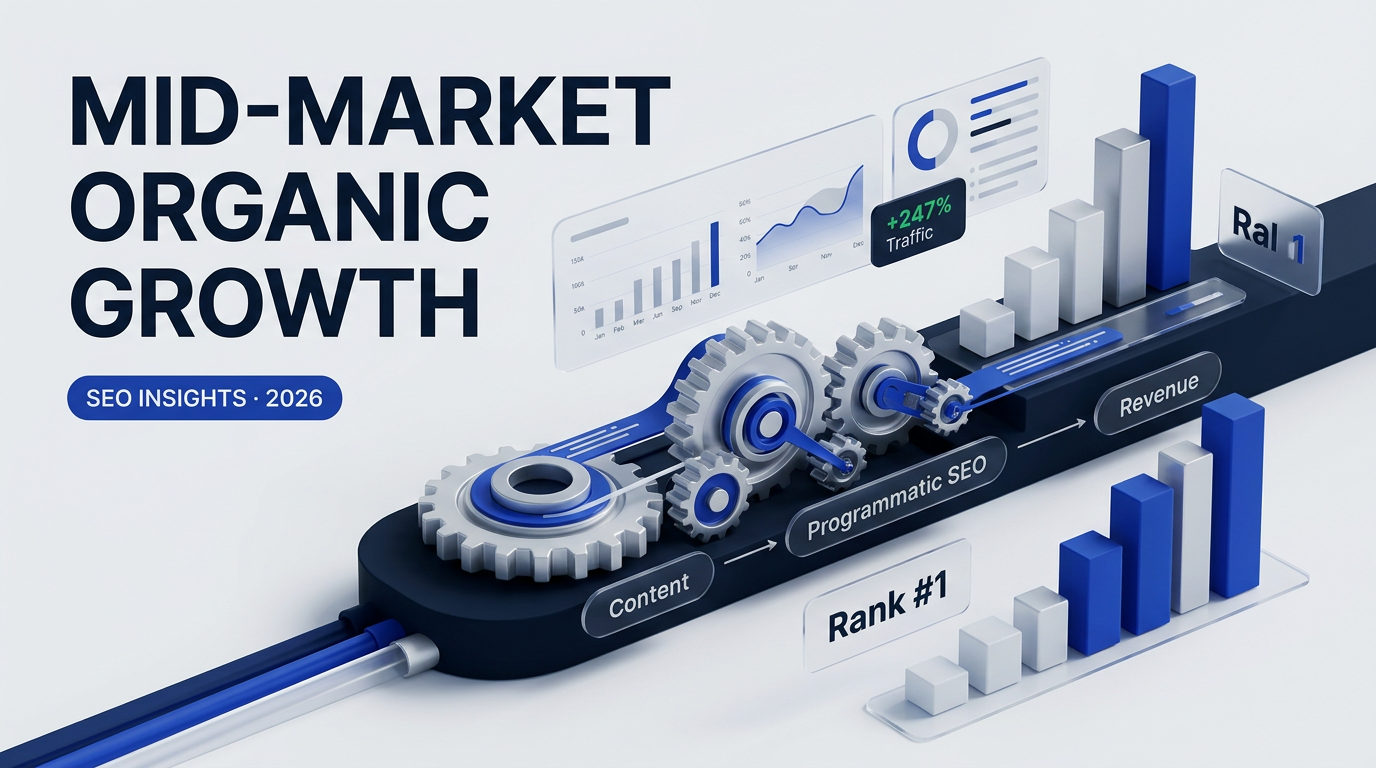
Forget the endless content treadmill. For 2026 and beyond, scaling requires a fundamental shift in perspective. As AI-powered search features transform the SERPs, your strategy must evolve from simply winning clicks to winning customers. This means focusing on programmatic SEO, mastering the high-intent middle and bottom of the funnel, and building measurable flywheels that connect organic traffic directly to pipeline and revenue. It's time to move beyond the blog and build a true organic growth engine.
Rethinking "Content": From Blog Posts to Scalable Digital Assets
The single biggest limiter for mid-market SEO is often the reliance on manual, one-off content creation. A blog post is a valuable asset, but it’s inherently unscalable. True growth comes from identifying patterns in user demand and building systems to meet that demand at scale. This is the principle behind what some call "inventory-driven" websites, where new product features or page templates drive exponential traffic, not just another article.
For a mid-market company, this doesn't mean you need to be Quora or Amazon. It means looking for opportunities to turn your data, expertise, or unique value proposition into a scalable asset. Think about the questions your sales team answers repeatedly or the comparisons your prospects are constantly making. These are a goldmine for programmatic opportunities. Instead of one article on "How to Choose Project Management Software," you can build a scalable system of pages targeting hundreds of long-tail queries.
Potential scalable assets for mid-market brands include:
- Templates Libraries: E.g., "project kickoff meeting agenda template," "SaaS budget template."
- Glossaries or Dictionaries: A comprehensive, internally linked resource for all your industry's terminology.
- Integration Directories: A page for every tool your product integrates with (e.g., "[Your Product] + Slack Integration").
- Comparison Hubs: Programmatically generated pages for "[Your Product] vs. [Competitor]" or "[Competitor] Alternative."
- Free Tools: Simple calculators, generators, or checkers that solve a small but painful user problem (e.g., a "Website Carbon Footprint Calculator").
Each of these moves you from a one-to-one content model to a one-to-many model. You design the template once, source the data, and can then generate tens, hundreds, or even thousands of pages that each target a specific, high-intent user need.
Mastering the Mid-Funnel: Your Growth Engine in an AI World
The search landscape of 2026 is fundamentally different. With AI Overviews appearing for over 13% of queries and zero-click searches becoming the norm for simple informational questions, the top of the funnel (ToFU) has become a battlefield with low click-through rates. Chasing broad, high-volume keywords is an increasingly futile exercise. The real opportunity for mid-market brands lies in the middle (MOFU) and bottom (BOFU) of the funnel.
These are the queries that signal commercial intent—the user isn't just learning, they're actively evaluating and preparing to make a decision. AI is less likely to provide a definitive answer for these complex, comparison-based searches, making your specialized landing page the most valuable destination. This is where you can capture highly qualified traffic that is much closer to converting. Your goal should be to build a content moat around your product or service, answering every possible question a prospect might have before they buy.
To build a powerful MOFU/BOFU content strategy, follow these steps:
- Map the Buying Journey: Work with your sales and customer success teams to identify the key questions, comparisons, and pain points prospects have at the consideration and decision stages.
- Keyword Research with Commercial Modifiers: Go beyond simple head terms. Focus on keywords that include modifiers like: "vs," "alternative," "pricing," "review," "comparison," "for [your industry]," "integration," "best software for [specific job-to-be-done]."
- Create Hyper-Specific Content: Don't just write a generic "Us vs. Them" article. Create a detailed, honest, and data-backed comparison page. Build dedicated landing pages for each key use case or industry you serve.
- Optimize for Conversion: These pages aren't for traffic alone; they're for generating leads and sales. They must include clear calls-to-action (CTAs), social proof (testimonials, case studies), and pathways to a demo or trial.
Building Programmatic SEO Flywheels
Once you've identified a scalable asset type and a set of MOFU/BOFU keywords, the next step is to build the programmatic engine. This might sound intimidating, but it can be started manually and automated over time. A programmatic SEO flywheel is a system where a single template and a database of information combine to create a large number of targeted organic landing pages.
Let’s use an example: a B2B SaaS company that offers project management software. They identify that prospects frequently search for software tailored to specific team types. Instead of writing dozens of blog posts, they decide to build a programmatic set of pages based on the query pattern "project management software for [team]."
The process would look like this:
- Create the Data Source: Build a simple spreadsheet or database with a list of team types in one column (e.g., Marketing Teams, Engineering Teams, Creative Agencies) and unique content for each in other columns (e.g., specific features they'd value, relevant testimonials, a targeted headline).
- Design the Master Template: Design a high-converting landing page template. This will include static elements (like the overall value prop and CTA) and dynamic fields where the data for each team type will be inserted (e.g., `
Project Management Software for {{Team Name}}
`). - Generate the Pages: Use a simple script or a CMS feature (like HubDB in HubSpot or Advanced Custom Fields in WordPress) to generate a unique URL for each row in your database (e.g., `.../software/for-marketing-teams/`).
- Build the Hub Page: Create a primary "hub" page that lists and links to all the generated spoke pages (e.g., a page titled "Project Management Software for Every Team"). This is crucial for internal linking and helping search engines discover all your new pages.
This flywheel creates dozens of highly relevant pages that would be impossible to build and maintain manually. As you add new team types to your database, you automatically create new organic traffic opportunities.
The New Rules of Topical Authority for 2026
Topical authority is no longer about just having a "pillar page" and a few supporting blog posts. In the age of AI, search engines are looking for unambiguous signals of deep, comprehensive expertise across multiple formats. To truly own a topic, you must prove you are the definitive source of information, leaving no stone unturned.
For mid-market brands, this means going deep, not just wide. Instead of trying to rank for 100 different topics, focus on becoming the undisputed leader for the 5-10 topics that are most critical to your business. This involves an integrated approach that combines different content types to signal authority.
Your topical authority plan should include:
- A Definitive Pillar Page: A long-form guide that serves as the central hub for the topic.
- Supporting Cluster Content: Detailed articles that answer specific questions related to the topic, linking back to the pillar.
- Programmatic Assets: As discussed above, use scalable pages to cover long-tail variations within your topic.
- Proprietary Data/Research: Conduct a survey or analyze your internal data to publish a unique industry report. This is a powerful link-building asset.
- Expert-Driven Content: Feature interviews, quotes, or bylines from genuine subject matter experts within your company to build E-E-A-T (Experience, Expertise, Authoritativeness, and Trustworthiness).
- Strategic Internal Linking: Ensure all content within the topic is logically interlinked, guiding both users and search crawlers through your web of expertise.
Crucially, you must wrap all this content in robust structured data (Schema.org markup). Use `Article`, `FAQPage`, `HowTo`, and other relevant schema types to explicitly tell search engines what your content is about, who wrote it, and why it’s credible. This is no longer optional; it's a prerequisite for appearing in rich results and being cited by AI.
Measurement Beyond Vanity Metrics: Tying SEO to Pipeline
As a mid-market leader, you answer to a bottom line. Traffic is a means to an end, not the end itself. The most successful organic growth strategies are those that are directly tied to revenue and can demonstrate a clear return on investment. It's time to graduate from tracking just rankings and sessions to measuring what really matters.
Your reporting should tell a story that your CFO can understand. This means connecting the dots between your content and programmatic efforts and the leads, pipeline, and customers they generate. This requires a bit more setup but provides invaluable insight into what's actually working.
Key KPIs for measuring mid-market organic growth:
- Organic-Sourced MQLs/SQLs: Track how many qualified leads originate from organic search, and which pages are driving them.
- Pipeline Value from Organic: Use your CRM to attribute a dollar value to the sales pipeline influenced by organic touchpoints.
- Conversions on High-Intent Pages: Monitor demo requests, trial sign-ups, and contact form submissions specifically on your MOFU/BOFU content.
- Reduction in Blended Customer Acquisition Cost (CAC): Demonstrate how a rising tide of free, organic traffic is lowering the overall cost to acquire a customer.
- Keyword Performance for BOFU Terms: Track rankings not for vanity terms, but for the money-making keywords that signal purchase intent.
By focusing on these metrics, you can justify continued investment in SEO and make smarter decisions about where to allocate your resources. You'll be able to prove that scaling organic traffic isn't a cost center; it's a revenue driver and a powerful competitive advantage.
Key Takeaways
- Stop the Content Treadmill: Shift from manual, one-off blog posts to building scalable, programmatic assets like templates, tools, and comparison hubs.
- Win the Middle Funnel: Focus your efforts on high-intent MOFU and BOFU keywords where users are evaluating solutions and are more likely to click and convert in an AI-driven search world.
- Build Programmatic Flywheels: Identify repeatable query patterns and use a template-and-database approach to create hundreds of targeted pages at scale.
- Go Deep on Topical Authority: Own your core topics by combining long-form guides, cluster content, proprietary data, and robust structured data (Schema).
- Measure What Matters: Move beyond traffic and rankings. Track organic's contribution to leads, pipeline, and revenue to prove ROI and make smarter strategic decisions.