Boost Visibility Now: How Semantic SEO Maps Drive AI Search Rankings
In 2026, simply ranking for a keyword isn't enough. With AI-powered search engines like Google's AI Overviews and Perplexity synthesizing answers directly, your brand is either part of the conversation or it's invisible. If your content isn't being cited, you're losing the majority of your audience before they even see a traditional search result. Old-school SEO tactics based on keyword density are officially obsolete in this new landscape.
This is where a modern, strategic approach becomes critical. The key to being understood, trusted, and cited by AI is to build a deep web of contextual meaning around your expertise. You achieve this with semantic SEO maps, a powerful blueprint that guides search engines through your content, proving your authority and ensuring you are the source they rely on to answer user questions.
What Are Semantic SEO Maps (And Why They're More Than Just Topic Clusters)
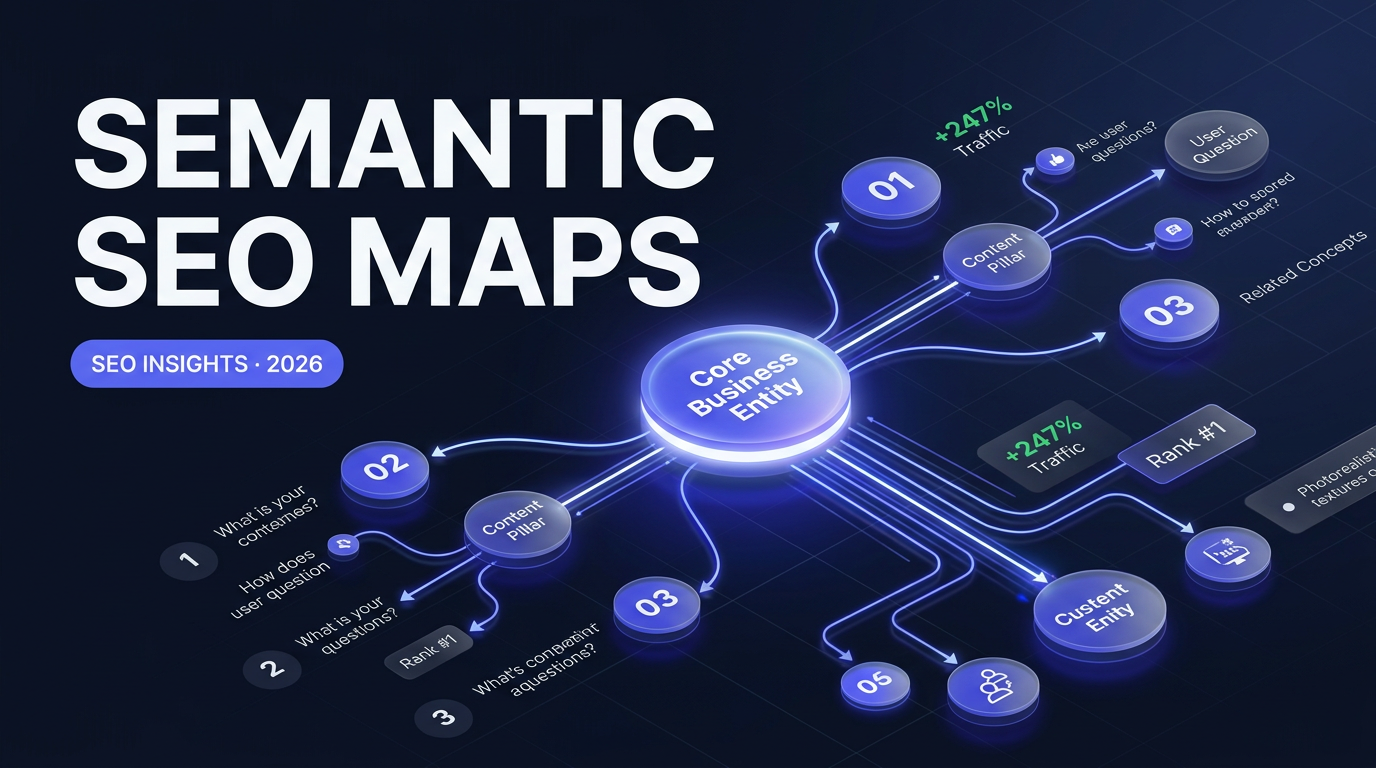
At its core, semantic SEO is the practice of creating content that is optimized for topics and intent, not just isolated keywords. It focuses on the relationships between different concepts, or entities. A semantic SEO map is the tangible, strategic document that visualizes these relationships for your entire digital ecosystem. It’s your master plan for establishing topical authority.
While many are familiar with topic clusters—a pillar page linked to several sub-pages—a semantic map is a far more sophisticated tool. A basic cluster model is hierarchical and often rigid. A semantic map, however, is a dynamic web that charts not just content pieces, but the contextual glue that holds them together. As experts at SE Ranking note, this approach helps search engines deliver more meaningful results by understanding context and relationships. Your map charts the course for both users and AI to navigate your expertise comprehensively.
Think of it this way: a topic cluster is a list of destinations, but a semantic SEO map is the full GPS experience. It shows the highways (pillar pages), the local roads (cluster content), points of interest (related entities), and even common traffic patterns (user search journeys). It’s a living document that guides your entire content strategy toward one goal: becoming the definitive answer.
- Central Entity: The core concept, product, or service your map is built around.
- Content Hubs/Pillars: Broad overview pages that serve as the primary entry point to a topic.
- Content Spokes: Detailed articles, guides, or FAQs that answer specific questions and dive deep into sub-topics identified on your map.
- Question Constellations: Clusters of related user queries (informational, commercial, transactional) surrounding each topic.
- Semantic Pathways: The deliberate internal linking structure that connects all related content, reinforcing context for search engines.
Step 1: Charting Your Core Territory with Entity Research
Before you can draw your map, you need to define your landmarks. In semantic SEO, these landmarks are your 'entities.' An entity is any well-defined thing or concept: a person, a place, an organization, a product, or an idea. Google’s own Knowledge Graph is built on identifying and connecting entities. To win in AI search, you need to teach Google what your core entities are and why you are an authority on them.
This process goes far beyond traditional keyword research. You're not just looking for what people type; you're identifying the fundamental concepts that define your business. This is the foundation of your entire map. For example, if you sell project management software, your entities aren't just keywords like “gantt chart tool.” They are the concepts themselves: Project Management, Agile Methodology, Team Collaboration, and your own Brand Name and Product Name.
Your goal is to build a rich network of meaning that AI models can process and trust. The more clearly you define and connect your entities, the more confident a search engine will be in citing your content as a reliable source. This strategy is essential for what some agencies call optimizing for AI comprehension.
- Identify Your Primary Entity: Start with the single most important concept, product, or service you offer. This is the sun in your solar system.
- Discover Related Entities: Use Google Search, Wikipedia, and competitor analysis to find related people, organizations, technologies, and concepts. Look at the “People also ask” and related searches for clues.
- Analyze Competitor Entity Associations: Search for your top competitors. What entities appear in their Knowledge Panel? What topics do they rank for comprehensively? This reveals the semantic territory you need to compete in.
- List Your Foundational Entities: Compile a list of these core and related entities. These will become the major hubs and points of interest on your semantic SEO map.
Step 2: Mapping User Intent and Search Journeys
With your entities defined, the next step is to map the human element: what are people actually trying to achieve when they search for these topics? In 2026, users don’t just type keywords; they ask complex, multi-faceted questions. AI search engines are designed to provide synthesized, comprehensive answers, and your map must account for the entire user journey, not just one touchpoint.
For each entity on your map, you need to brainstorm and research the full spectrum of user questions. Group these questions by intent. Informational queries seek to understand, commercial queries seek to compare, and transactional queries seek to act. A robust semantic map charts content to satisfy all these intents, creating a seamless journey from initial curiosity to final conversion.
This creates 'question constellations' around each of your core entities. By mapping these out, you are preemptively building the exact knowledge base that AI models need to construct a thorough answer. When your site provides the best, most interconnected answers to an entire constellation of questions, the AI has a clear reason to cite you as the primary source.
- Informational Intent: For the entity “Electric Vehicles,” this includes questions like “How do EV batteries work?” and “What is the environmental impact of EVs?”
- Commercial Intent: This layer includes comparative queries like “Tesla Model Y vs. Ford Mustang Mach-E” or “best home EV chargers 2026.”
- Navigational Intent: Searches for your brand or specific product pages, like “PieroSEO blog” or “Tesla financing calculator.”
- Transactional Intent: Queries with high purchase intent, such as “buy EV charger online” or “schedule a Tesla test drive.”
Step 3: Building Your Content Pillars and Connection Pathways
Your semantic map is now a strategic blueprint. The next step is the construction phase: creating the content and the pathways that connect it. This is where you build the hubs and spokes that form the structure of your topical authority. The map dictates precisely what content you need to create and, just as importantly, how it should all link together.
Start with the 'pillar' or 'hub' pages for your most important entities. These are broad, comprehensive guides that act as the definitive starting point for a topic. From this pillar, you will build out 'spoke' content. Each spoke is a detailed article that addresses a specific sub-topic or question cluster from your map. For example, your “Electric Vehicles” pillar would link out to spokes on “EV Battery Technology,” “Government EV Incentives,” and “Home Charging Solutions.”
The most critical part of this step is creating the 'semantic pathways' through internal linking. Your map should define the linking logic. Every spoke page must link back to its parent pillar page. Furthermore, related spoke pages should be interlinked to show search engines the relationship between nuanced concepts. Use descriptive, entity-focused anchor text (e.g., linking with “latest EV battery innovations” instead of “click here”) to make these connections explicit and powerful.
- Create Pillar Content: Write a comprehensive, long-form guide for each primary entity on your map. This page should provide a complete overview and link out to your detailed spoke content.
- Develop Spoke Articles: Produce in-depth content that addresses every question and sub-topic identified in your user journey mapping. Each piece should be the best possible answer to a specific query.
- Implement a Deliberate Internal Linking Strategy: Use your map to link spokes to their pillar and to other relevant spokes. This creates a dense, logical web of information that is easy for both users and AI to crawl.
- Use Contextual Anchor Text: Ensure your link text clearly describes the content of the destination page, using relevant entities and keywords to reinforce the semantic connection.
Step 4: Reinforcing Your Map with Structured Data
If content and internal links are the substance of your map, structured data is the technical layer that makes it machine-readable at a glance. Structured data (most commonly Schema.org markup) is a vocabulary you add to your website's code to explicitly tell search engines what your content is about. It turns ambiguous text into a clear, labeled set of facts and relationships.
For example, you can use Schema to label your company as an `Organization`, your article as an `Article`, its author as a `Person`, and a Q&A section as an `FAQPage`. This removes all guesswork for AI crawlers. By explicitly defining the entities and their properties on your page, you are directly feeding their knowledge graphs and confirming the relationships you've built with your content and linking strategy. A page with well-implemented structured data is far more likely to be understood and trusted by AI.
Alongside Schema, using semantic HTML is crucial. Structuring your content with tags like `
`, ``, ``, and `` creates a logical hierarchy. This simple practice helps AI models understand the structure and importance of your content, much like clear headings and paragraphs help a human reader. A clean, logical structure is a prerequisite for being parsed effectively by advanced AI systems.- `Organization` Schema: Clearly define your business name, logo, address, and social profiles to establish your core brand entity.
- `Article` Schema: Mark up your blog posts with headlines, publication dates, and author information to add credibility.
- `FAQPage` Schema: Label question-and-answer sections to make them eligible for rich results and easy for AI to pull as direct answers.
- `BreadcrumbList` Schema: Reinforce your site structure and show how the current page fits within the broader content hierarchy defined by your map.
- `Person` Schema: Identify authors to build their expertise and authority within your niche.
Key Takeaways
The rise of AI search is not a threat; it's an opportunity for businesses that are willing to adapt. Moving away from chasing single keywords and toward building deep topical authority is the only sustainable path forward. Semantic SEO maps provide the strategic framework for this transition.
- Think Maps, Not Lists: Go beyond simple topic clusters. Build dynamic semantic maps that visualize the relationships between entities, user intent, and your content.
- Start with Entities: Define the core concepts of your business first. Your entire strategy should be built around establishing authority on these foundational entities.
- Map the Full Journey: Address the entire spectrum of user questions, from initial awareness to the point of purchase, for each of your core topics.
- Link with Purpose: Use your map to design a deliberate internal linking strategy that creates clear semantic pathways for search engines to follow.
- Make It Machine-Readable: Reinforce your map with structured data (Schema) and clean semantic HTML to explicitly communicate your content's meaning and context to AI.
- ` creates a logical hierarchy. This simple practice helps AI models understand the structure and importance of your content, much like clear headings and paragraphs help a human reader. A clean, logical structure is a prerequisite for being parsed effectively by advanced AI systems.
- `Organization` Schema: Clearly define your business name, logo, address, and social profiles to establish your core brand entity.
- `Article` Schema: Mark up your blog posts with headlines, publication dates, and author information to add credibility.
- `FAQPage` Schema: Label question-and-answer sections to make them eligible for rich results and easy for AI to pull as direct answers.
- `BreadcrumbList` Schema: Reinforce your site structure and show how the current page fits within the broader content hierarchy defined by your map.
- `Person` Schema: Identify authors to build their expertise and authority within your niche.
- Think Maps, Not Lists: Go beyond simple topic clusters. Build dynamic semantic maps that visualize the relationships between entities, user intent, and your content.
- Start with Entities: Define the core concepts of your business first. Your entire strategy should be built around establishing authority on these foundational entities.
- Map the Full Journey: Address the entire spectrum of user questions, from initial awareness to the point of purchase, for each of your core topics.
- Link with Purpose: Use your map to design a deliberate internal linking strategy that creates clear semantic pathways for search engines to follow.
- Make It Machine-Readable: Reinforce your map with structured data (Schema) and clean semantic HTML to explicitly communicate your content's meaning and context to AI.
Key Takeaways
The rise of AI search is not a threat; it's an opportunity for businesses that are willing to adapt. Moving away from chasing single keywords and toward building deep topical authority is the only sustainable path forward. Semantic SEO maps provide the strategic framework for this transition.