Boost Visibility with Entity SEO: The Advanced Tactic You're Missing
You’ve heard the buzz about Entity SEO. You nod along when someone mentions the Knowledge Graph. But when it comes to execution, you’re still defaulting to keyword research and link building, hoping for the best. If that sounds familiar, you’re not alone. Most businesses understand the what of entity SEO, but are completely missing the how.
In an era of AI-driven answers and semantic search, clinging to old methods is a recipe for invisibility. It's time to graduate from theory to practice. This is the advanced Entity SEO tactic you need to stop just competing and start dominating your niche. We’re moving beyond definitions and into a repeatable framework for building true topical authority that Google can’t ignore, especially as we head into 2026.
Beyond Keywords: Why Your 2026 Strategy Demands Entities
For years, SEO was a game of words. Find a keyword, put it on a page, and build links. Today, that’s like trying to navigate a city with a 10-year-old map. Google and other search engines have evolved. They no longer just match strings of text; they understand concepts, or what we call 'entities'. As iPullRank explains, an entity is essentially a noun: a specific person, place, organization, or concept that is well-defined and distinct.
Think of 'Apple' the company versus 'apple' the fruit. A keyword-based engine gets confused; an entity-based engine understands the difference based on context. This understanding is the bedrock of modern search features like Knowledge Panels, 'People Also Ask' boxes, and the AI-generated snapshots rapidly taking over SERPs. If your business isn't a recognized entity connected to your core topics, you simply won't appear in these valuable, high-visibility placements.
Your 2026 SEO strategy must shift from winning keywords to becoming the definitive entity for your area of expertise. This isn’t about tricking an algorithm; it’s about clearly and comprehensively communicating your authority to a machine that thinks in terms of relationships and concepts, not just words.
Introducing the “Entity Reconciliation & Expansion” (ERE) Tactic
To move from abstract concept to concrete results, you need a structured approach. We call it the Entity Reconciliation & Expansion (ERE) tactic. It’s a two-phase process designed to first solidify Google’s understanding of your core business and then systematically expand your influence across your entire topic universe.
Forget random acts of content. The ERE tactic is a deliberate campaign to build a web of interconnected signals that establish your brand as an authoritative node in Google's Knowledge Graph. It breaks down like this:
- Phase 1: Reconciliation. This is the foundation. You must audit and correct how Google perceives your most critical entities: your brand, your products, and your key people. If Google is confused about who you are, it will never trust you on what you know.
- Phase 2: Expansion. This is where you build dominance. Once your core is solid, you strategically map and create content for related entities, proving your expertise and becoming the go-to source for your entire niche, not just a few head-term keywords.
This framework turns entity SEO from a vague philosophy into an actionable project. It provides a clear path to building the kind of deep authority that thrives in an AI-first search world.
Step 1: Auditing and Reconciling Your Core Entities
Before you can expand your authority, you must ensure Google has its facts straight about you. Misinformation or ambiguity about your own brand entity is a critical blocker to success. This reconciliation process involves auditing your digital footprint and using structured data to speak Google's language directly.
Your goal is to make it effortless for Google to answer the question, "Who is this business and what does it do?" Start by looking at your brand through Google's eyes. Search for your brand name. Do you have a Knowledge Panel? Is the information accurate? Check your key pages with Google’s own tools to see what it understands. Any discrepancy is a point of friction you must resolve.
Your Reconciliation Checklist:
- Identify Your Core Entities: List the non-negotiable entities that define your business. This includes your official brand name, CEO or founder, flagship products, and physical location if applicable.
- Run a Google NLP Analysis: Copy the text from your homepage and About Us page and paste it into the Google Cloud Natural Language API Demo. Look at the 'Entities' tab. Does Google correctly identify your brand, people, and industry? If not, your on-page copy needs clarification.
- Claim and Correct Your Knowledge Panel: If a Knowledge Panel exists for your brand, claim it. Systematically go through and use the 'Suggest an edit' feature to correct any inaccuracies, from your logo to your founding date. If one doesn't exist, strengthening your signals through the next steps is the path to earning one.
- Standardize Your Digital Identity: Ensure your business Name, Address, and Phone number (NAP) are identical across your website, Google Business Profile, and major industry directories. Consistency is a powerful trust signal.
- Implement Foundational Schema Markup: Deploy `Organization` schema on your homepage and `Person` schema on your about page for key executives. This is not a suggestion; it is a requirement for clear entity communication. This structured data explicitly defines who you are in a machine-readable format.
Step 2: Mapping Your Topical Entity Universe
With your core entity reconciled, it's time to expand. You don't just want to be known for your brand name; you want to be the recognized authority for the topics your customers care about. This requires moving beyond a simple keyword list and mapping the entire universe of related entities.
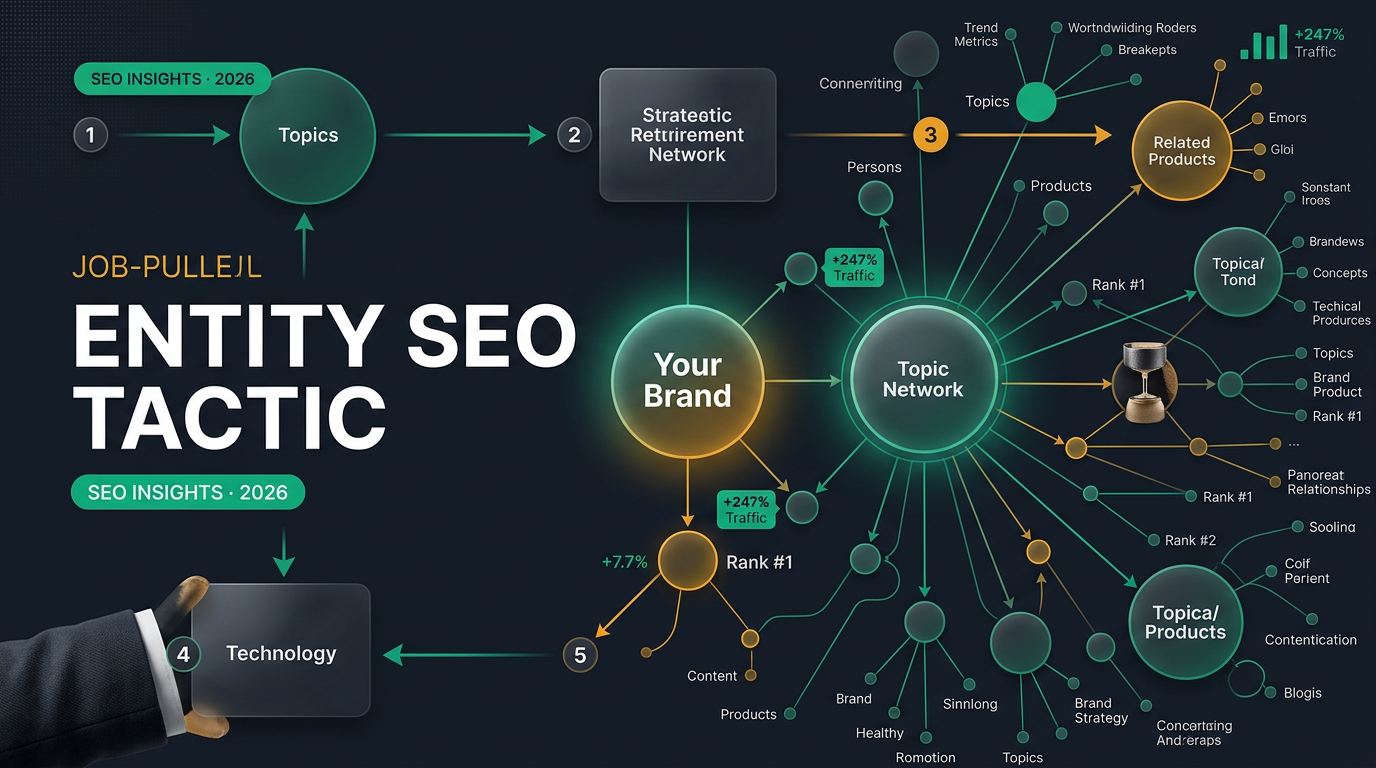
An Entity Map is a strategic blueprint for your content. It visualizes the relationships between concepts in your niche, helping you identify content opportunities that build comprehensive topical authority. This is how you go from being a site that ranks for 'blue widgets' to the definitive resource for the entire 'widget' ecosystem. This process, as highlighted in guides like the one from InLinks, is about understanding the network of 'things', not just words.
How to Build Your Entity Map:
- Define Your Pillar Topic: Start with the primary concept you want to own (e.g., "Project Management Software"). This is the center of your universe.
- Harvest Related Entities: Use a combination of tools and sources to find connected entities. Check the Wikipedia article for your pillar topic, paying close attention to the table of contents and bolded terms. Analyze the 'People also ask' and 'Related searches' on Google. Look at the topics discussed by authoritative competitors.
- Categorize Your Entities: Group your discovered entities into logical categories. For "Project Management Software," your categories might be: Methodologies (Agile, Scrum, Kanban), Features (Gantt charts, time tracking), Competitors (Asana, Trello), and Influencers (thought leaders in project management).
- Prioritize and Plan: You can't target everything at once. Prioritize entities based on their relevance to your products and their importance to your audience. This prioritized list becomes your content calendar's strategic guide.
Step 3: Activating Your Entity Map with Content and Links
Your Entity Map is useless as a spreadsheet. Its power is unleashed when you use it to direct your content creation, internal linking, and outreach efforts. Every piece of content you create and every link you build should now have a specific purpose: to strengthen the connection between your brand and a target entity from your map.
This is where you operationalize your Entity SEO tactic. You'll create a tightly woven web of content that covers your topic from every angle, using schema and strategic linking to make the relationships explicit for search engines. This creates a feedback loop: great content earns authority, and that authority helps you rank for even more entities.
Content and On-Page Execution:
- Build Your Topic Hub: Create a comprehensive pillar page for your main topic. Then, write detailed articles or cluster pages for each of the high-priority entities you mapped.
- Implement Semantic Internal Linking: Link from your cluster pages up to your pillar page using descriptive anchor text. Crucially, also link *between* relevant cluster pages (e.g., your page on 'Agile' should link to your page on 'Scrum'). This demonstrates your understanding of the relationships.
- Link to Authoritative Entities: Don't be afraid to link out. Citing authoritative sources like Wikipedia, research institutions, or industry standards when you mention an entity helps Google contextualize your content and associate you with those trusted sources.
- Use Advanced Schema Markup: On each article, use `Article` schema and the `about` and `mentions` properties to explicitly list the key entities the content covers. Use `FAQPage` schema to answer common questions related to your entities, targeting featured snippets.
Off-Page Entity Association:
- Pursue Entity-Based Link Building: Instead of chasing any link, target backlinks from websites that are themselves established entities for your topics. A link from an authoritative industry publication is worth more than ten links from unrelated blogs.
- Digital PR and Source Creation: Create original research, studies, or data visualizations related to your entities. Become the source that other authoritative sites cite when they discuss your topic.
- Build Your Brand Entity Off-Site: Ensure your company and key people are present and consistently represented on relevant platforms like LinkedIn, industry-specific communities, and Wikidata.
Key Takeaways
Moving to an entity-first approach is no longer optional for serious businesses. As search engines become more sophisticated, success will be determined by who demonstrates the deepest, most connected authority. Stop chasing keywords and start building your legacy as a definitive entity.
- Embrace the ERE Tactic: Start with Reconciliation to clean up your core brand entity, then move to Expansion to systematically build authority across your entire topic universe.
- Think in Connections, Not Keywords: Your goal is to build a web of meaning. Every piece of content, internal link, and schema tag should reinforce the relationships between concepts in your niche.
- Use Schema as Your Translator: Structured data is the most direct way to communicate with search engines. Use `Organization`, `Person`, `Article`, and `FAQPage` schema to remove all ambiguity.
- Authority is Built, Not Bought: True entity authority comes from creating comprehensive, expert content and earning associations (links, mentions) from other trusted entities. There are no shortcuts.