Data-Driven Strategies to Scale Mid-Market Organic Traffic
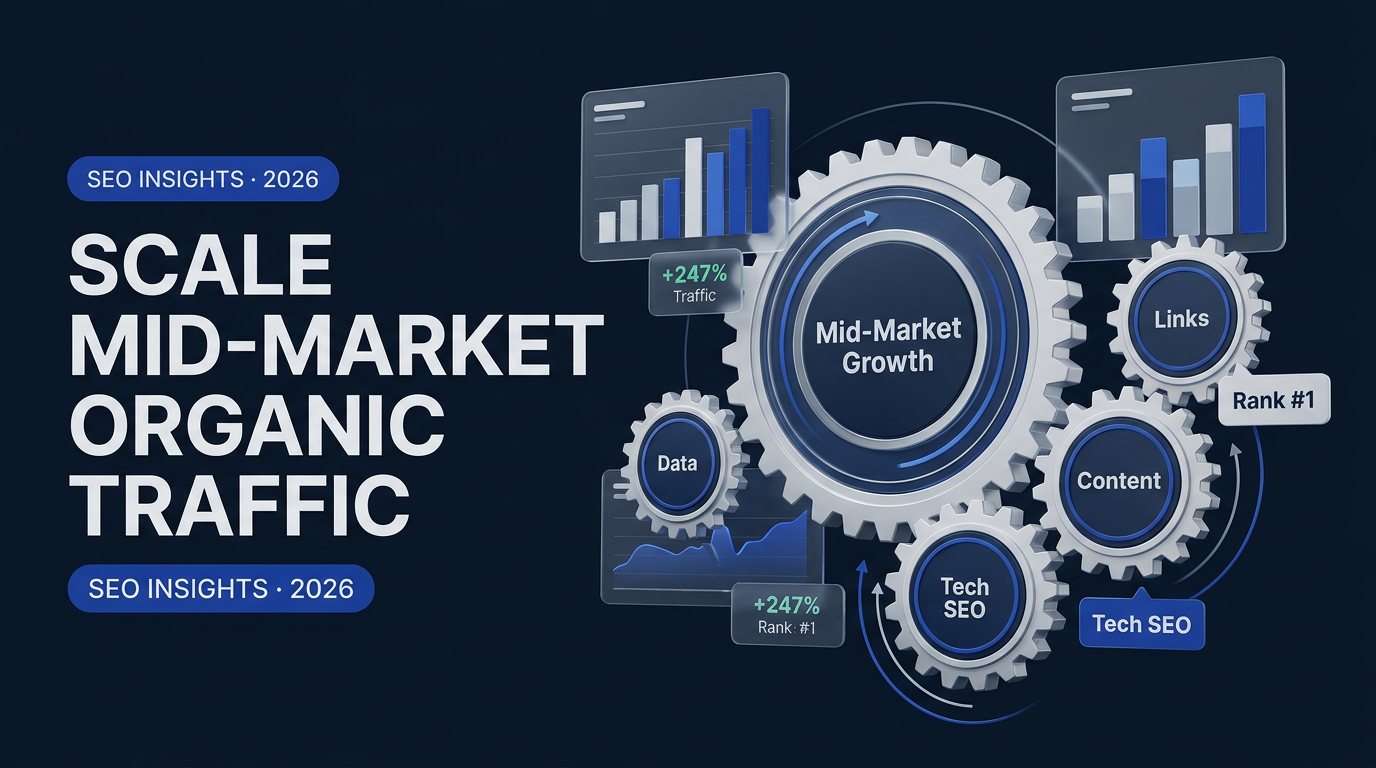
You’re in the messy middle. Your business has outgrown the scrappy, do-everything-manually startup phase, but you don't have the near-infinite resources of an enterprise giant. This is the mid-market challenge: how do you achieve exponential growth without a linear increase in budget and headcount? The answer lies in shifting your mindset from creating content to building a scalable, data-driven growth engine.
For too long, SEO has been treated as a mix of guesswork, creative sprints, and manual checklists. That approach hits a hard ceiling. To truly scale mid-market organic traffic in 2026 and beyond, you need to embed data into every part of your strategy. This isn't about more dashboards; it's about building repeatable systems that leverage your unique data to create a moat your competitors can't cross. Let’s explore the actionable strategies that will get you there.
Beyond Keywords: Mastering Programmatic SEO for Scale
Manual keyword research and one-off article writing are the enemies of scale. If your strategy relies on a writer tackling one keyword at a time, you'll never capture the long tail of search intent where your most qualified customers are hiding. The solution is to think like a publisher and build a content machine with Programmatic SEO (pSEO).
Programmatic SEO is the practice of using a structured database and a dynamic page template to generate hundreds or even thousands of optimized pages at scale. Think of Zillow's pages for every city and neighborhood, or Zapier's landing pages for every possible app integration. They aren't writing these by hand. They've built a system. For a mid-market company, this could mean creating pages for every industry you serve, every problem you solve, or every competitor you compare against.
Getting started with pSEO requires a strategic, multi-step approach:
- Identify Your Scalable Dataset: What unique data does your business possess? This could be product features, service locations, software integrations, job titles you serve, or common customer use cases. This dataset is the fuel for your pSEO engine.
- Build a Dynamic Page Template: Design a high-quality page template that serves user needs. It should include placeholders for your data variables (e.g., `[Industry_Name]`, `[Feature_Name]`, `[City]`). This template is your blueprint for every page you'll generate.
- Develop a Robust Internal Linking Structure: This is critical for success. Plan how your generated pages will link to each other and back to your main pillar pages. For example, all state pages should link to a country page, and all city pages should link to their respective state page. This distributes authority and helps search engines discover your content.
- Populate and Publish: Use your database and template to generate the pages. This can be done with custom scripts, no-code tools like Webflow's CMS, or integrations with a headless CMS. As noted in a recent Search Engine Journal guide, the technical setup is a one-time investment for ongoing returns.
Leveraging First-Party Data for Unbeatable Content-Market Fit
Public keyword research tools are valuable, but they have one major flaw: all your competitors are using them. This leads to a sea of homogenous content all targeting the same head terms. Your secret weapon to break out of this is your first-party data—the information you collect directly from your prospects and customers. This data is your unique, un-replicable source of truth about what your market truly wants.
Instead of guessing customer pain points, you can mine them directly from the source. By analyzing your internal data streams, you can build a content strategy that has a near-perfect market fit from day one. This creates content that not only ranks but also converts, because it speaks your customer's exact language.
Here are the goldmines of first-party data you should be tapping immediately:
- Sales Call Transcripts: Using AI-powered conversation intelligence tools like Gong or Chorus.ai, you can automatically transcribe and analyze every sales call. Search for recurring pain points, feature requests, competitor mentions, and objections. Each one is a high-intent topic for a new article or landing page.
- Customer Support Tickets: Your support team is on the frontline of customer problems. Analyze support tickets and chat logs to find the most common "how-to" questions, troubleshooting issues, and points of confusion. Turn these into ultra-detailed tutorials, knowledge base articles, and video guides.
- CRM Data: Look at the firmographic and demographic data of your best customers. Which industries, company sizes, and job titles are most profitable? Use this insight to build hyper-specific content personas and tailor your content to their unique challenges, as recommended by Harvard Business Review's research on customer-centricity.
- On-site Search Queries: The search bar on your own website is a direct line to user intent. What are people looking for when they're already on your domain? If they're searching for something and you don't have a relevant result, you've just found a guaranteed content gap with a captive audience.
The 'Digital PR Flywheel': Building Authority at Scale
Old-school link building is a slow, painful grind of manual outreach with a low success rate. To scale authority, you need to stop begging for one-off links and start earning them systematically. The most effective way to do this is by building a "Digital PR Flywheel"—a repeatable process for creating link-worthy assets that generate high-quality backlinks and brand mentions over time.
The flywheel concept is about creating momentum. Instead of a single campaign that ends, you build a content engine that consistently produces assets so valuable that journalists, bloggers, and industry leaders *want* to cite and link to them. This shifts you from a position of outreach to a position of authority.
In 2026, you don't just 'build links'; you build a reputation that attracts them. Your data is the foundation of that reputation.
Follow these steps to build your own Digital PR Flywheel:
- Ideate with Data: The best link-worthy content is based on new, interesting data. You can achieve this by surveying your customers, analyzing your anonymized product usage data, or commissioning a formal industry study. The goal is to create a unique story that only you can tell. For example, "The State of Hybrid Work in Mid-Market Tech Companies 2026."
- Create a Cornerstone Asset: Package your research into a high-value, aesthetically pleasing cornerstone asset. This is typically a gated report, a comprehensive whitepaper, or a large interactive infographic. This will be the central hub of your campaign.
- Atomize the Content: Don't stop at the report. "Atomize" your cornerstone asset into dozens of smaller pieces of content. Pull out key stats for social media graphics, write blog posts that dive deeper into specific findings, create a short video summary, and host a webinar to discuss the results. This maximizes your reach, as we demonstrated in a recent PieroSEO case study.
- Execute Targeted, Story-Driven Outreach: Now, when you reach out to journalists, you're not asking for a favor. You are offering them a unique story backed by data. Personalize your pitch, explaining why this specific data is relevant to their audience. This strategic approach dramatically increases your success rate.
Topical Authority Mapping with AI and Entity Analysis
Google no longer just ranks pages; it ranks expertise. Simply publishing a few articles around a topic is not enough to convince search engines that you are an authority. To win in competitive niches, you must demonstrate comprehensive knowledge by building topical authority. This means strategically mapping and covering a subject from every conceivable angle, creating an interconnected web of content that signals your expertise.
In 2026, AI-powered tools and entity-based SEO principles make this process more data-driven than ever. An entity is a specific, well-defined thing or concept (like a person, place, product, or company) that Google understands. By including relevant entities in your content and structuring it logically, you help Google see you as a definitive source.
To build topical authority at scale, follow this process:
- Define Your Content Pillars: Identify the 3-5 core topics that are central to your business. These are your content "pillars"—broad subjects you want to be known for, such as "Cloud Data Security" or "B2B Account-Based Marketing."
- Use AI for Cluster Planning: Leverage advanced content optimization tools (like Clearscope, MarketMuse, or newer AI-native platforms) to analyze a pillar topic. These tools will generate a comprehensive map of related subtopics, user questions (People Also Ask), and key entities you need to cover to be considered an expert.
- Conduct a Content Gap Analysis: Audit your existing content against the AI-generated topic map. Identify which subtopics you've already covered and, more importantly, where the gaps are. Prioritize creating content to fill these gaps, starting with those that have the highest business value.
- Fortify with Internal Linking: This is the glue that holds your topic cluster together. Every new "cluster" article must link back up to the main "pillar" page. Furthermore, related cluster pages should link to each other contextually. This thoughtful internal linking architecture is a powerful signal of topical depth to search engines.
Routine Technical Audits for Performance and Crawl Efficiency
As your website grows, so does your technical debt. Broken links, slow page templates, redirect chains, and index bloat accumulate, dragging down performance and wasting Google's precious crawl budget. For a scaling mid-market site, these small issues multiply quickly, creating a systemic drag on your SEO efforts. A proactive, routine technical audit process is not optional—it's essential for sustainable growth.
Your focus should be on scalable fixes. Instead of manually checking individual pages, look for patterns and template-level issues that, once fixed, improve thousands of pages at once. This is the difference between plugging leaks and reinforcing the ship's hull.
Incorporate these data-driven checks into your regular technical SEO audits:
- Log File Analysis: Your server logs provide the ultimate truth about how Googlebot interacts with your site. Analyze these logs to see which pages are being crawled frequently, which are ignored, and if crawl budget is being wasted on low-value pages (like expired promotions or parameter-heavy URLs). Use this data to prioritize fixes and guide your crawling strategy.
- Core Web Vitals at the Template Level: Use Google Search Console and a crawler like Screaming Frog to identify groups of URLs with poor Core Web Vitals (LCP, INP, CLS). Often, the issue is not the content on the page, but the underlying page template—a slow hero image component or a layout-shifting ad slot. Fixing one template can resolve issues across your entire blog or product section.
- Schema Markup Validation: Structured data (Schema) is crucial for helping Google understand your content and earning rich results. Use tools like the Schema Markup Validator to regularly audit your site's schema implementation. Ensure it's correctly deployed and error-free across all major page types (Article, Product, FAQPage, etc.).
- Index Bloat Pruning: A bigger site isn't always a better site. Actively identify and remove thin, duplicate, or low-value content from Google's index using "noindex" tags, robots.txt disallows, or canonical tags. This concentrates your site's authority on the pages that matter most, focusing Google's attention and often leading to better overall rankings.
Key Takeaways
Scaling organic traffic in the mid-market requires a fundamental shift from manual tasks to data-driven systems. By focusing on efficiency and repeatability, you can punch above your weight class and drive sustainable growth. Remember to:
- Use Programmatic SEO to capture the long-tail of search intent at scale.
- Leverage your unique first-party data from sales and support to create content with unbeatable market fit.
- Build a Digital PR Flywheel to create link-worthy assets that consistently earn authority.
- Map and own entire subjects with Topical Authority planning, guided by AI and entity analysis.
- Conduct regular Technical SEO Audits focused on performance and crawl efficiency to ensure your foundation is solid.