
The Scale Trap of Enterprise Programmatic Search
Scaling organic growth across an enterprise footprint frequently stalls at the intersection of technical infrastructure and algorithmic search quality. A poorly engineered enterprise programmatic seo architecture inevitably creates catastrophic index bloat, burns through search crawler budgets, and triggers site-wide algorithmic devaluations across search engines like Google and emergent AI-driven answer engines.
Building sustainable scale across tens of thousands or millions of programmatic URLs requires abandoning static templating habits. Success demands treating organic search as an end-to-end data engineering challenge: structuring programmatic entities, deploying dynamic edge-caching architectures, enforcing programmatic quality validation gates, and orchestrating strict indexation controls.
The Core Engineering Pipeline: From Data Store to Search Index
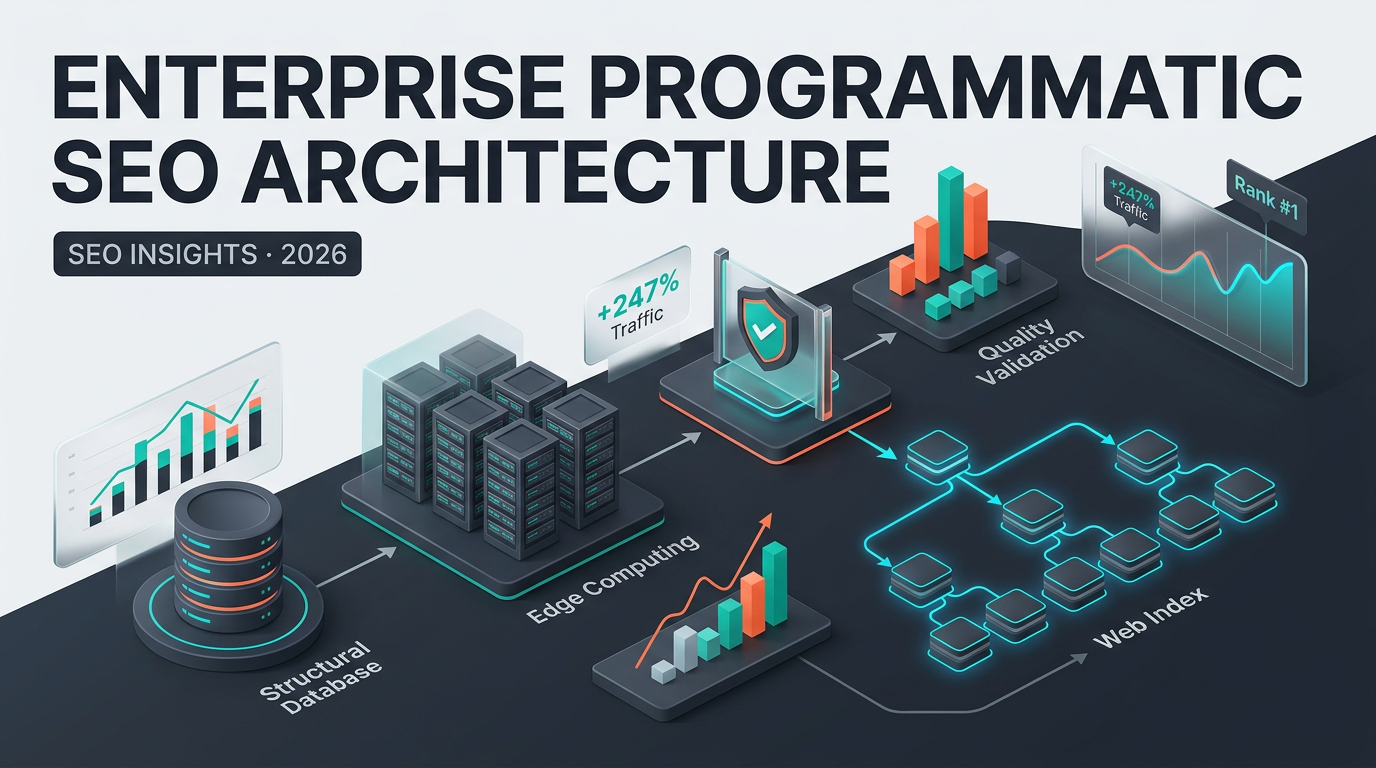
Enterprise-grade programmatic systems reject brittle CSV-to-CMS imports. Instead, high-performance systems deploy an automated ingestion and rendering pipeline that couples relational data stores with modern edge-computing runtimes, turning structured database models into performant search real estate.
According to technical teardowns of programmatic SEO architecture, sustainable programmatic engines decouple static content generation from human hours. They execute this by operating as a continuous three-tier pipeline that guarantees freshness and technical crawlability:
- The Normalized Entity Data Layer: A centralized PostgreSQL, Supabase, or headless data lake organizing records into clean Entity-Attribute-Value (EAV) paradigms or strictly typed graph models.
- The Dynamic Edge-Rendering Layer: Server-Side Rendering (SSR) or Incremental Static Regeneration (ISR) using modern edge runtimes (e.g., Next.js App Router, Cloudflare Workers, or Fastly Compute) delivering fully hydrated, zero-layout-shift HTML directly to Googlebot within sub-300ms Time to First Byte (TTFB).
- The Automated Schema and AEO Pipeline: Dynamic injection of semantic JSON-LD structures (such as Product, SoftwareApplication, or AggregateRating), allowing answer engines like ChatGPT Search and Google AI Overviews to parse proprietary data feeds effortlessly.
By enforcing clear separation between the data plane and presentation layer, your infrastructure allows engineering teams to deploy system-wide template updates, schema iterations, and routing adjustments across millions of URLs without manual recrawling bottlenecks.
Defeating Index Bloat: Algorithmic Quality Gates and Demand Validation
The single greatest hazard in enterprise deployments is unconstrained page generation. If you build 100,000 permutations because your database permits it mathematically, but only 5,000 exhibit measurable user demand, search crawlers will swiftly classify the directory as thin, auto-generated boilerplate, penalizing the entire root domain.
To avoid this fate, enterprise architectures must establish rigorous programmatic quality gates prior to exposing URLs to the crawler footprint:
- Search Intent & Search Volume Pruning: Automatically gate page creation by matching target combinatorial queries against search demand data (via DataForSEO, Ahrefs, or proprietary clickstream feeds). Permutations falling below a minimum volume or traffic threshold remain hidden behind canonical rollups or parameterized search filters.
- Unique Data Density Metric (UDD): Measure the structural and lexical variance of each generated page. If unique dynamic entities contribute less than 35% of the total on-page DOM relative to the boilerplate template, the page must not be exposed as an indexable leaf node.
- Automated Dynamic Canonicals: Programmatically direct low-inventory or near-duplicate category and attribute combinations back to an authoritative parent hub via
rel="canonical"until inventory thresholds are satisfied.
Architectural teardowns of enterprise programmatic SEO scale demonstrate that companies like Zapier maintain extreme topical dominance by pruning millions of potential mathematical permutations down to strictly verified, search-backed combinations.
Edge Caching, Dynamic Rendering, and Crawl Budget Management
Search engines do not allocate infinite crawling resources to any domain. Crawling millions of dynamic pages can exhaust server capacities, spike latency, and prompt Google's Web Rendering Service (WRS) to throttle crawling frequencies, leaving your freshest data unindexed for quarters.
A resilient programmatic architecture relies on edge infrastructure designed specifically to minimize origin server load while maximizing crawl efficiency:
- Edge Stale-While-Revalidate Caching: Cache pre-rendered HTML payloads on Content Delivery Network (CDN) edge nodes globally. User and bot requests are served static, high-speed HTML instantaneously while background processes revalidate expired caches asynchronously.
- Adaptive Crawl Throttling: Monitor incoming bot user-agents in real time. If edge response times degrade, programmatic middleware should prioritize Tier-1 high-intent templates while serving 429 status codes or 304 Not Modified headers on stale nodes to protect critical infrastructure.
- Zero-JavaScript Payload Delivery: Search engine bots should never wait on client-side React hydration to inspect primary content. Deliver mission-critical copy, navigational graphs, and structured markup entirely inside raw server-rendered HTML.
Implementing an aggressive edge-first caching tier guarantees that response times remain sub-200ms across tens of millions of page variants, directly incentivizing crawlers to broaden their daily crawl depth across your programmatic catalog.
Directed Acyclic Graph (DAG) Internal Linking Networks
Flat sitemaps alone cannot sustain indexation across massive programmatic directories. If deep programmatic URLs sit four or more clicks away from the homepage without structured contextual links, PageRank decay will render them invisible to organic search indexes.
Enterprise programmatic SEO architectures solve this with algorithmic link distribution modeled on Directed Acyclic Graphs (DAG):
- Hierarchical Taxonomies: Strict, predictable parent-child breadcrumbs linking leaf pages directly back to intermediate categorical directories and broad parent silos (e.g.,
/integrations/crm/hubspot-to-salesforce/linking up to/integrations/crm/and/integrations/hubspot/). - Co-Occurrence and Lateral Clustering: Programmatically calculate entity proximity and display dynamic "Related Workflows," "Adjacent Locations," or "Alternative Integrations" based on shared database attributes.
- Anchor Text Matrix Rotation: Rather than relying on static, generic anchor strings, algorithmically generate diverse, semantically precise anchor text across internal link blocks to expand your footprint across auxiliary long-tail variants.
- Dynamic Paginated Index Rings: Replace legacy endless scroll interfaces with discrete, indexable pagination modules (utilizing clear next/prev links) to construct crawlable traversal chains across high-depth catalogs.
By transforming raw programmatic URLs into an interlinked topical graph, internal link equity cascades evenly from root domains down to granular, long-tail programmatic endpoints.
Sitemap Partitioning and Real-Time Indexation Protocols
Managing indexation visibility across hundreds of thousands of dynamic URLs requires segmented reporting and instantaneous indexation dispatching. Dumping all URLs into a singular, monolithic sitemap file creates an unmonitorable black box inside Google Search Console.
Modern programmatic deployments utilize partitioned XML architectures coupled with direct search engine ingestion APIs:
- Granular Sitemap Partitioning: Segment XML sitemaps strictly by page type, publication cohort, and update frequency (e.g.,
sitemap-integrations-1.xml,sitemap-integrations-2.xml, capped at 10,000 URLs per partition instead of the standard 50,000 limit). - Indexation Differential Tracking: With 10,000-URL caps per file, programmatic engineering teams can track Google Search Console's "Indexed vs. Crawled - Currently Not Indexed" ratios per sitemap segment, instantly isolating low-performing database cohorts.
- IndexNow Protocol Integration: Trigger real-time, automated HTTP webhooks to the IndexNow protocol (and Google Indexing API where compliant) upon any database update, schema revision, or programmatic node release to bypass passive crawl discovery cycles.
This automated verification loop allows technical leads to detect algorithmic rejections, template regression errors, or indexing decay within days rather than months.
Enterprise Monitoring: Measuring Index Health and Preventing Regressions
Operating a programmatic system at enterprise scale demands continuous programmatic observability. A single erroneous deployment—such as an unescaped character breaking JSON-LD blocks, or a database migration returning empty attribute fields—can instantly decimate organic traffic across hundreds of thousands of URLs.
Building a robust technical monitoring harness involves three essential programmatic safeguards:
- Synthetic Automated Scraping: Run daily headless bot crawls across a randomized, statistically significant sample (e.g., 2–5%) of programmatic URLs across all template archetypes to evaluate DOM health, schema validity, and HTTP response codes.
- Automated Empty State Interception: When underlying database attributes drop below minimum data thresholds (e.g., a service provider closes or a product drops inventory to zero), your application tier must programmatically return a 404, 410 Gone, or
noindexdirective rather than rendering a thin, low-content blank page. - Log File Analysis Pipelines: Stream CDN log events directly into tools like Datadog, Snowflake, or BigQuery. Continuously monitor crawler activity by bot type, measuring crawl rates, bot error codes (5xx/4xx), and bot-specific latency shifts before they manifest as catastrophic search drops.
Treating enterprise SEO with the same automated telemetry and rigorous unit-testing applied to core product engineering is what separates fragile programmatic experiments from long-term, compounding organic enterprise assets.
Key Takeaways
- Decouple Content from Manual Labor: Treat programmatic SEO as an engineering discipline centered on structured databases, dynamic edge rendering, and AEO-ready semantic schemas.
- Validate Demand to Stop Index Bloat: Enforce strict programmatic quality gates based on search demand, data density thresholds, and automated canonical logic before publishing programmatic pages.
- Leverage Edge Performance: Implement server-side edge rendering with stale-while-revalidate caching strategies to deliver sub-300ms payloads that maximize crawl capacity.
- Structure Internal Links via DAGs: Ensure no programmatic page becomes an orphan by architecting lateral and hierarchical graph connections between related programmatic entities.
- Segment XML Sitemaps: Partition sitemaps into cohorts of 10,000 URLs to pinpoint template-level indexing decay inside Google Search Console in real time.
- Automate Technical Observability: Deploy continuous synthetic crawling, log monitoring, and automated empty-state handling to catch technical regressions before they damage site authority.