
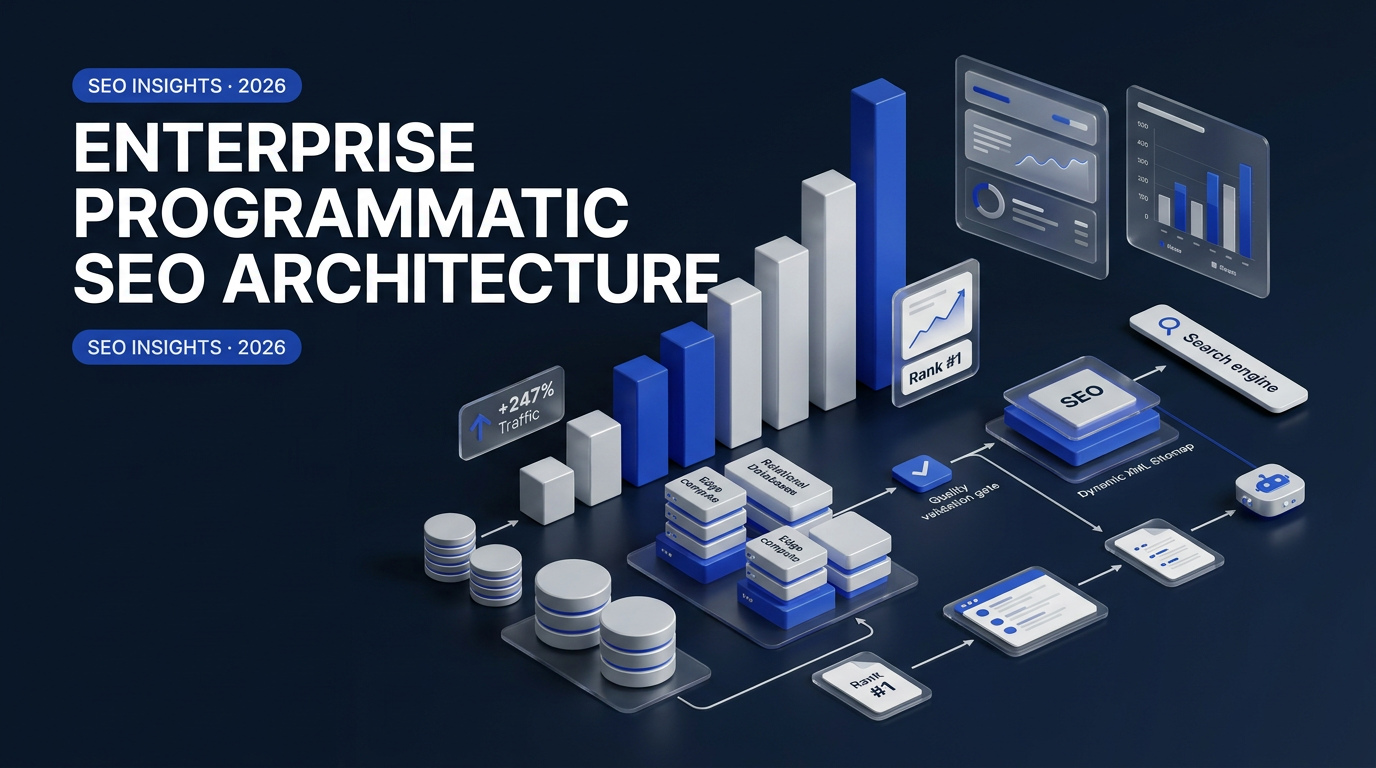
Deploying ten thousand programmatic landing pages is a growth hack; scaling to over one million indexable URLs without collapsing your crawl budget or triggering search quality demotions requires a specialized engineering discipline. Designing a resilient enterprise programmatic seo architecture demands that engineering and organic search teams treat web pages as real-time queries against structured data graphs rather than static assets in a content management system.
In 2026, search engines evaluate massive page catalogs through aggressive helpfulness classifiers, rendering-cost calculations, and behavioral interaction signals like NavBoost. If your rendering pipeline introduces latency, duplicate entity layers, or thin variations, search bots will quickly throttle crawl rates and drop indexed pages. Below is the blueprint enterprise platforms use to orchestrate high-performance data pipelines, edge-rendering topologies, algorithmic quality controls, and dynamic internal link graphs at seven-figure URL scales.
1. The Multi-Tier Data Layer: Moving Beyond EAV Anti-Patterns
At the million-page tier, simple Entity-Attribute-Value (EAV) tables and relational database joins fail under simultaneous user and bot request volumes. High-scale programmatic systems require a decoupled, polyglot persistence architecture that separates core business records from normalized search-intent entities. Relational databases like PostgreSQL house transactional records, while dedicated document stores like MongoDB or distributed graph databases like Neo4j handle relational taxonomic associations.
To support programmatic template queries without causing database lockouts, enterprises build an intermediate materialized search layer. This layer aggregates raw data attributes—such as local pricing metrics, regional compliance codes, and competitor feature vectors—into pre-computed, immutable JSON document caches hosted in low-latency stores like Redis or AWS DynamoDB.
- Transactional Data Store: Maintains authoritative product, geographical, or categorical records with strict ACID compliance.
- Graph Database (Taxonomy Layer): Maps complex entity relationships, such as parent-child geographic hierarchies or app-to-app integrations, to prevent broken link clusters.
- Materialized Document Cache: Serializes dynamic page payloads into pre-compiled JSON schemas that can be ingested by frontend templates in under 10 milliseconds.
- Change Data Capture (CDC): Leverages Apache Kafka or Debezium pipelines to invalidate and rebuild document caches immediately when upstream entity values change.
By decoupling content generation from operational databases, you eliminate backend latency bottlenecks and ensure that bot requests never degrade core application performance. As outlined in Atlas Leads' guide to programmatic database architecture, treating content as normalized relational entities rather than loose editorial text is the prerequisite for predictable indexation efficiency.
2. Hybrid Edge Rendering: Balancing TTFB with Cache Invalidation
The debate between Static Site Generation (SSG) and Server-Side Rendering (SSR) breaks down when managing a catalog exceeding one million pages. Pure SSG leads to multi-hour build pipelines that block real-time updates, while pure runtime SSR introduces latency spikes that exhaust search crawler connection pools. The modern standard is a Hybrid Distributed Edge Rendering model built on frameworks like Next.js App Router deployed across edge worker networks such as Cloudflare Workers or Fastly Compute.
Under this architectural pattern, tier-one hub pages (country directories, primary category hubs) use Incremental Static Regeneration (ISR) with long stale-while-revalidate intervals. Meanwhile, deep leaf nodes (hyper-local long-tail and combinatorial comparison pages) are rendered on-demand at the network edge with aggressive sub-request caching.
A reliable rule of thumb for million-URL catalogs: Your global Time to First Byte (TTFB) for search engine user agents must remain below 120 milliseconds across all edge locations, regardless of cache state.
- Edge Cache Hit: Edge workers serve pre-rendered HTML snapshots from distributed KV stores, achieving sub-40ms delivery with zero origin compute overhead.
- Edge Cache Miss (Stale-While-Revalidate): If a cache entry is expired, the worker serves the stale page to the crawler immediately while dispatching a background sub-request to re-render the page against the materialized document cache.
- Surrogate-Key Purging: Cache tags are attached via HTTP headers (e.g.,
Cache-Tag: entity-austin-tx, category-plumbing), allowing targeted purge calls that flush thousands of dependent pages across the global CDN in milliseconds when regional data updates.
This edge strategy guarantees that search crawlers encounter fully rendered HTML payloads without requiring client-side JavaScript execution, lowering the rendering cost for Google's Web Rendering Service (WRS) and preserving your overall crawl frequency.
3. Algorithmic Quality Gates and Structural Variance Engines
The primary reason programmatic deployments lose organic visibility is not technical infrastructure failure, but algorithmic demotions driven by systemic content redundancy. If your 1,000,000 pages rely on identical sentence structures with only geographic or noun swaps, search engine quality classifiers will evaluate your catalog as programmatic spam.
To prevent this, technical architects must implement algorithmic quality gates directly into the deployment pipeline. Every template must enforce strict minimum structural variance thresholds before generating an indexable URL.
- Dynamic Component Variation: Templates should conditionally assemble distinct UI modules based on data density. If a record possesses comprehensive review data, render an interactive comparison matrix; if data is sparse, adapt the layout to a consolidated directory model.
- Data-Density Thresholds: Programmatic routes must evaluate data completeness at build or render time. If an entity contains fewer than five verified attributes, the page must automatically return a
404or dynamicnoindexheader rather than an empty, low-value shell. - Combinatorial Demand Pruning: In combinatorial architectures (e.g., "Software A vs. Software B"), mathematical possibilities can explode into tens of millions of pages. Follow the methodology detailed in Search Atlas's teardown of enterprise programmatic examples: programmatically restrict URL generation to permutations with confirmed search demand or verified historical query impressions.
- Above-The-Fold Utility: Satisfy Google's behavioral and dwell-time evaluation by placing an interactive tool, actionable schema, or core data summary within the first 600 pixels of the viewport to minimize bounce rates.
4. Crawl Budget Governance: Directed Acyclic Graph (DAG) Internal Linking
Search engines discover and crawl pages through physical links, not sitemaps alone. In a seven-figure deployment, flat site architectures and basic breadcrumb trails cause crawl traps, create orphan pages, and leave deep leaf nodes undiscovered. The solution is an engineered Directed Acyclic Graph (DAG) for site taxonomy.
A DAG model ensures that PageRank and crawler traffic flow systematically from authoritative root domains down through categorical and regional parent hubs, transverse sibling vectors, and ultimately down to atomic leaf pages—all without creating infinite circular loops.
Structural Linking Topology for Enterprise Catalogs
Ensure that no leaf page sits more than four clicks away from the homepage by implementing horizontal and thematic contextual links:
- Strict Vertical Hierarchies: Maintain explicit parent-child relations with reciprocal links (e.g., State Hub → County Hub → City Page → Sub-Service Leaf).
- Co-Occurrence Sibling Linking: Connect related leaf pages dynamically based on entity embeddings or shared data classifications (e.g., a software page links to the top five alternative platforms sharing identical integration protocols).
- Faceted Pagination Controls: Never allow infinite scroll or uncontrolled multi-select facet permutations to remain indexable. Restrict crawler indexation strictly to single-dimension facet URLs while applying
rel="nofollow"or canonical fallbacks to multi-variable combinations.
5. Automated XML Sitemap Partitioning and Real-Time Push Protocols
Managing indexation pipelines at scale requires automated sitemap generation decoupled from application deployments. Google limits XML sitemaps to 50,000 URLs or 50MB uncompressed, meaning a million-URL footprint requires a multi-tiered, sharded sitemap architecture.
Store and update dynamic sitemaps within object storage (such as AWS S3 or Cloudflare R2), organized logically by vertical directory, entity cluster, or publication cohort. A root sitemap index references these discrete partitions, which update automatically as underlying database entries cycle through programmatic quality gates.
- Sitemap Sharding by Entity Health: Partition sitemaps not only by category, but by indexation performance. Group recently created, unvalidated URLs into separate evaluation sitemaps to monitor initial crawler uptake via Google Search Console API metrics.
- The IndexNow Pipeline: For search engines supporting real-time discovery (such as Bing and Yandex), integrate automated Webhooks that send batched payload pings across the IndexNow protocol whenever programmatic records are published, updated, or purged.
- Lastmod Discipline: Maintain strict timestamp accuracy for the
<lastmod>tag. If an edge worker merely rebuilds a page without material data modifications, do not touch the timestamp. Abusing<lastmod>without actual content changes degrades your crawl trust across major search engines.
6. Answer Engine Optimization (AEO) and Connected Schema Graphs
By 2026, capturing traditional SERP real estate is only half the battle. Programmatic architectures must also structure information so that conversational discovery engines, Large Language Model (LLM) agents, and Google AI Overviews can accurately parse, extract, and cite your database records.
This requires moving past fragmented, superficial JSON-LD snippets. Enterprise architectures must dynamically construct deeply linked, fully realized schema graphs using distinct entity identifiers (@id URIs) that establish semantic relationships directly in the HTML document.
- Nested Multi-Entity Declarations: Instead of disconnected markup, connect parent schemas (such as
Product,Service, orSoftwareApplication) directly to regionalPlace,AggregateRating, andFAQPagenodes using structured graph identifiers. - Explicit Entity Disambiguation: Use
sameAsfields pointing directly to authoritative reference databases like Wikidata or DBpedia within programmatic templates to ensure search engines correctly identify your entity definitions. - Machine-Readable Comparative Tables: LLM web crawlers prioritize semantically rich HTML tables and definition lists. Structure critical database attributes into valid HTML table tags wrapped in clear attribute identifiers, allowing AI engines to parse comparative matrices reliably.
7. Observability, Telemetry, and Dynamic Indexation Pruning
An enterprise programmatic deployment without real-time telemetry is a liability. A single bad schema deployment or edge worker misconfiguration can create millions of soft-404s or infinite crawl traps within hours. You must implement unified observability across edge access logs, crawler patterns, and indexation rates.
Stream CDN edge logs (Cloudflare Logpush, Fastly Real-Time Log Streaming) into analytics platforms like Datadog, Snowflake, or ClickHouse. Group log queries by user agent to isolate Googlebot Smartphone and Googlebot Desktop, tracking requests per second, response codes, and cache-hit ratios across every programmatic template family.
- Soft-404 Detection Alarms: Monitor edge responses for low byte-length anomalies. If a programmatic route returns an HTTP 200 with an unusually low DOM node count, trigger an alert before search engines index empty states.
- Automated Pruning Workflows: If log analysis reveals that Googlebot has repeatedly crawled a directory for 90 days without indexing its URLs, initiate automated pruning. Transition low-performing leaf nodes to a dynamic canonical pointing to their parent category, or return HTTP 410 Gone status codes to protect crawl bandwidth.
- Bot-Specific Rendering Budgets: Track WRS response durations. If server-side rendering latency exceeds 200ms on complex pages, provision isolated compute pools dedicated specifically to verified search engine user agents to prevent queue drops.
Key Takeaways
- Decouple Your Data: Shift away from monolithic CMS records to a pipeline that feeds transactional data through normalized graph schemas and distributed, materialized document caches.
- Render at the Edge: Implement hybrid ISR and on-demand edge rendering to guarantee global sub-120ms TTFB while maintaining instantaneous surrogate-key cache invalidation.
- Enforce Quality Thresholds: Eliminate thin content by programmatically blocking pages that fall below strict data-density and structural variance minimums before they reach search engines.
- Govern Crawl Traversal: Connect deep catalogs using a Directed Acyclic Graph (DAG) internal linking model that distributes PageRank and guarantees all pages sit within four clicks of root hubs.
- Structure for AI Engines: Generate interconnected, deeply nested JSON-LD schema graphs to position database attributes for inclusion in AI Overviews and conversational answer engines.
- Monitor Real-Time Logs: Pipe edge CDN logs directly into telemetry engines to identify soft-404 regressions, latency spikes, and crawl starvation across programmatic directories.