Mid-market brands occupy a precarious tier in modern search marketing. Having outgrown the scrappy tactics that carried them past their first $10M in revenue, they often lack the massive backlink moats and legacy brand equity enjoyed by category-defining Fortune 500 giants. When search landscape dynamics shift—especially with AI Overviews and answer engines rewriting click-through curves—conventional advice fails.
To consistently scale organic traffic today, mid-market organizations cannot simply publish more blog posts or chase vanity keywords. Growth requires an institutional, systems-driven architecture that bridges technical engineering, deep semantic entity mapping, and automated content governance. This framework outlines how mature marketing teams turn search into an accretive revenue engine.
The Mid-Market Growth Plateau: Why Early Tactics Break Down
In the early stages of business growth, organic search gains typically stem from picking low-hanging fruit: addressing basic on-page technical errors, building initial cornerstone landing pages, and capturing niche, long-tail query volume. However, as marketing teams hit 20 to 50 employees and company revenues enter the mid-eight-figure range, this playbook hits an inevitable stagnation wall. Growth flattens, customer acquisition costs rise across paid channels, and organic impressions decouple from pipeline generation.
As highlighted in Mario Peshev's analysis on mid-market organic growth challenges, these organizations often battle internal friction. They are caught between executive demands for instant quarterly pipeline and the reality of technical debt accumulating across legacy tech stacks. Decisions become siloed between brand, product, and web engineering teams, creating an operational bottleneck that stifles search velocity.
The symptoms of the mid-market organic plateau typically include:
- Keyword Cannibalization: Uncoordinated content production creates dozens of overlapping URLs competing against one another for identical informational intent.
- Crawl Waste and Bloat: Faceted navigation systems, untracked staging environments, and legacy site migrations bleed search bot crawl budget across thousands of zero-value pages.
- Sub-Domain Fragmentation: Knowledge bases, marketing sites, international portals, and regional stores operate on disjointed subdomains, splitting domain authority and diluting PageRank.
- Superficial Content Quality: Outsourced freelance production models generate generic listicles that fail Search Quality Rater Guidelines and get ignored by modern semantic indexers.
Overcoming this plateau requires shifting from reactive page optimization to architectural topic ownership, treating search optimization as an engineered digital supply chain rather than an editorial side project.
Architectural Entity Mapping: Beyond Traditional Keyword Lists
Modern search engines evaluate relevance not by isolated keyword strings, but through neural embeddings and structured knowledge graphs. Mid-market companies that win in competitive verticals design their sites around topical completeness and verified entity relationships. Instead of asking what keywords to target, enterprise strategists identify the core entities your brand possesses definitive authority to explain.
Entity mapping starts by constructing semantic clusters structured around your flagship solutions. A mid-market B2B software or multi-location e-commerce brand must identify the parent entity, child concepts, operational attributes, and contextual variants required to satisfy an informational journey from discovery to procurement. This ensures every page reinforces the contextual authority of the entire ecosystem.
Implementing Semantic Hub-and-Spoke Topology
To enforce topic authority across enterprise website architectures, organize your directory paths into structured semantic nodes rather than flat blog directories:
- Core Pillar Nodes: Definitive, evergreen reference assets covering high-level conceptual entities with comprehensive breadth (e.g.,
/platform/supply-chain-orchestration/). - Vertical Sub-Clusters: Mid-funnel execution blueprints detailing specific industry applications, regulatory considerations, or operational frameworks.
- Transactional Solution Pages: Bottom-funnel feature pages, interactive calculator tools, and software comparison matrices engineered for commercial intent.
- Programmatic Support Entities: Standardized reference materials, API documentation, or glossary nodes designed to claim long-tail informational share across technical users.
By binding these nodes together through strict hierarchical breadcrumbs and bidirectional, contextual anchor text, you signal unambiguous thematic relevance to semantic crawlers while funneling internal link equity directly to high-converting commercial pages.
Programmatic Expansion and Automated Quality Governance
Manual content production cannot keep pace with the breadth of queries enterprise markets generate. While early-stage teams rely on manual copywriting, scaling brands must deploy programmatic generation across standardized, database-driven templates—without sacrificing editorial rigor or triggering helpful content suppression.
As outlined in Dave Taylor's framework for scaling SEO systems, sustainable scale depends heavily on clean website architecture and repeatable content templates that maximize user utility rather than inflating raw index count. When programmatic systems fail, it is usually because organizations publish thin permutations of the same landing page across geographic locations or industry tags without providing proprietary, unique data.
The Triad of Defensible Programmatic Pages
If you build programmatic directories—such as software integration catalogs, vendor comparison portals, or location-based service hubs—every dynamically rendered page must satisfy three criteria:
- Proprietary Dynamic Data: Each page must pull unique variables from an internal database, such as local pricing benchmarks, verified customer metrics, or specific integration capabilities that competitors cannot duplicate.
- Modular Qualitative Content: Blend algorithmic data modules with vetted, expert-written editorial blocks tailored to specific industry verticals or use cases.
- Real-Time Indexation Pruning: Implement programmatic filters that automatically assign
noindextags to low-inventory or zero-data variants, protecting your crawl budget from thin-content flags.
When engineered correctly, programmatic frameworks allow marketing teams to launch thousands of authoritative, conversion-optimized URLs that answer hyper-specific commercial intent across long-tail buyers.
Resolving Enterprise Technical Debt and Crawl Budget Governance
As websites expand beyond 10,000 indexable URLs, technical performance stops being a checklist item and becomes the definitive ceiling on organic growth. Mid-market sites frequently run on modern headless CMS stacks, hybrid single-page applications, or convoluted e-commerce backends that introduce critical rendering delays and crawl barriers.
Search engine crawlers allocate fixed computational resources to your domain based on its authority and update frequency. If spiders waste cycles rendering client-side JavaScript, navigating duplicate facet variations, or resolving redirect chains, your high-priority revenue pages will face delayed discovery, infrequent re-indexing, and fluctuating rankings.
Key Technical Guardrails for High-Scale Sites
Ensure your digital engineering sprint queue prioritizes architectural crawling hygiene by implementing these protocols:
- Edge-Rendered SSR or Dynamic Rendering: Serve fully rendered HTML payloads to bot user agents at the CDN level. Never force search engine crawlers to rely entirely on deferred JavaScript hydration queues to parse critical links and copy.
- Canonical Facet Management: Restrict faceted site searches and filter queries using parameterized robots.txt rules, or lock parameters behind self-referencing canonical tags paired with dynamic URL stripping.
- Automated Redirect Sanitization: Audit database-level redirects bi-weekly to collapse multiple internal hops into direct 301 responses and immediately eliminate 404 links within primary navigation components.
- Log File Monitoring Pipelines: Route server access logs into an analytical dashboard to track crawler behavior in real time, detecting indexing dropped zones, crawl spikes, and unauthorized bot scraping before performance degrades.
Engineering teams must treat internal crawl efficiency as a core performance metric. A technically unoptimized architecture will neutralize even the most sophisticated content marketing strategy.
Optimizing for AI Overviews and Generative Engine Discovery
In 2026, scaling organic traffic means capturing visibility beyond traditional blue hyperlinks. With generative answer engines, AI Overviews (AIO), and autonomous conversational search tools synthesizing source material directly into zero-click interfaces, mid-market brands must optimize for extraction and conceptual citation.
Generative Engine Optimization (GEO) does not replace traditional search signals; it builds on top of them. Search engines prioritize websites that demonstrate verifiable first-hand experience, transparent author credentials, and structurally digestible data formats that machine learning scrapers can parse without ambiguity.
Tactics for Maximum AI Citation Share
To ensure your corporate assets are consistently selected as core reference sources by neural models, weave these structural patterns across your digital footprint:
- Structured Answer Synthesis: Position clear, unambiguous 40-to-60-word definitions and analytical summaries immediately below major subheadings, directly preceding granular explanations.
- Proprietary Research and Original Datasets: Run annual customer benchmark surveys and release proprietary telemetry data. LLM training pipelines and retrieval-augmented generation (RAG) systems heavily favor unique numerical claims that fill information voids.
- Granular Schema Microdata: Mark up your content using precise JSON-LD types—including
TechArticle,Dataset,Organization, and nestedItemReviewmodels—to remove entity ambiguity at the machine level. - Off-Site Entity Verification: Seed brand authority through third-party industry journals, high-tier podcast transcripts, and authoritative review portals. Generative models construct brand trust vectors by evaluating off-page web consensus as much as self-published claims.
When your brand becomes the default factual consensus for industry queries, your domain captures both direct generative citations and high-intent residual referral traffic from users seeking primary verification.
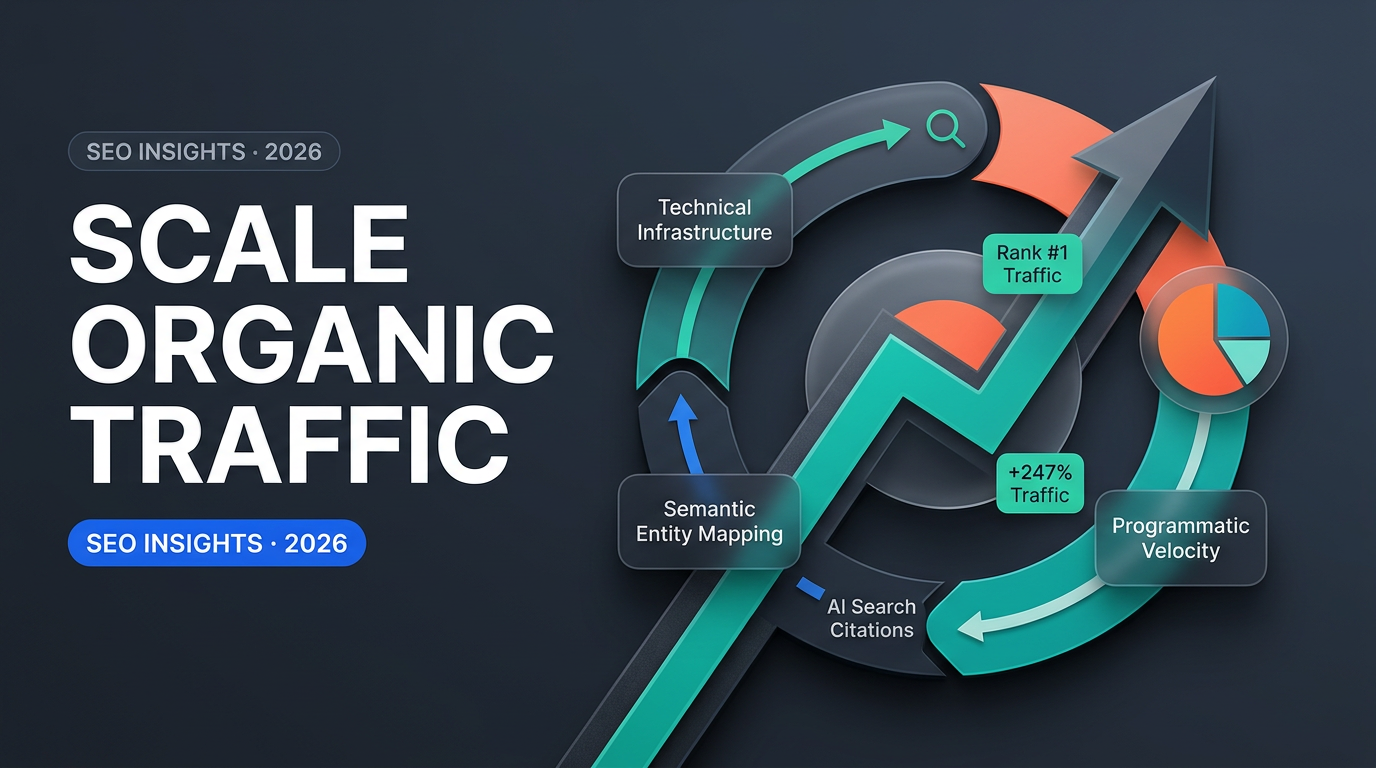
Building the Cross-Functional Organic Growth Flywheel
The single greatest operational vulnerability mid-market organizations face is treating SEO as an isolated department. In high-performing organizations, organic search operates as a horizontal capability that supports product marketing, web development, content production, and enterprise sales enablement.
Sustainable traffic velocity requires structured processes that integrate search data across all digital workflows. When content marketing targets buyers' active pain points, developers protect architectural site health, and product marketing validates market positioning through search intent data, organic growth becomes predictable and resilient against algorithm adjustments.
Establishing an Operational SEO Rhythm
Scale requires structured operational cadences that hold cross-functional team members accountable:
- Bi-Weekly Engineering Sprints: Reserve 15% of web development sprint capacity exclusively for technical infrastructure tickets, Core Web Vitals optimization, and internal linking automation.
- Editorial Quality Assurance Gates: Enforce strict peer-review pipelines where subject matter experts (SMEs) verify technical accuracy, practical usefulness, and brand voice alignment before publication.
- Content Decay and Refresh Auditing: Run quarterly historical audits to systematically consolidate, update, or prune decaying assets that bleed domain authority or traffic volume.
- Executive Business Impact Reporting: Tie search metrics directly to qualified pipeline, customer acquisition cost reduction, and organic conversion attribution rather than relying on raw ranking metrics.
By establishing this operational engine, your company stops relying on serendipitous viral spikes and builds an enduring corporate moat that steadily captures market share from competitors.
Key Takeaways
- Transition from keywords to entities: Anchor your digital footprint to comprehensive topic clusters and semantic knowledge graph mapping rather than fragmented keyword lists.
- Unify engineering and marketing: Allocate dedicated development capacity to eliminate technical debt, optimize crawl budgets, and maintain lightning-fast edge rendering.
- Scale responsibly with programmatic templates: Leverage database-driven pages augmented with proprietary datasets, modular analysis, and strict indexation pruning to capture long-tail traffic.
- Engineer for Generative Engine Optimization (GEO): Structure content for LLM ingestion using proprietary telemetry data, direct answer formats, and rigorous JSON-LD schemas.
- Establish institutional accountability: Embed organic search metrics across product, engineering, and editorial teams to transform search into a sustainable, cross-functional growth flywheel.