Google AI Overviews have rewritten search mechanics, shifting query processing from simple keyword matching to neural retrieval and knowledge graph synthesis. If large language models and search evaluation agents cannot unambiguously reconcile what your business does and who built your content, your pages are bypassed during citation selection. Mastering entity schema markup is now the primary technical bridge separating brands referenced in AI summaries from those buried in traditional ten-blue-link obscurity.
By structuring your digital presence around semantic entities rather than fragmented text blocks, you hand AI search agents a machine-readable knowledge graph. This guide unpacks exactly how to construct, link, and validate enterprise-grade entity markup that earns persistent citations across AI Overviews and conversational discovery engines.
How AI Overviews and RAG Pipelines Evaluate Entities
Modern search engines rely on Retrieval-Augmented Generation (RAG) pipelines to produce real-time AI Overviews. Before an LLM writes an answer, retrieval models scan the index for factual claims, verify authority, and extract structured evidence. If multiple websites discuss the same concept, the retrieval engine checks entity resolution databases to confirm which site holds authoritative expertise. When your pages feature robust entity markup, you eliminate the cognitive overhead and extraction errors that cause neural models to hallucinate or discard sources.
Entity resolution works by mapping named entities—people, organizations, methodologies, software, and products—to a global consensus layer such as Wikidata or Google's proprietary Knowledge Graph. If your content merely drops industry jargon in body copy, the crawler must infer context through probabilistic natural language processing. If that same content defines those terms using structured JSON-LD schemas with distinct identifiers, the engine immediately links your concepts to its core Knowledge Graph.
To secure AI citations, your schema must perform three specific tasks for retrieval models:
- Eliminate ambiguity: Differentiate identical terms (for instance, distinguishing "Apple" the corporation from the agricultural fruit, or proprietary software frameworks from open-source utilities).
- Establish relationship vectors: Map direct semantic triples (Subject – Predicate – Object) showing that Author X is the creator of Framework Y within Organization Z.
- Quantify topical authority: Signal to retrieval rankers that your page constitutes a canonical node for a specific cluster of concepts rather than an aggregate summary.
The Core Pillars of Entity Schema Markup: @id, about, and mentions
Traditional SEO schema usually consists of disconnected blocks: an Article type on one page, an Organization type on the homepage, and an Author profile floating without semantic anchors. In modern entity schema markup, isolated nodes fail because neural crawlers evaluate the entire interconnected graph. To build a resilient semantic graph, you must harness three core attributes: @id, about, and mentions.
The @id property acts as a universal resource identifier across your entire domain. Instead of redefining your company inside every single blog post schema, you define your Organization once—typically on your homepage or about page—and assign it a deterministic URI (such as https://example.com/#organization). Every subsequent schema on any page can reference that exact entity simply by calling its @id, preserving crawl budget and ensuring semantic consistency across millions of URLs.
Defining the Subject with the 'about' Property
The about property tells AI search engines what the fundamental thesis of a page is. While standard web pages touch on dozens of tangential ideas, the about tag isolates the central entity. If you publish an exhaustive breakdown of semantic search architectures, your about array should not contain generic strings; it must point directly to formal Knowledge Graph definitions.
- Limit scope: Restrict your
aboutarray to one, two, or at most three primary entities that define the page's core focus. - Use formal types: Instead of nesting a basic
Thing, use specific types likeTechArticle,SoftwareApplication, orMedicalCondition. - Link outward: Anchor each entity to its Wikidata or official authoritative URI to confirm consensus meaning.
Enriching Context with the 'mentions' Property
While about defines the primary topic, the mentions property documents secondary entities that support your narrative. When an AI agent digests your text, detecting verified entities in the mentions array validates the technical depth and factual thoroughness of your analysis, matching the content pattern expected of high-authority citations.
Disambiguation Tactics: Harnessing sameAs with Authoritative Repositories
Entity disambiguation is the process of mapping a raw string to an unambiguous semantic identifier. If your enterprise offers a proprietary cybersecurity protocol named "Sentinel," a search crawler could confuse it with dozens of unrelated software products, military satellites, or comic book characters. The sameAs property is the single most effective tool in schema markup to eliminate this confusion.
The sameAs array establishes equivalence between your local entity node and canonical reference points across the web. While many SEOs lazily populate sameAs with social media handles, authoritative entity resolution requires third-party knowledge bases vetted by human editors and automated validation pipelines.
Prioritize these authoritative targets when populating sameAs attributes:
- Wikidata Entity URIs: The primary structured data layer of the internet (e.g.,
https://www.wikidata.org/wiki/Q11660). Referencing Wikidata gives AI agents immediate access to established semantic relationships and classifications. - Wikipedia Entries: Useful for general-interest concepts, historical definitions, and major corporate brands.
- Industry Registries: Niche-specific authorities such as Crunchbase for startups, GitHub for developer tools, or official national corporate registries.
- Academic Identifiers: ORCID IDs for authors and Google Scholar profiles for research contributors.
A common mistake in semantic schema is linking sameAs to internal pages or non-canonical redirects. Every sameAs link must resolve to a recognized, publicly verified database entry that reinforces external consensus.
Building a Unified Entity Graph: Connecting Organization, Author, and Content
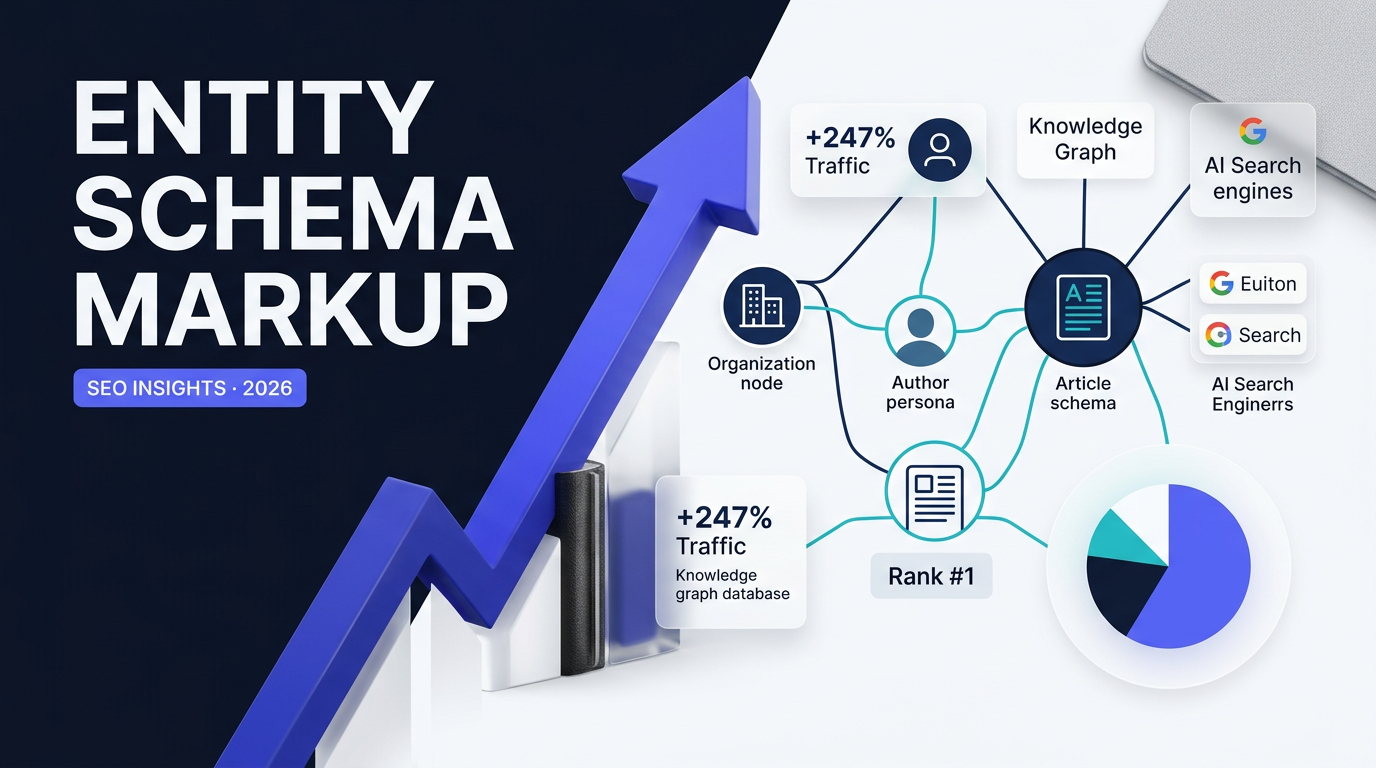
AI models prioritize trustworthy content creators through algorithmic assessments of Experience, Expertise, Authoritativeness, and Trustworthiness (E-E-A-T). However, textual bios alone are difficult for machines to confirm at scale. An interconnected entity graph links your content node, author persona, and publishing organization into an unbroken chain of verified credibility.
To achieve this, your JSON-LD should be constructed as a cohesive @graph block rather than disparate objects. The article references the author via @id; the author schema declares their organizational affiliation, credentials, and external profiles via sameAs; and the organization schema defines its official registry data and topical focus areas.
Structuring the Graph Hierarchy
Consider the necessary layers of an enterprise graph designed for AI Overview citation extraction:
- The WebSite Node: Defines the broader publication, its canonical URL, and its integrated search action.
- The Organization Node: Establishes the business identity, headquarters, executive leadership, and disambiguating Wikidata/Crunchbase links.
- The Person (Author) Node: Outlines the writer's official credentials, their professional role within the organization, and verifiable proofs of subject-matter expertise.
- The CreativeWork/Article Node: Ties everything together by declaring the author as the creator, the organization as the publisher, and pointing its
aboutandmentionsarrays to external knowledge repositories.
When Google's retrieval models ingest this consolidated graph, they can effortlessly confirm that the article was written by a verified expert backed by an established enterprise, making the content an ideal candidate for high-visibility AI Overview extraction.
Advanced Strategies: Nested Entities for Comparison and Analysis Content
Transactional and investigative searches—such as software comparisons, solution reviews, and multi-faceted market analyses—trigger some of the most dynamic AI Overviews. In these scenarios, AI engines look for structured data that systematically outlines relationships between competing entities.
Instead of relying purely on paragraph text, you can structure these comparisons through nested schemas like itemReviewed, ItemList, and paired PropertyValue blocks. This allows AI parsing engines to extract side-by-side matrices directly from your structured data without risking interpretive errors.
Implement these advanced nesting patterns to capture multi-entity queries:
- Dataset and ItemList Schema: When presenting benchmarks or data tables, wrap rows and columns into machine-readable datasets with explicit metric definitions.
- Structured Criteria Matching: Use
additionalPropertynodes to define performance metrics, pricing structures, and compliance certifications for each compared entity. - Bi-directional Mentions: In comparative analyses, ensure all compared items are mirrored as formal entities in the
mentionsarray, linked via their respective Wikidata or product knowledge graph IDs.
By transforming qualitative comparisons into structured, relational datasets, your site becomes the simplest, most reliable source for RAG engines seeking verified, balanced data points to summarize for users.
Validating, Injecting, and Auditing Entity Schema in Modern CMS Workflows
Writing theoretically pristine JSON-LD is futile if your content management system breaks the code or introduces hydration errors. Modern JavaScript frameworks (Next.js, Nuxt, Astro) and headless architectures frequently inject schema dynamically, which can lead to parsing discrepancies between client-side renders and search engine crawlers.
Server-side rendering (SSR) of JSON-LD is essential for reliable AI ingestion. While search bots can render client-side JavaScript, the high-throughput pipelines that crawl and index web pages for near-real-time AI synthesis frequently parse initial server responses before deciding whether to allocate resources for full dynamic rendering. If your entity schema is not immediately present in the raw server HTML payload, you risk being excluded from time-sensitive generative overviews.
Follow this checklist to audit and maintain your semantic schema health:
- Test against Schema.org Standards: Run your raw payload through the official Schema.org Validator to verify pure semantic syntax, alongside Google's Rich Results Test for compliance with specific SERP features.
- Inspect Rendered DOM Graphs: Ensure no duplicate
@identries exist across distinct components on the page. Multiple instances of the same identifier with conflicting properties will break graph traversal. - Monitor Search Console Extraction: Regularly inspect the "Unparsable structured data" and specific enhancement reports in Google Search Central to catch schema parsing anomalies before they degrade your visibility.
- Verify Knowledge Graph Alignment: Periodically query the Google Knowledge Graph Search API using your brand or author names to confirm that search engines are actively consolidating your entities into external reference systems.
Key Takeaways: Your Blueprint for AI Overview Dominance
- Shift from Keywords to Graph Nodes: AI Overviews operate on semantic entity resolution; your content must be defined using explicit, machine-readable concepts rather than isolated search terms.
- Unify Everything with @id: Never build isolated schema blocks. Use persistent, deterministic URIs to connect articles, authors, organizations, and conceptual topics into a single continuous entity graph.
- Anchor Ambiguity with sameAs: Leverage third-party repositories—specifically Wikidata, Wikipedia, and established industry registries—to eliminate identity confusion for your products and brand.
- Clarify Focus with 'about' and 'mentions': Tell AI retrieval models precisely what your primary topic is using
about, while highlighting the technical depth of supporting subtopics withmentions. - Enforce Server-Side Execution: Render your JSON-LD directly from the server to guarantee instant, error-free ingestion by high-speed neural web crawlers.