
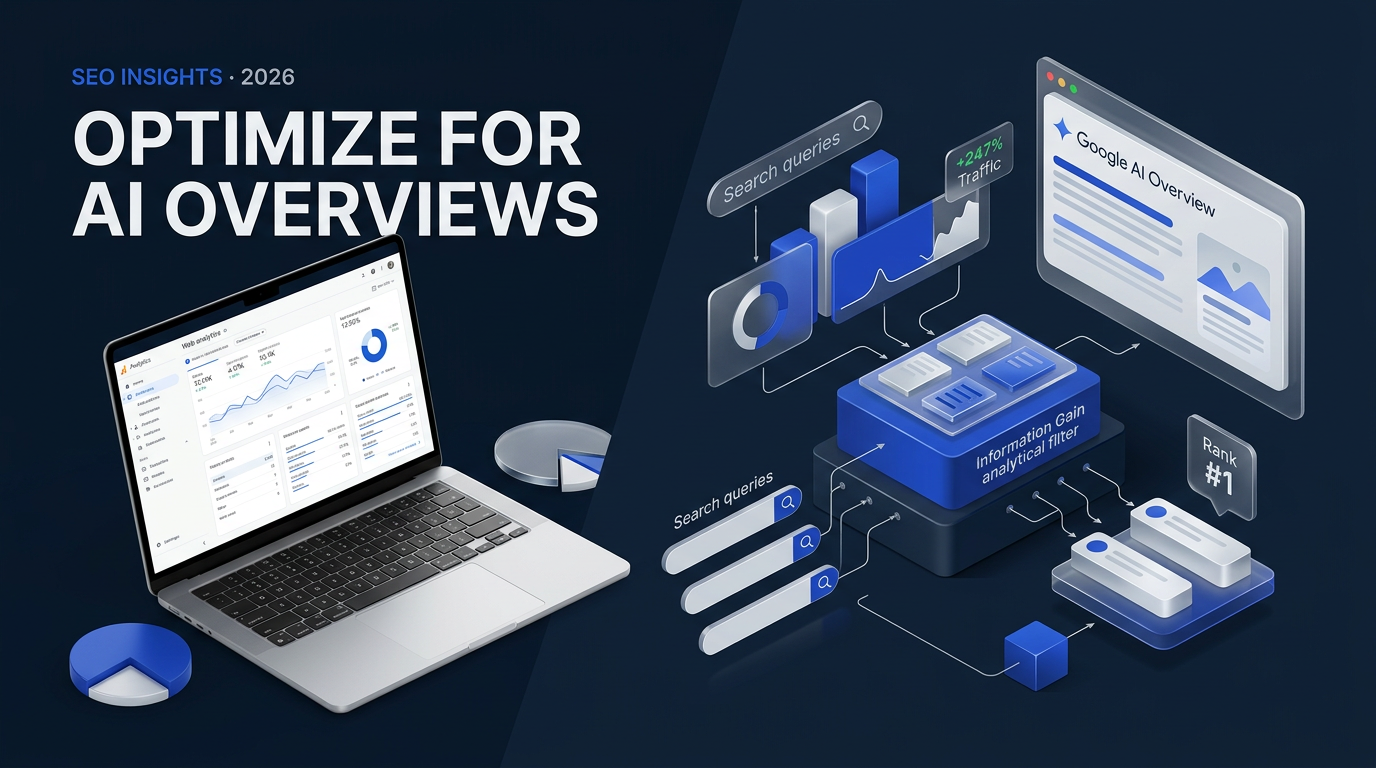
Google's search results have undergone their most radical transformation in two decades. For digital teams and growth leaders, the core challenge is no longer merely ranking in the traditional ten blue links; you must learn how to optimize for AI overviews to capture visibility before the user ever scrolls. Generative search interfaces powered by Gemini prioritize syntheses, answers, and direct citations, compressing organic real estate and filtering out repetitive web copy.
The secret to winning citations in this generative ecosystem is not keyword density or semantic padding. It is Information Gain. In this guide, we break down the mechanics behind Google's retrieval-augmented generation (RAG) architecture and outline the exact framework your business needs to become an irreplaceable citation source in AI Overviews throughout 2026 and beyond.
Understanding Information Gain and Google's Generative Architecture
To understand why most legacy content fails in generative search, you must first understand how Google decides what gets included in an AI Overview. Google's patent portfolio on Contextual Information Gain (pioneered in US Patent 10,795,942) outlines an algorithmic approach to scoring content based on the net-new information it contributes beyond what a user has already encountered or what top-ranking documents already state.
When a user conducts a query, Google's retrieval pipeline extracts candidate passages from top-tier indexed documents. Rather than assembling a collage of duplicate facts, the model measures semantic redundancy. As highlighted in Google's Search Central documentation on succeeding in AI experiences, the search engine explicitly prioritizes original reporting, distinct points of view, and unique data that provide immediate, satisfying answers without re-hashing standard SERP consensus.
If five articles explain "what is inventory turnover" with the identical formula, identical examples, and similar phrasing, the language model treats pages two through five as zero-marginal-utility noise. The system awards citation space to the source that introduces novel variables, fresh industry benchmarks, or counter-intuitive case findings. Information Gain is the mathematical filter preventing Gemini from generating boring, repetitive summaries.
The Anatomy of an AI Overview Citation Source
Google AI Overviews rarely cite an entire web page; they cite specific semantic chunks that substantiate a synthesized claim. When reverse-engineering high-frequency citations across competitive verticals, successful pages consistently exhibit four structural traits:
- High Entity Disambiguation: Content clearly names specific entities, organizations, metrics, and relationships rather than leaning on vague pronouns or passive voice.
- Syntactic Claim-Evidence Pairs: Sentences follow a tight format where a definitive assertion is immediately backed by an empirical data point, benchmark, or verified methodology.
- Direct Inverted Pyramid Formatting: Core answers appear in the first 40 to 60 words beneath semantic subheadings, allowing RAG scrapers to extract relevant vectors cleanly.
- Original Structured Formats: Tables, step-by-step procedures, and bulleted criteria that distill complex decision-making into easily ingestible tokens.
As observed in practical testing and discussions across the SEO community on Reddit, sites that merely rewrite Wikipedia entries or summarize existing page-one results are systematically dropped from AI snapshot carousels, while niche practitioners with proprietary field data dominate citation cards.
Step-by-Step Framework to Engineer High-Information-Gain Content
Transforming your editorial workflow to earn consistent inclusion requires moving away from traditional "skyscraper" content assembly. Instead, implement this four-phase Information Gain pipeline across your strategic assets.
1. Identify the "Consensus Baseline"
Before writing a single sentence, catalog what the top five ranking pages already say. This constitutes the consensus baseline. Everything in this baseline carries an Information Gain score approaching zero. If every competitor mentions that "customer retention lowers acquisition costs," repeating that phrase adds no value to an LLM's synthesis graph. Note these table-stakes facts, but relegate them to concise contextual framing rather than your article's core focus.
2. Inject Proprietary First-Party Data
The fastest way to elevate Information Gain is to introduce figures that do not exist elsewhere on the web. This does not require a million-dollar market research initiative. Consider leveraging:
- Internal platform metrics anonymized and aggregated across customer cohorts.
- Pricing surveys conducted directly within your target demographic or community.
- A/B testing outcomes with exact percentages, sample sizes, and duration parameters.
- Operational teardowns highlighting proprietary workflow timelines or cost breakdowns.
When an LLM parses an anomalous, authoritative data point—such as "our analysis of 450,000 checkout events revealed a 14.2% drop-off at two-factor authentication"—it recognizes a high-gain token cluster that provides unique justification for user queries.
3. Provide Experiential Context and Contrarian Findings
Google's search algorithms are heavily tuned to reward genuine first-hand experience (the first 'E' in E-E-A-T). When optimizing for AI Overviews, personal or institutional execution details offer immense leverage. Instead of theoretical advice, detail what failed during execution, edge cases where standard rules break down, and contrarian perspectives backed by real-world friction.
"Content that simply answers a query with textbook generalities is treated as a commodity. Content that details the exact friction points, failures, and edge cases of implementing that answer becomes the definitive citation."
4. Create Conceptual Frameworks and Named Models
Large language models operate by predicting probabilistic semantic linkages between concepts. When you invent or standardize a named methodology (e.g., "The 3-Tier Margin Audit" or "The Vector Decay Principle"), you introduce a distinct, queryable entity. As other sites, social channels, and forum discussions reference your named construct, the entity establishes an authoritative node in Google's Knowledge Graph, drastically elevating its likelihood of being pulled into AI Overview syntheses.
Structuring and Formatting for Retrieval-Augmented Generation
Writing high-value content is only half the battle; your document architecture must allow automated parsers to segment, score, and retrieve your text without semantic degradation. Here is how to format your pages for machine readability in 2026:
Deploy the BLUF Model (Bottom Line Up Front)
Every <h2> and <h3> section should immediately lead with the direct answer, insight, or summary takeaway. Avoid flowery transitions, rhetorical throat-clearing, or historical context in the opening paragraph of a section. State the conclusion in bold terms, then use the following paragraphs to present your supporting methodology and nuanced caveats.
Optimize Data Density with Semantic Tables
Gemini and related retrieval models display an extraordinary affinity for clean comparison tables. HTML tables with clean semantic headers (such as Feature, Impact, Baseline, and Recommended Action) present structured facts that are computationally trivial for an LLM to synthesize. If you are comparing technologies, strategies, or pricing, always provide a semantic table alongside descriptive text.
Implement Micro-Answer Bullet Lists
For process-driven and "how-to" queries, utilize ordered lists where the first three to six words of each bullet point encapsulate an actionable directive. For example:
- Audit your top-ranking URLs: Extract existing queries where your site appears in positions 1–4 but fails to earn an AI Overview card.
- Identify missing entity vectors: Compare your section topics against semantic co-occurrence patterns in top scholarly or industry publications.
- Insert verified primary research: Add proprietary survey findings, concrete calculations, or direct interview excerpts directly below your section headers.
- Validate schema accuracy: Ensure JSON-LD markup matches visible content seamlessly without injecting orphaned or contradictory attributes.
Multimodal Reinforcement: Expanding Beyond Plain Text
Text-only optimization is no longer sufficient to secure top generative visibility. As Google's models increasingly incorporate multimodal ingestion, visual and interactive elements play a direct role in AI Overview inclusion.
Original diagrams, schematics, and process flowcharts tagged with descriptive alt text and surrounded by contextual semantic copy are frequently selected for inclusion in multimodal carousel blocks alongside text answers. When designing graphics, avoid generic stock imagery. Instead, produce annotated process diagrams, proprietary data visualization charts, and visual summaries that explain multi-step relationships at a glance.
Furthermore, video timestamps from YouTube containing clear chapter markers, transcript synchronization, and direct spoken answers feed directly into Google's multimodal index. By mirroring your high-gain textual claims across video transcripts and structured graphics, you create redundant retrieval pathways that reinforce your domain as the primary source of truth.
Measuring AI Overview Inclusion and Real Business Impact
Tracking success in the era of generative search requires new metrics. Traditional rank-tracking tools that report a static blue-link position obscure the real story: whether your brand was cited inside the AI Overview, linked via a resource bubble, or bypassed entirely.
- Citation Frequency: Track the percentage of target brand and non-brand queries where your domain appears as an anchored reference tile within generative snapshots.
- Entity Share of Voice: Monitor how frequently your proprietary frameworks, company name, and proprietary data are synthesized into the generative answer text itself.
- Downstream Conversion Velocity: Visitors arriving via AI Overview citations typically exhibit higher intent and spend less time browsing foundational pages because the discovery phase occurred inside the SERP. Track conversion rates specifically for AI-referred landing sessions.
- Unbranded Referral Volume: Measure changes in organic click volume across informational queries where traditional snippet real estate has contracted.
Key Takeaways for AI Overview Optimization
- Information Gain is non-negotiable: Content that duplicates existing SERP consensus is filtered out by Google's deduplication and RAG scoring algorithms.
- Lead with the Bottom Line: Place definitive, claim-backed answers in the first 50 words below each heading to maximize semantic chunk extraction.
- Publish first-party data: Proprietary benchmarks, survey metrics, and internal platform analytics generate novel tokens that LLMs actively seek to substantiate answers.
- Name your methodologies: Coining distinct, well-defined frameworks turns your ideas into verifiable entities within Google's Knowledge Graph.
- Format for machine parsers: Use structured HTML tables, clear ordered lists, and semantic tags to make your highest-value insights easy for generative engines to retrieve and display.