
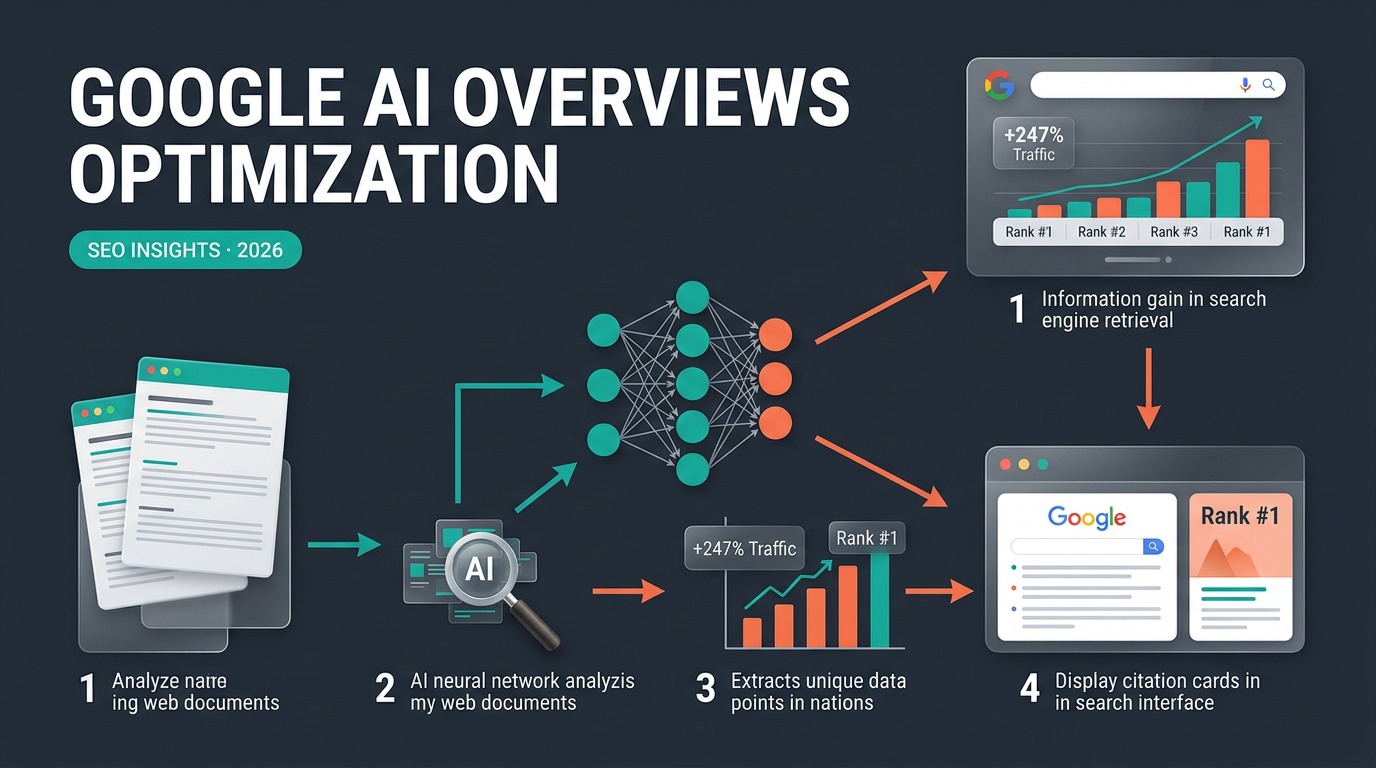
Google Search has crossed a decisive threshold. Generative summaries and multi-step reasoning engines increasingly satisfy basic queries directly in the search results, compressing traditional organic click-through rates across informational topics. For brands competing in this landscape, securing search visibility requires mastering google ai overviews optimization through a disciplined focus on information gain.
Winning citations in AI Overviews is not about repeating consensus definitions or writing longer skyscraper posts. Instead, Google's underlying retrieval-augmented generation (RAG) systems look for unique data, distinct perspectives, and verifiable facts that do not already exist in the cluster of retrieved documents. Here is how to engineer content that Gemini and Google's ranking algorithms actively select as authoritative source material.
Deconstructing Google’s Information Gain Framework
Google's Information Gain patent (US Patent 10,621,221) outlines a system designed to measure the marginal value of a document relative to what a user has already seen or what the search engine's index already knows. When applied to AI Overviews, this system penalizes redundancy. If five web pages explain a concept using the same steps and vocabulary, Gemini only needs one of them—or none of them—to synthesize an answer.
In technical terms, an AI Overview operates as an extraction-and-generation loop. The search engine executes a dense vector search across top documents, retrieves relevant passages, and feeds them into a context window. If your content merely paraphrases the existing knowledge graph, its information gain score approaches zero. To earn a citation card or in-text link, your content must provide an informative delta—a measurable increase in unique, verifiable facts.
As Google highlighted in their guidance on succeeding in AI search experiences, the priority remains delivering unique value that goes beyond generic summaries. Content that supplies net-new context gives the generative engine a concrete reason to cite your URL rather than synthesize around it.
Why Paraphrased Content Fails in Generative Search
For over a decade, standard content marketing relied on analyzing the top ten organic results and creating an aggregated, slightly more thorough version. In generative search environments, this strategy is dead on arrival. Language models excel at compressing commoditized information; they do not need secondary commentary to summarize what Wikipedia or industry documentation already established.
When an algorithmic update consolidates search queries into AI Overviews, websites relying on regurgitated definitions suffer severe traffic drops. Industry analyses of AI Overview visibility and CTR impacts reveal that generic informational pages lose substantial engagement because users receive direct answers without clicking. However, traffic from AI Overview citations is exceptionally high-intent when the summary cites an exclusive statistic, proprietary methodology, or contrarian benchmark.
AI Overviews do not cite pages simply because they rank on page one; they cite pages that provide the unique factual building blocks required to assemble the answer.
5 Pillars of High Information Gain Content
To maximize information gain, every piece of content published on your domain must incorporate elements that cannot be hallucinated, generalized, or scraped from public consensus. Integrate these five architectural pillars into your editorial workflow:
- Proprietary Data and Benchmarks: Conduct quarterly data analyses from your product usage, user surveys, or proprietary testing. Even a modest sample size of 200 verified industry participants yields original percentages, conversion medians, and cost benchmarks that LLMs treat as authoritative reference points.
- Named Operational Frameworks: Give distinct, memorable names to your proprietary workflows, diagnostics, or processes. When an algorithm detects an original methodology supported by step-by-step logic, it frequently pulls the named framework directly into the AI Overview's structured steps.
- Counter-Consensus Case Studies: Document experiments where conventional wisdom failed. Detail the hypothesis, variables, unexpected failure points, and subsequent adaptations. LLMs identify counter-intuitive findings as high-gain signals because they add nuanced divergence to the retrieval pool.
- Direct Practitioner Proof: Include verified quotes, code implementations, and visual evidence from senior subject matter experts who actively execute the work. Avoid anonymized or generic editorial commentary.
- Structured Comparison Metrics: Replace subjective prose with quantified evaluation tables. Detail exact tolerances, pricing tiers, integration trade-offs, and latency benchmarks rather than claiming a product is fast or cost-effective.
Semantic Formatting for Seamless Citation Extraction
Information gain ensures your content is selected during retrieval, but semantic structure determines whether the language model can cleanly extract and attribute your points. Generative models operate on chunk-based retrieval. If an essential data point is buried in a 400-word block of stream-of-consciousness text, the parser may discard it in favor of a competitor's concise table or bulleted definition.
Structure your high-gain assets using the following formatting disciplines:
- The Bottom Line Up Front (BLUF) Pattern: Open informational subsections with an explicit 40-to-60-word declarative answer that directly addresses the entity and question. Follow this direct answer with supporting empirical evidence and caveats.
- Semantic HTML Tables: Enclose comparative datasets within clean table tags with explicit header scopes. RAG systems can easily parse tabular key-value pairs without losing context across row boundaries.
- Entity-Dense Lists: When listing tactical instructions or features, begin each list item with a bolded action or entity identifier followed by a single explanatory sentence.
- Schema Markup Consistency: Ensure all on-page data points match your JSON-LD structured data exactly. Discrepancies between schema attributes and visible copy trigger factual confidence penalties within Google's validation layer.
Managing Technical Extraction Signals
Ensure that search crawlers can render and consume your primary factual assets without requiring heavy client-side JavaScript execution. If your unique data visualizations rely entirely on client-rendered canvas elements, supplement them with structured summary tables and downloadable datasets directly in the HTML DOM. Furthermore, review your robots directives to ensure preview controls like max-snippet or data-nosnippet are configured intentionally rather than inadvertently suppressing the very text chunks Gemini needs to parse.
Measuring AI Overview Visibility and Referral Traffic
Standard rank tracking fails to capture generative visibility accurately. A URL might occupy position three in traditional blue-link results while simultaneously serving as the primary citation card in an AI Overview—or it might rank position one below an AI Overview that cites three competitors. Sophisticated performance measurement requires a differentiated tracking framework.
To evaluate your visibility, monitor the following indicators:
- Search Console Impression vs. Click Divergence: Queries where impressions surge while clicks remain flat or decline often indicate the rollout of an AI Overview. Segment these queries to verify whether your domain is cited within the panel.
- High-Intent Referral Conversion Rates: Users who read an AI Overview and proceed to click an embedded source citation typically demonstrate deeper intent than casual searchers. Track the post-click behavior of visits landing on your high-gain assets; average session duration and lead conversion rates should significantly outperform legacy informational traffic.
- Brand Entity Citation Monitoring: Frequently audit your core service categories inside generative queries. Track whether Gemini synthesizes recommendations that include your brand entity even when direct links are distributed across industry third parties.
A 4-Step Editorial Audit for Existing Content
You do not need to create every high-gain asset from scratch. Auditing and retrofitting your existing organic footprint can yield rapid gains in AI citation coverage. Apply this four-step refresh protocol to your top commercial and informational URLs:
- Identify the Consensus Baseline: Run your target keyword through search and review the current AI Overview alongside the top three organic competitors. Note the consensus facts, standard definitions, and predictable subheadings.
- Excavate the Unique Delta: Determine what missing operational realities, proprietary metrics, or dissenting observations your organization can add. Interview internal engineers, sales specialists, or client managers to capture real-world friction points absent from current SERP coverage.
- Strip Editorial Fluff: Ruthlessly delete introductory throat-clearing, redundant rhetorical questions, and generic background paragraphs. Replace these low-value word counts with concrete technical tables, verified statistics, or step-by-step diagnostic workflows.
- Anchor with Semantic Precision: Add clear H3 subheadings formatted around specific secondary entities, embed self-contained definition callouts, and apply relevant schema properties to authenticate authorship and primary sources.
Key Takeaways: Winning the Citation Game in AI Search
- Information gain dictates citations: Redundant summaries are ignored by generative models; you must deliver unique data, original methodologies, or proprietary benchmarks to be cited.
- Ditch standard skyscraper aggregation: Aggregating the top ten results without adding net-new insights results in zero-click marginalization.
- Format for chunk extraction: Use declarative BLUF paragraphs, semantic HTML tables, and explicit entity-based lists so retrieval models can parse your data seamlessly.
- Track post-click quality: Measure AI Overview impact through conversion performance and citation presence rather than raw impression volume alone.
- Audit existing inventory: Continually refresh historical content by stripping generic consensus text and inserting verifiable, first-hand data.