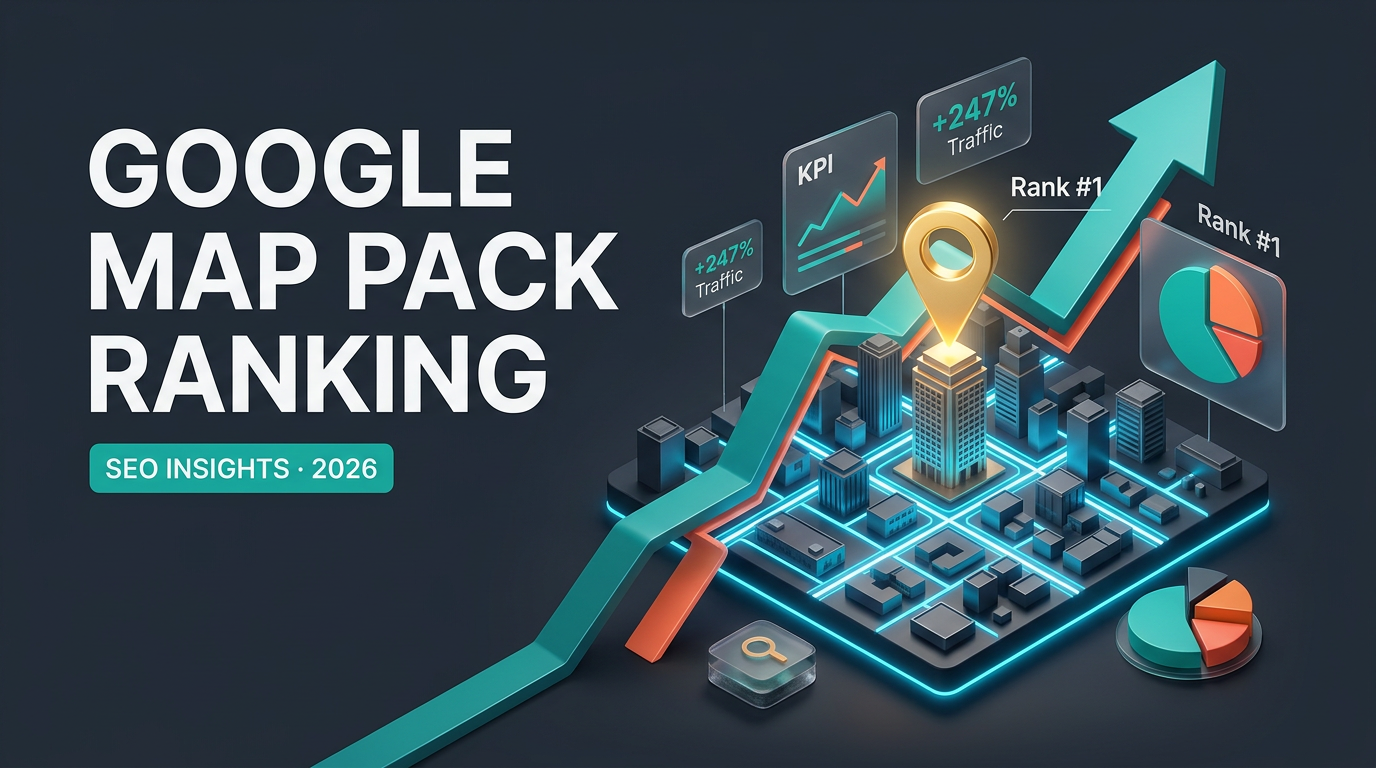
When local customers encounter an immediate need—whether a burst pipe, an emergency tooth extraction, or the closest espresso bar—they turn to their smartphones. Achieving a top google map pack ranking is the single most lucrative digital milestone for any local business, capturing over 40% of all localized search clicks before a user ever reaches standard organic results.
The Google 3-Pack (or Local Pack) displays the three most relevant local listings directly underneath an interactive map. Securing one of these three coveted positions is not a matter of luck; it requires a systematic execution of profile architecture, localized entity signals, and behavioral authority tailored to Google's evolving search algorithms.
The Core Algorithm: Relevance, Distance, and Prominence
Google's local search algorithm evaluates local entities through three foundational pillars defined in the official Google Business Profile guidance: relevance, distance, and prominence. To rank sustainably, small business owners must understand how machine learning models weigh each factor across different search contexts.
Relevance determines how closely a business profile matches the underlying intent of a searcher's query. If a consumer searches for "emergency commercial roofing contractor," Google analyzes your primary and secondary categories, your website copy, your service list, and customer review text to determine semantic fit. Without clear entity alignment, your profile will not qualify for consideration, regardless of your physical location.
Distance measures physical proximity between the device executing the search and the registered location of the business. While you cannot change where a customer stands, you can expand your effective ranking radius by maximizing relevance and prominence across surrounding zip codes. Prominence functions as a measure of digital reputation and brand equity, heavily influenced by review volume, review velocity, inbound local links, directory authority, and user engagement signals.
- Relevance: Semantic alignment between user query and profile metadata, website content, and service offerings.
- Distance: The physical proximity of the business address to the geo-location of the searcher.
- Prominence: The business's authority across the broader web, including citations, customer feedback, and brand mentions.
Optimizing Your Google Business Profile Architecture
Your Google Business Profile (GBP) functions as the core digital passport for your local entity. Many small businesses make the critical error of treating their profile as a static phonebook entry, leaving substantial configuration settings empty or improperly formatted. Every data point provided inside GBP serves as an explicit entity signal to Google's ranking systems.
Your primary category carries more algorithmic weight than almost any other single on-profile factor. Select the primary category that matches the exact commercial core of your revenue model. For instance, selecting "Plumber" versus "Drainage Service" will fundamentally alter your initial grid visibility. Secondary categories should encompass every supplementary service you provide, without adding unrelated categories that dilute your topical focus.
Ensure your business name strictly adheres to Google's guidelines. Adding unauthorized keywords or geographic modifiers to your official legal name may offer temporary ranking boosts, but it exposes your listing to algorithmic demotions and competitor-driven suspension flags. Instead, build your relevance through full completion of the services menu, detailed pricing tiers, inventory integrations, and accurate business attributes.
- Primary Category Selection: Audit top-ranking competitors in your exact market to identify the dominant primary category driving conversions.
- Secondary Category Stacking: Add up to 9 relevant secondary categories that capture long-tail service variations.
- Service Descriptions: Craft 300-word descriptions for each core service, incorporating localized service terms naturally.
- Attributes Configuration: Check every applicable attribute, such as wheelchair accessibility, veteran-owned, or specific payment methods.
- High-Resolution Visuals: Upload geo-relevant photos of your physical location, team, branded vehicles, and completed work weekly.
The 2026 Review Engine: Semantic Velocity and Sentiment Analysis
Review quantity alone no longer guarantees a top map pack placement. Modern natural language processing models dissect customer feedback for semantic sentiment, service confirmation, and geographic keywords. A 5-star review that reads "Great service!" carries significantly less algorithmic weight than a detailed review stating, "The technicians repaired our commercial HVAC unit in North Austin on a Sunday afternoon."
Review velocity—the consistent, natural acquisition of reviews over time—signals an active, reputable business. Spikes of 30 reviews in two days followed by three months of silence trigger algorithmic scrutiny and review filtering. Establish an automated post-service SMS and email workflow that prompts happy clients for detailed feedback immediately following project completion.
Responding to reviews is equally critical for brand prominence. Rather than publishing generic corporate thank-you notes, craft responses that reinforce your local relevance. Mention the specific service performed and the neighborhood served in a natural, conversational manner. This practices conversational entity association, signaling to Google that your business actively fulfills specific requests in targeted areas.
Small business owners often ignore review responses, treating them as optional PR. In reality, your reply copy is indexed text that reinforces topical relevance and demonstrates high operational responsiveness.
Website Localization: Connecting On-Page Signals to Map Visibility
A fatal misconception in local SEO is that your Google Business Profile operates independently of your website. In practice, Google's map algorithms use the landing page linked to your GBP profile as a primary corroboration source. If your linked website lacks structural topical authority and geo-relevance, your map pack performance will stall.
Your linked page—typically the homepage or a dedicated city location page—must feature clean, comprehensive LocalBusiness Schema markup formatted in JSON-LD. This structured data must explicitly state your official name, physical address, phone number (NAP), geo-coordinates, operating hours, and service categories, perfectly mirroring your GBP data.
Build localized content depth across your site to establish regional authority. Instead of generic service pages, construct dedicated local service hubs that explain how your services address regional pain points, climate challenges, or municipal codes. Internal linking from these neighborhood-specific pages back to your main GBP landing page funnels organic domain equity directly into your local pack entity.
- NAP Consistency: Ensure your Name, Address, and Phone number match across your website footer, header, and structured schema.
- JSON-LD LocalBusiness Schema: Embed geo-coordinates, operating hours, accepted currencies, and service area polygons.
- Geo-Specific Content Hubs: Develop pages covering specific service neighborhoods, case studies, and local project galleries.
- Speed and Mobile Usability: Optimize Core Web Vitals to prevent mobile searchers from bouncing back to the search results page.
Entity Corroboration: Citations and Hyperlocal Link Building
In search forums and specialized communities like r/localseo, experienced practitioners consistently emphasize that off-page entity corroboration separates competitive businesses from market leaders. Google needs to verify that your business exists in real life through consistent third-party footprints.
Begin by securing foundational citations on tier-1 platforms: Apple Maps, Bing Places, Yelp, YellowPages, Better Business Bureau, and industry-specific aggregators (such as Avvo for attorneys or Houzz for contractors). Inconsistent data across these primary databases creates algorithmic ambiguity, dampening your prominence score.
Move beyond automated directory submissions toward hyperlocal link acquisition. A link from a local high school sports sponsorship, a regional chamber of commerce, a local charity event, or a neighborhood business association carries far more local pack weight than a generic high-domain backlink from an unrelated blog. These hyperlocal citations anchor your physical presence directly into your regional community graph.
- Data Aggregator Distribution: Claim and clean your business profiles on major data aggregators (Data Axle, Neustar Localeze, Foursquare).
- Chamber of Commerce Memberships: Join regional business alliances that provide verified member directory links with localized schema.
- Community Event Sponsorships: Sponsor local 5K runs, non-profit drives, or youth athletics to earn natural, localized editorial links.
- B2B Partner Co-Marketing: Partner with complementary local non-competing vendors to cross-link case studies and supplier directories.
Expanding Your Geo-Grid Ranking Radius
When tracking your visibility using local geo-grid rank tracking software, you will notice a common pattern: your business ranks #1 right outside your front door, but drops to position #8 or #12 just three miles away. Expanding this ranking radius requires optimizing behavioral signals and organic relevance rather than engaging in deceptive address manipulation.
Deceptive practices—such as renting virtual mailboxes, co-working desks, or fake P.O. boxes in neighboring towns—violate Google's terms and inevitably lead to hard suspensions. Instead, grow your radius naturally by generating directional requests and mobile phone engagement from users located across target neighborhoods.
When customers use Google Maps to navigate to your physical storefront or click your phone number from surrounding zip codes, Google registers meaningful user engagement. Run localized micro-targeted mobile ads (Google Local Services Ads or geo-fenced Meta campaigns) within outer-perimeter zip codes to stimulate initial click-to-call, direction requests, and brand searches originating outside your immediate neighborhood.
- Analyze Geo-Grids: Use rank-tracking tools to map your specific drop-off zones across 1-mile to 5-mile increments.
- Localized Digital PR: Secure press coverage in community papers specific to outer suburbs to anchor regional brand awareness.
- Service Area Layering: Specify exact service zip codes within your GBP backend without obscuring your verified physical storefront.
- Mobile Engagement Campaigns: Drive localized search traffic through click-to-call Google Ads targeting adjacent high-value zip codes.
Key Takeaways for Dominating the Google 3-Pack
- Categorization is King: Select the absolute most accurate primary category; never compromise precision for broad appeal.
- Data Symmetry: Maintain 100% data consistency for your Name, Address, and Phone number across your GBP, website schema, and tier-1 directories.
- Contextual Reviews: Systematically collect detailed customer reviews that naturally reference specific services and neighborhood locations.
- On-Page Coupling: Anchor your GBP listing with a fast, mobile-friendly landing page enriched with JSON-LD LocalBusiness structured data.
- Hyperlocal Authority: Prioritize localized sponsorships, local press mentions, and civic partnerships over generic, detached link building.
- Sustainable Growth: Expand your ranking radius through legitimate user engagement and localized content rather than synthetic addresses.