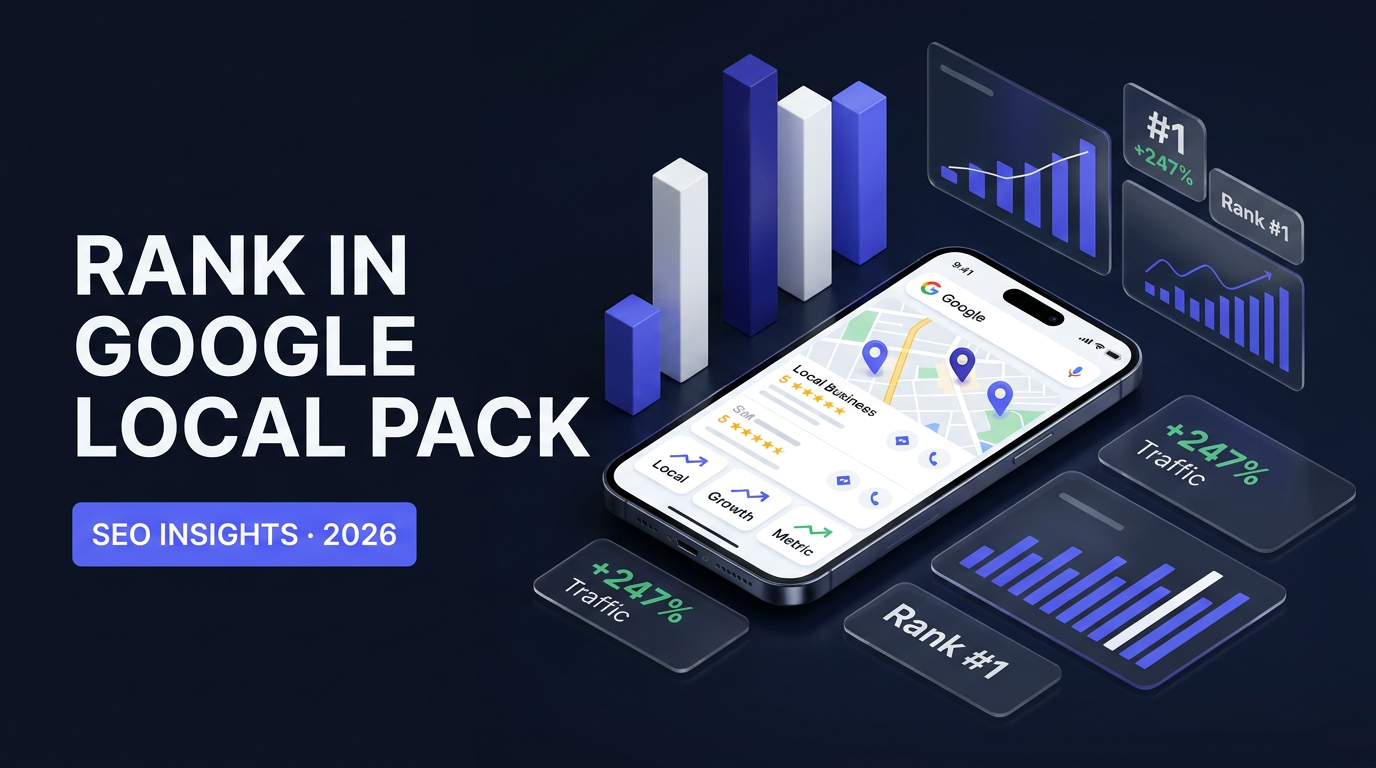
Winning local customers starts with claiming the most prominent real estate on search engine results pages. If you want your business to capture high-intent shoppers in your immediate neighborhood, learning how to rank in the Google Local Pack is the single highest-ROI marketing strategy you can implement this year.
When potential buyers search for services near them, Google showcases the top three local listings directly underneath an interactive map. Earning a spot in this coveted 3-pack doesn't just increase brand awareness—it drives direct phone calls, foot traffic, and consultation requests before searchers ever scroll down to standard organic links.
What Is the Google Local Pack and Why Does It Drive Massive Conversions?
The Google Local Pack—often referred to as the Google 3-Pack or Map Pack—is a dedicated SERP block highlighting three local business establishments relevant to a user's location-based search. It typically features the business name, star rating, total review volume, operational hours, category, physical address, and interactive buttons for phone calls, directions, and website visits.
Because the Local Pack sits above standard organic search results on both mobile and desktop screens, it commands the lion's share of consumer attention. According to Search Engine Land's analysis of local consumer behavior, businesses that secure placement in the top three local spots earn up to 126% more traffic and 93% more customer actions (such as phone calls and direction requests) compared to businesses ranked in positions 4 through 10.
Google displays the Local Pack whenever an algorithm detects geo-specific intent. This occurs across several distinct query patterns:
- Implicit "near me" searches: Queries like "plumber" or "emergency vet" typed on a mobile device where GPS data implies immediate local need.
- Explicit geo-targeted terms: Phrases that include city or neighborhood modifiers, such as "commercial roofing Dallas" or "coffee shop downtown Seattle."
- Curated superlatives: Searches like "best Italian restaurant near me" or "top rated CPA in Chicago."
The Three Core Ranking Factors: Proximity, Relevance, and Prominence
To rank consistently across target territories, small business owners must understand the underlying algorithmic framework Google uses to determine local placement. Unlike standard organic search, which focuses heavily on traditional backlink metrics and technical crawling, local search is governed by three fundamental pillars established in Google's official documentation.
Relevance measures how thoroughly your business attributes match the intent behind a search query. If someone searches for "transmission flush," Google evaluates whether your primary and secondary categories, service lists, and website content explicitly confirm that specialization.
Prominence reflects how well-known, established, and reputable your business is within its market. Google determines prominence through several signals, including review volume, sentiment velocity, local directory citations, brand mentions, and the organic SEO strength of your linked website.
Proximity calculates how physically close your registered address is to the searcher's physical location or the geographic centroid of the search query. While proximity is the hardest factor to manipulate ethically, understanding its impact prevents businesses from making costly categorization and address mistakes.
Proximity sets the boundary of where you can compete, but relevance and prominence determine whether you actually claim the top three spots within that boundary.
Step 1: Build a Flawless Google Business Profile Foundation
Your Google Business Profile (GBP) is the engine behind your local pack visibility. As noted by Semrush's guide to Google 3-Pack rankings, a fully claimed, verified, and complete profile is a non-negotiable prerequisite to appearing in map-based results.
Start by auditing your core data inside Google's Merchant Experience dashboard. Accuracy and precision here dictate how effectively Google's entity graph classifies your storefront.
- Select the right primary category: Your primary business category is arguably the single most influential individual ranking factor in local SEO. Do not settle for a broad descriptor if a hyper-specific one exists. For example, choose "Water Damage Restoration Service" instead of simply "Contractor."
- Maintain an authentic business name: Avoid the temptation to spam your registered business title with geographic keywords or marketing slogans (e.g., "Dave's Plumbing - Best Fast Cheap Plumber Austin"). Google aggressively suspends listings that violate real-world naming guidelines.
- Complete every profile attribute: Populate accessibility details, payment methods accepted, parking availability, and owner-led identity attributes (such as veteran-owned or women-owned). These micro-attributes help Google match your listing with voice searches and filtered conversational queries.
- Upload real, geocoded visual assets: Stock imagery hurts user engagement. Regularly publish high-resolution photos of your actual team, fleet, storefront, completed projects, and interior spaces to build consumer confidence and signal ongoing activity.
Step 2: Optimize for Local Justifications and Review Velocity
In modern search results, simply having high star ratings isn't enough to secure top placement. Google uses dynamic callouts called local justifications—small snippets of text appearing inside the 3-Pack listing that highlight why a result matches the user's specific keyword.
Justifications pull data from four main sources: customer reviews, services listed on your GBP, website content, and in-stock product inventory. When a user searches for "gluten-free crust," Google looks through customer reviews for that exact phrase and displays a snippet reading: "…offers an amazing gluten-free crust…" alongside a checkmark.
Systematize Customer Feedback and Sentiment
To win justifications and build algorithmic prominence, businesses need an automated, persistent review acquisition funnel. Stale reviews from two years ago will not maintain your rank against hungry local competitors.
- Generate consistent review velocity: A steady cadence of 3–5 authentic reviews every month signals to Google that your business is currently active and reliable, which is far better than receiving 40 reviews in a single weekend followed by silence.
- Encourage descriptive reviews: Prompt satisfied clients to mention specific services and neighborhoods in their feedback (e.g., "Could you mention which neighborhood we serviced and the specific repair we completed?").
- Respond to every review strategically: Reply to all feedback within 48 hours. Integrate natural service terminology and local landmarks into your responses without sounding robotic or repetitive.
Step 3: Align On-Page SEO and Technical Entity Architecture
Your Google Business Profile does not operate in an isolated silo. Google's web spiders crawl the specific landing page linked to your GBP listing to verify that your business entity matches the claims made on your profile card.
If you operate a single-location storefront, link your GBP directly to your homepage. If you operate multiple locations or serve distinct geographic hubs, link each specific GBP listing to its dedicated, localized location page.
Key Landing Page Elements for Local Pack Authority
- Clean NAP representation: Ensure your Name, Address, and Phone number on your landing page footer and contact block match your GBP details down to the exact suite number and capitalization.
- LocalBusiness Schema Markup: Implement JSON-LD structured data on your target landing page. Include distinct properties such as
@type,name,address,geo(exact latitude and longitude coordinates),telephone, andopeningHoursSpecification. - Hyperlocal content depth: Avoid thin, duplicate location pages. Feature specific driving directions, neighborhood landmarks, unique customer testimonials from that specific district, embedded Google Maps, and photos of local team members.
- Fast mobile user experience: The vast majority of map pack searches occur on smartphones. If your linked page takes more than three seconds to load or shifts layout while loading, bounce rates will spike, dragging your prominence score down with it.
Step 4: Establish Citation Consistency and Hyperlocal Link Equity
Citations—online references to your company's Name, Address, and Phone number across directories—act as digital verification certificates for search engines. While citations alone won't catapult you to position one in hyper-competitive markets, inconsistencies across core databases will actively suppress your visibility.
Ensure your business data is completely uniform across Tier-1 data aggregators and leading platforms like Apple Maps, Bing Places, Yelp, YellowPages, BBB, and industry-specific hubs (such as Avvo for legal professionals or Houzz for home remodelers).
Hyperlocal Link Building Tactics That Move the Needle
Traditional SEO strategies prioritize high-Domain-Authority editorial backlinks from national publications. Local SEO, however, places massive weight on geographic proximity links—links from organizations located in your exact town or county, even if those websites have modest authority metrics.
- Sponsor local youth leagues and charities: Sponsoring a neighborhood Little League team, 5K fun run, or animal rescue frequently yields high-trust local backlinks from their official sponsors page.
- Join local business associations: Secure listings in your municipal Chamber of Commerce, local BNI chapters, and regional trade syndicates.
- Publish localized community resources: Create practical local content, such as a guide to zoning permits in your city or a map of historic building materials used in your metro area. These assets naturally attract links from local news outlets and community bloggers.
Step 5: Monitor Geo-Grid Performance and Modern SERP Shifts
Traditional desktop rank tracking tools are obsolete for local pack optimization because rankings fluctuate drastically from street to street. A business might rank #1 for a user standing 500 feet from their front door, but drop to #8 when searched by someone two miles west.
Use geo-grid tracking software to visualize your rank across an entire town. These tools plot a grid of geographic pins across your service area and simulate search queries from each specific coordinate, generating a visual heat map of your strengths and blind spots.
Adapting to Modern Local SERP Evolutions
Search engines continue to test new features that alter the local search landscape. Keep your strategy forward-compatible by preparing for these ongoing developments:
- Operational hours bias: Google places heavier ranking weight on businesses that are actively open at the exact moment a search occurs. If your listed hours don't reflect your actual emergency or customer service availability, you will disappear from results during off-hours.
- AI Overviews and local snapshots: Google is increasingly integrating conversational summaries directly above the local pack. These AI snapshots synthesize customer sentiment, web citations, and FAQ content to provide direct answers, making third-party reputation management even more critical.
- Direct booking and messaging integrations: Enable native features such as Google Messages, appointment scheduling URLs, and direct quote requests within your profile to capture users who prefer instant communication.
Key Takeaways for Dominating the Google 3-Pack
- Target the primary category: Choose the most specific, accurate category available for your Google Business Profile; it remains the single strongest algorithmic lever.
- Drive consistent review velocity: Focus on receiving regular, keyword-rich customer feedback and respond promptly to all reviews to trigger high-converting local justifications.
- Synchronize on-page local SEO: Link your profile to a mobile-optimized landing page with complete JSON-LD LocalBusiness schema and consistent NAP data.
- Prioritize hyperlocal links over raw domain metrics: Build digital equity through local sponsorships, Chamber of Commerce directories, and regional community partnerships.
- Track using geo-grid tools: Measure rankings across neighborhood grids rather than relying on single-point rankings to uncover true visibility across your entire market.