Search behaviour has undergone an irreversible shift. As users abandon the endless page of blue links in favour of AI Overviews, Perplexity, and ChatGPT Search, your organic traffic increasingly depends on becoming the source an LLM quotes. Mastering answer engine optimization is no longer an experimental growth project; it is the fundamental framework required to stay visible in an era of zero-click synthesis.
Large language models do not read websites like human users or index them like traditional web spiders. They extract, weigh, and reassemble factual entities into direct answers. To win the citation, your digital real estate must be engineered to deliver clean semantic nodes that automated retrieval engines can verify and reference without ambiguity.
How Answer Engines Parse and Select Content for Citations
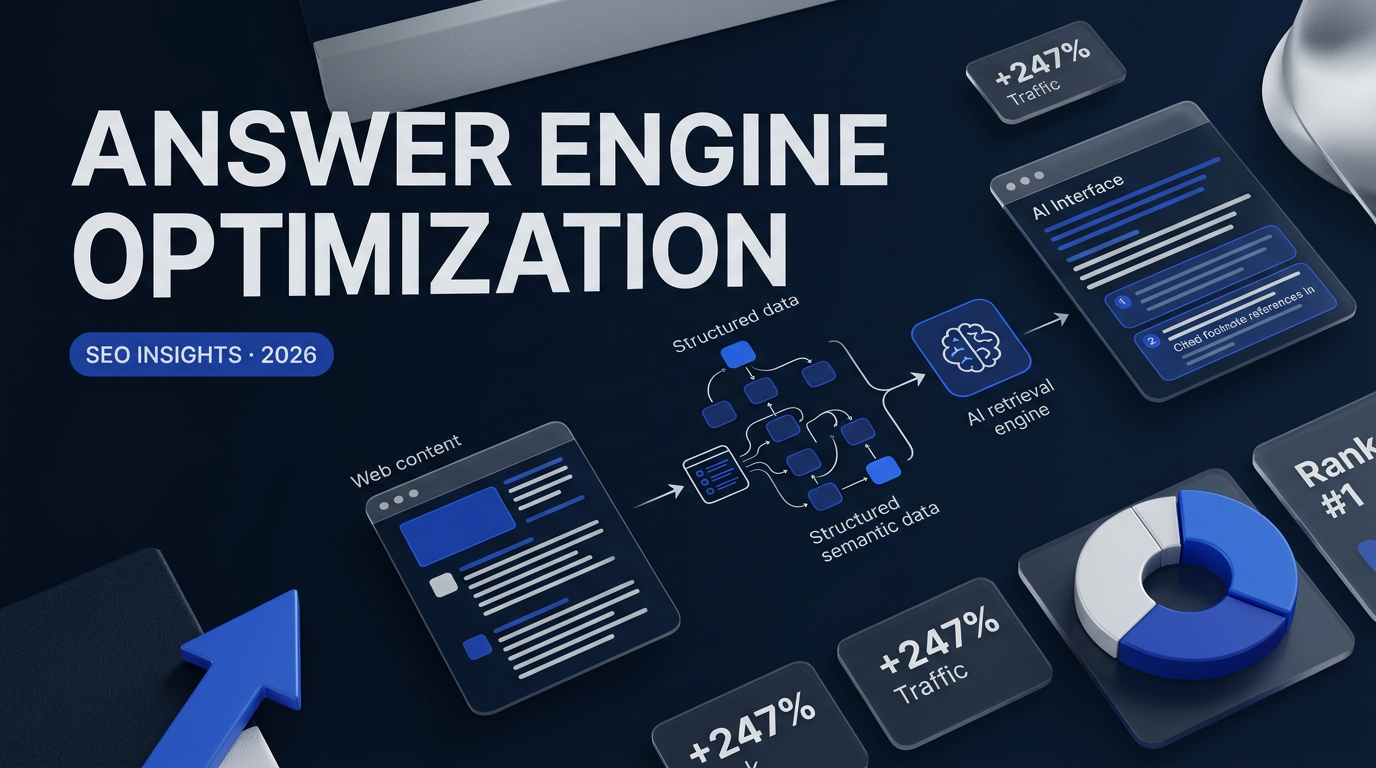
Modern answer engines operate on Retrieval-Augmented Generation (RAG) frameworks coupled with real-time vector search. When a user submits a query, the model does not browse the entire page. Instead, it segments raw HTML into manageable semantic chunks, embeds those chunks into multi-dimensional vectors, and measures their semantic similarity to the prompt.
Once candidate passages are retrieved, the engine’s secondary re-ranking algorithms evaluate source credibility, informational density, and factual coherence. Traditional PageRank still matters, but retrieval engines prioritize passages that require the least cognitive computational load to extract facts. If your core conclusion is buried beneath narrative introductions or bloated background history, the parser skips your chunk in favour of a more atomic competitor.
- Vector Embedding Alignment: Ensuring high semantic overlap between distinct subheadings and potential conversational queries.
- Passage Retrieval Windows: Writing content in self-contained blocks of 120 to 180 words that preserve full contextual meaning when isolated.
- Factual Density Scores: Maximizing the ratio of verified entities, dates, metrics, and relationships per paragraph.
The Q-A-E Framework: Structuring Context for AI Parsers
To capture citations reliably across platforms like Google AI Overviews and Perplexity, your content must adopt the Question-Answer-Elaboration (Q-A-E) structural pattern. Generative engines are built to identify the definitive answer to an inquiry immediately, validating it through contextual corroboration in the trailing sentences.
Start every major informational section with a heading formatted as an explicit user question or search intent. Directly follow that heading with a single, standalone sentence (40 to 60 words) that directly answers the question. Only after this atomic answer has been delivered should you expand into nuance, supporting data, methodology, and examples.
- Question (Heading): Formulate an H2 or H3 using targeted natural language entities (e.g., "What is the optimal latency threshold for RAG retrieval?").
- Answer (Direct Lead): Provide an objective, fact-rich declaration that functions perfectly even if lifted entirely out of the article.
- Elaboration (Body): Follow with two to three sentences containing empirical evidence, industry standards, or operational criteria.
According to Google's guidance on optimizing for generative AI, producing non-commodity, structured editorial content with clear technical hygiene is foundational for appearing in automated search features.
Information Gain and Entity Salience: Escaping Commodity Content
Large language models actively filter out content redundancy. If your article merely summarizes the existing top ten search results, an LLM’s compression algorithms view your text as low-entropy noise. To earn citations, your content must deliver quantifiable information gain—data points, original experimentation, proprietary survey figures, or first-hand operational workflows that exist nowhere else.
Entity salience is the mathematical metric representing how centrally an entity is positioned within a passage. Rather than repeating broad focus keywords, integrate unambiguous entity nodes recognized by Wikidata and the Google Knowledge Graph. Use definitive noun phrases instead of vague pronouns to ensure extraction models do not lose context during chunking.
- Unique Data Attribution: Publish original industry metrics, benchmarks, or case study figures that force answer engines to attribute the source data to your domain.
- Explicit Entity Naming: Replace pronouns like "it", "they", or "this system" with explicit technical nouns such as "the PostgreSQL vector database" or "the retrieval pipeline".
- Contrarian Analysis: Provide substantiated counterpoints to prevailing consensus; LLMs frequently cite contrasting viewpoints to balance synthesis summaries.
Technical Formatting: Schema, Microdata, and HTML Hierarchies
Behind the visible layout, your HTML structure provides the scaffold that search spiders and headless parsers rely on to interpret hierarchical relationships. Strict semantic HTML eliminates the need for LLMs to infer context through heuristics, significantly reducing parsing errors.
Organize documents strictly using sequential heading levels (H2, followed by H3, followed by lists or paragraphs). Avoid skipping levels or using heading tags solely for visual styling. Complement this hierarchy with precise JSON-LD structured data. Connect entities explicitly using properties like about, mentions, and hasPart to anchor your concepts into the global semantic web.
"Structured semantic hierarchies allow automated inference engines to map concepts with minimal compute, directly translating to higher extraction velocity and consistent attribution."
Combine nested FAQPage, Article, and Dataset schemas with clean semantic micro-formatting. When presenting comparisons, abandon custom CSS-grid tricks in favor of valid, accessible semantic HTML tables containing clear <th> headers and granular data cells. LLMs ingest tables with exceptional accuracy when synthesizing comparative answers.
Zero-Click Defensive Tactics: Driving Value Through Citation Anchors
A central challenge of modern generative search is the proliferation of zero-click outcomes. As highlighted in analysis by the Digital Marketing Institute on AI search trends, an overwhelming majority of search interactions now conclude directly within the synthesized engine interface without sending users downstream.
To convert citations into qualified referral traffic, you must engineer intentional "curiosity gaps" and proprietary utility into your cited materials. Provide the high-level factual answer that secures the AI citation, but deliberately tie that answer to complex downstream assets—such as downloadable execution templates, interactive calculators, proprietary code snippets, or deeper analytical frameworks.
- The Incomplete Utility Hook: State the strategic conclusion directly to win the snippet, but reference an indispensable implementation tool hosted on your domain.
- Proprietary Methodology Framing: Coin distinct terminology for your proprietary frameworks (e.g., "The Vector Alignment Protocol"); AI engines cite the creator when users request deeper definitions.
- Data Citations with Deep Footnotes: Host the granular methodology and downloadable raw datasets on subpages to drive high-intent analytical researchers to your site.
Auditing and Tracking Your Answer Engine Visibility
Traditional rank trackers monitoring standard SERP positions provide blind spots regarding whether your content is cited in synthetic responses. Developing a modern answer engine optimization workflow requires monitoring conversational visibility across Google AI Overviews, Perplexity Pages, Microsoft Copilot, and ChatGPT Search.
Regularly execute programmatic prompts against key commercial and informational queries using LLM APIs to verify whether your domain is selected as an inline attribution anchor. Track the exact passages extracted to identify which content formats deliver the highest citation hit rate for your brand.
- Prompt Archetype Testing: Query major AI engines using four distinct formats: direct definitional queries, comparative analysis prompts, procedural "how-to" questions, and commercial evaluation queries.
- Citation Frequency Analysis: Quantify how often your domain appears as an explicit footnote versus an unlinked textual mention.
- Passage Decay Audits: Update aging metrics, case points, and technical standards every quarter to prevent answer engines from swapping your citation for more recency-biased competitors.
Key Takeaways
- Answer Engine Optimization is Structural: Modern visibility depends on organizing content into unambiguous, entity-dense semantic chunks tailored for vector retrieval.
- Lead with Atomic Answers: Utilize the Q-A-E framework by delivering standalone, direct 40–60 word answers immediately beneath descriptive H2/H3 queries.
- Inject Information Gain: Prevent algorithmic summarization redundancy by contributing unique proprietary statistics, operational methodologies, and original research.
- Rely on Strict Semantic HTML: Support ingestion pipelines with clean heading hierarchies, standard HTML tables, and connected JSON-LD entity schemas.
- Engineer for Referral Value: Defend against zero-click traffic loss by coupling direct synthetic citations with proprietary implementation tools and actionable assets.