
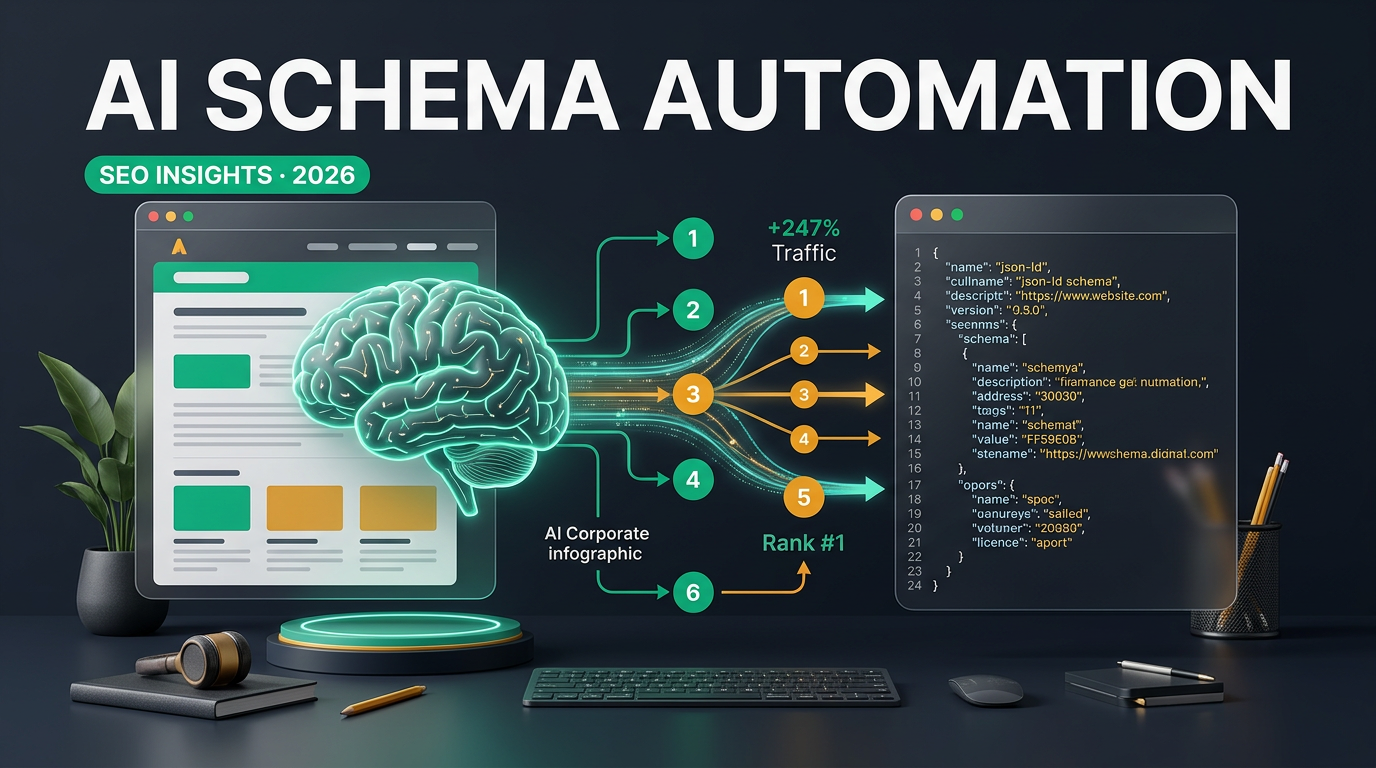
Leveraging Generative AI for Enhanced Schema Markup Automation
In the relentless pursuit of search engine visibility, we’ve long understood that speaking the language of search engines is non-negotiable. For years, schema markup has been that language—a structured vocabulary that translates our content into unambiguous data for machines. But deploying it has often been a tedious, manual slog, prone to human error and difficult to scale. Imagine trying to manually update schema for thousands of products during a flash sale. It’s simply not feasible.
This is where the paradigm shifts. The conversation is no longer just about having schema; it's about deploying it with intelligence, accuracy, and unprecedented efficiency. Welcome to the era of AI schema automation, a transformative approach that moves beyond single-page generators and into the realm of site-wide, dynamic, and context-aware structured data implementation. By 2026, this isn't a luxury for enterprise giants—it's a fundamental component of a modern SEO strategy for any business serious about growth.
What is Schema Markup and Why It Matters More Than Ever in 2026
Let's briefly realign on what schema.org structured data is today. It’s a collaborative framework that creates a machine-readable layer on your website. Think of your webpage as a story. The text and images are for human readers, but the schema markup is the neatly organized cliff notes for search engines, telling them explicitly that this number is a price, this text is a review, and this person is the author of an article.
In 2026, however, the role of schema has evolved far beyond just winning rich snippets like star ratings or FAQ dropdowns in search results. It's now about entity-first indexing. Search engines like Google are focused on understanding real-world entities—your company, your products, your experts—and the relationships between them. Accurate and interconnected schema is the most direct way to feed and shape that understanding, building a comprehensive knowledge graph for your own brand.
The core benefits remain powerful, but their context has deepened:
- Enhanced Visibility: Securing rich results is still a primary goal, significantly increasing your search engine results page (SERP) real estate and click-through rate (CTR).
- Improved Relevancy Signals: Explicitly defining content helps search engines match your pages to user intent with higher confidence, especially for long-tail and conversational queries.
- Voice Search & AI Assistant Optimization: AI assistants like Google Assistant and Siri rely heavily on structured data to provide direct, specific answers. Your schema is your API to these conversational platforms.
- Building Topical & Entity Authority: A well-structured site with interconnected schema (e.g., your Organization publishes Articles written by an expert Person) proves your authority and expertise in a way machines can process and trust.
The Old Guard: The Limits of Manual Schema Generation
For years, our toolkit for schema implementation has been limited. The process was often bifurcated into two main approaches: painstaking manual coding or using basic generator tools. Hand-coding JSON-LD is powerful but demands developer resources, is incredibly time-consuming, and a single misplaced comma can invalidate the entire script. For most, this isn't a sustainable solution.
This led to the popularity of tools like the Schema Markup Generator. These tools are fantastic for generating code for a single page, like a new blog post or your contact page. You fill out a form, and it spits out a validated JSON-LD snippet. However, their utility breaks down dramatically when faced with the realities of a dynamic, modern website.
The limitations of these traditional methods have become glaring bottlenecks:
- Lack of Scalability: Manually generating and inserting code for a site with hundreds of articles or thousands of products is an impossible task.
- Static and Brittle: If a product's price or availability changes, the manually generated schema becomes outdated and incorrect, potentially leading to manual actions from Google.
- Requires Manual Data Entry: The user must find and copy-paste every single piece of information into the generator's fields, a repetitive and error-prone process.
- Inability to Handle Complex Relationships: Creating nested schema that interconnects an event, its performer, its location, and its ticket offers with a manual tool is complex and unwieldy.
The AI Revolution: How Generative AI is Transforming Schema
AI schema automation is the intelligent evolution of structured data implementation. It’s not just a faster form-filler. It is a system that can read, understand, and structure information from your website autonomously. Leveraging natural language processing (NLP) and machine learning models, these platforms can crawl a URL, analyze its unstructured content, and generate perfectly-formed, contextually-relevant schema markup.
Imagine an AI that reads your new blog post, identifies the author, publish date, and key topics to generate `BlogPosting` schema. On another page, it sees a product image, a price, and customer reviews and instantly generates nested `Product`, `Offer`, and `AggregateRating` schema. This is the power of AI in action—it moves implementation from a reactive, manual task to a proactive, automated process.
The Core Capabilities of AI Schema Platforms
By 2026, leading AI schema solutions offer a suite of capabilities that were science fiction just a few years ago:
- Content-to-Schema Mapping: The AI intelligently reads plain text on your page and maps it to the appropriate schema.org properties without you needing to specify every field. For example, it recognizes "In stock" and maps it to `https://schema.org/InStock`.
- Dynamic Schema Generation: AI platforms integrate with your CMS or can be set to crawl your site regularly. When a new blog post is published or a product's details are updated, the schema is automatically created or refreshed in real-time.
- Nested Schema & Entity Connection: This is a key differentiator. An AI can understand that a `Product` page also contains `Review` information and links back to the `Organization` that manufactures it. It can build these complex, interconnected graphs effortlessly, creating a rich semantic tapestry.
- Automated Validation & Error Correction: The AI doesn't just generate code; it validates it against Google's latest requirements. Advanced systems can even audit your existing, non-AI schema, flag errors or deprecations, and suggest corrections.
Practical Strategies for Implementing AI Schema Automation in 2026
Theory is great, but tangible results come from strategic application. Adopting AI schema automation is not a magic bullet, but a powerful tool that, when wielded correctly, yields significant competitive advantages. Here are the most impactful strategies for businesses today.
First, use AI for a full-site audit and remediation project. Many sites suffer from a patchwork of old, broken, or missing schema. An AI tool can crawl your entire domain in hours, providing a complete diagnostic of your structured data health. It can identify high-priority pages (like product or service pages) missing schema entirely and generate the correct code for bulk implementation.
Second, for e-commerce, the killer application is dynamic product and offer schema. Integrate an AI schema platform with your product inventory system or CMS. When prices drop for a sale, an item goes out of stock, or new reviews come in, the AI detects these changes on the page and updates the `Product`, `Offer`, and `AggregateRating` schema instantly. This ensures Google always has the most accurate information for Merchant Center and rich results, preventing user frustration and potential penalties.
Finally, think bigger and use AI to architect your brand's knowledge graph. Move beyond page-level schema. Instruct your AI to identify key entities and connect them. For example, ensure your `Article` schema always links to the `Person` schema of the author, and that `Person` schema links to your main `Organization` schema. This creates a powerful, interconnected web of data that establishes your company, products, and people as authoritative entities in your niche.
A Step-by-Step Implementation Guide
- Choose Your AI Platform: Evaluate leading AI schema tools. Look for critical features like direct CMS integrations (e.g., Shopify, WordPress, Adobe Experience Manager), a dynamic crawler, a robust validation suite, and the flexibility to define rules for different content types.
- Set Up a Baseline Audit: Before deploying anything, run a full site crawl with the tool. This gives you a clear baseline of your current schema health and helps you prioritize which page templates or sections to address first.
- Define Automation Rules: Configure the AI with simple rules. For example: "For all URLs containing `/blog/`, apply `BlogPosting` schema." The AI will then take that instruction and handle the field-level mapping autonomously for every blog post. Good platforms will even suggest these rules for you.
- Deploy in a Staging Environment: Best practice is to never push code straight to your live site. Deploy the AI-generated schema on a staging or development server first. Use the Rich Results Test to validate a sample of URLs and ensure the code is perfect.
- Go Live and Monitor: Once validated, deploy the solution live. Keep a close watch on your Google Search Console "Enhancements" reports. You should see a decrease in errors and an increase in valid items detected. Correlate this with performance data (clicks, impressions, CTR) to measure the true impact.
The Future of Schema: AI, Entities, and the Semantic Web
Looking ahead, the synergy between AI and schema is the bedrock of the next generation of search. The game is no longer about tricking an algorithm with keywords; it's about clearly communicating facts to an intelligence. AI schema automation is your primary tool for this communication.
As search engines become answer engines powered by Large Language Models (LLMs), their need for structured, unambiguous data will only grow. A webpage with perfect schema is an LLM's dream source. It can pull your product's price, your recipe's cooking time, or your article's key takeaways with certainty, making your content more likely to be used in generative search experiences and AI-powered summaries.
Discussions around `schema markup for AI` are already happening, hinting at a future where we use schema to describe AI models, datasets, and their outputs. Being proficient in automated schema deployment now positions you to adapt to these new vocabularies as they emerge.
The future powered by this symbiosis looks like this:
- Hyper-Personalized Search: Search engines will use your granular schema data (e.g., price range, brand, features) to match your products to users who have shown explicit interest in those attributes.
- Fact-Based Generative Answers: Conversational AI and generative search experiences will cite your well-structured content as the source for their answers, driving highly qualified traffic.
- True Entity Optimization: Your SEO efforts will shift from optimizing pages to curating your brand's entity graph, with schema as the primary tool for defining who you are, what you do, and why you're an authority.
- Ambient Computing Integration: Your business information, structured via schema, will appear seamlessly in car dashboards, smart home devices, and augmented reality overlays, all powered by a universal understanding of your data.
Key Takeaways
As we navigate the AI-driven landscape of 2026, embracing automation is key to not just surviving, but thriving. When it comes to structured data, the path forward is clear.
- Manual schema generation and basic tools are no longer sufficient for dynamic websites or for competing at scale.
- AI schema automation delivers unparalleled accuracy, scalability, and the ability to create the complex, interconnected schema that search engines now demand.
- Begin by using AI for a site-wide audit to find and fix errors, then prioritize dynamic deployment for your most valuable content like products, services, and articles.
- The ultimate goal is to move beyond page-level snippets and build a comprehensive, machine-readable knowledge graph for your brand entity.
- Mastering AI schema automation is a foundational step in future-proofing your SEO strategy for an internet built on entities, intelligence, and trust.