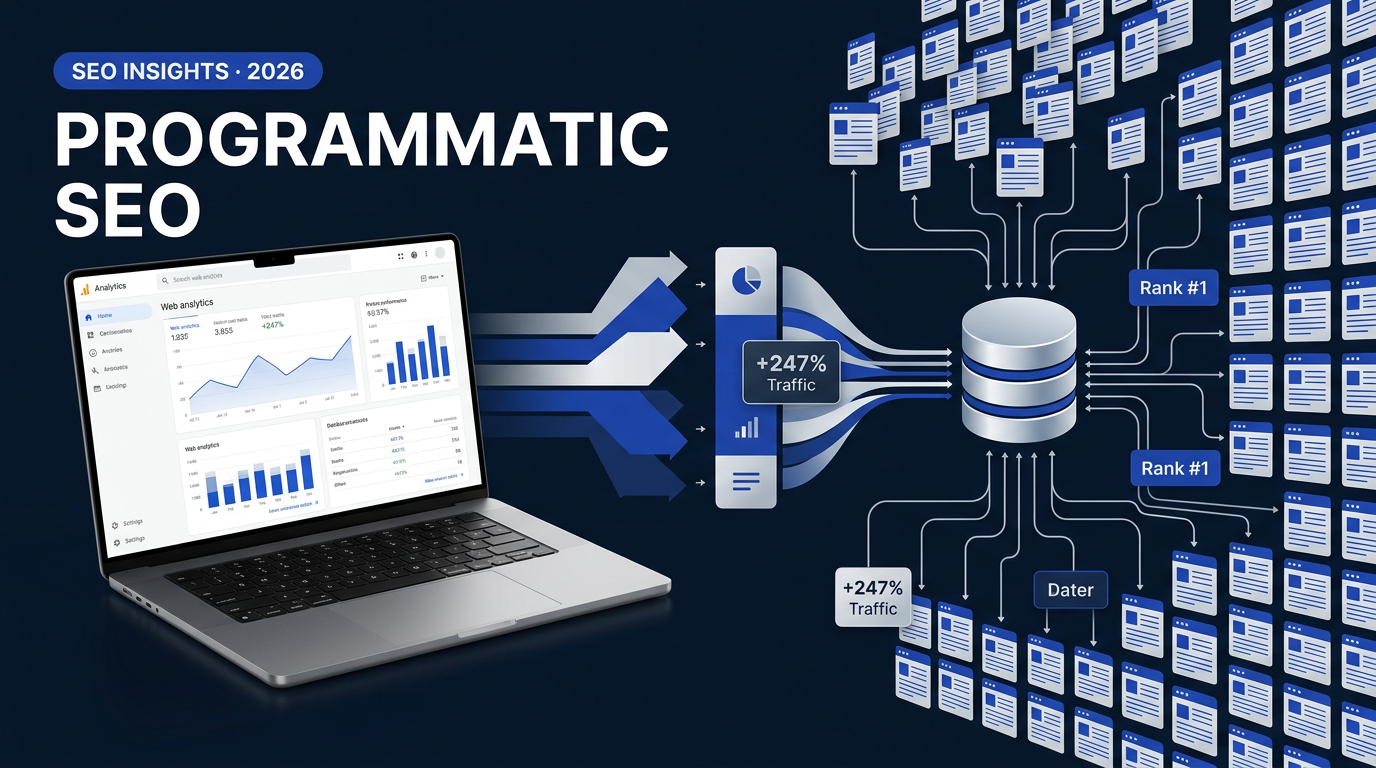
Tired of the content hamster wheel? You spend weeks crafting the perfect blog post for a specific keyword, only to see a trickle of traffic. To truly scale your reach and capture high-intent customers, you need a different engine. For countless businesses looking to dominate niche markets in 2026, that engine is Programmatic SEO. It’s the art and science of creating hundreds or even thousands of targeted, valuable pages from a single template and a structured dataset.
This isn’t about spammy, auto-generated content. It's about strategically answering thousands of specific user questions at a scale that manual content creation simply cannot match. By understanding the core principles of programmatic SEO (pSEO), any business—from a local service provider to a global SaaS company—can unlock a powerful new channel for sustainable organic growth and hyper-niche keyword domination.
What is Programmatic SEO (And What It's Not)?
At its core, programmatic SEO is a method of publishing pages at scale by using a database of information to populate a pre-designed page template. Think of it like a mail merge, but for creating web pages. You have a structured dataset (the names and addresses) and a template (the letter), and the system automatically generates a unique page for each entry in the database. The goal is to efficiently target a massive number of long-tail keywords that are individually low-volume but collectively represent a huge amount of search traffic.
Great examples of this are everywhere online. When you search for currency conversion rates on Wise, see restaurant listings on Yelp, or browse app integrations on Zapier, you're interacting with a programmatic SEO project. These sites aren't manually building a page for every single restaurant or every possible app combination. They define a template and let their data do the heavy lifting, creating rich, user-focused experiences at an incredible scale.
It’s crucial to distinguish pSEO from low-quality, AI-spun content. Programmatic SEO relies on structured, factual data to create value. The uniqueness of each page comes from the specific data points it presents (e.g., the cost of living in Lisbon vs. Bangkok). AI-generated spam, conversely, often just rephrases the same concepts with no underlying unique data, leading to thin content that provides no real user value and is likely to be penalized by Google.
Why pSEO is Your Secret Weapon in the AI Search Era
With the rise of Google's AI Overviews and other generative search experiences, many SEOs are worried about the future of traffic. However, programmatic SEO is uniquely positioned to thrive in this new landscape. AI Overviews excel at summarizing broad topics, but they struggle with highly specific, data-driven queries. This is precisely where pSEO shines. Your goal is to create pages that are the definitive answer for queries so niche that an AI has no choice but to cite your page as the primary source.
Consider a search like “best CRMs that integrate with QuickBooks and Mailchimp for under $50/month.” An AI would have to crawl and synthesize information from multiple sources to even attempt an answer. A programmatic page built on a SaaS database, however, can answer this question instantly and accurately. It’s not an opinion to be summarized; it’s a factual answer derived from your data. By creating these hyper-specific landing pages, you move from being a source that an AI *might* use to creating the destination page itself.
Furthermore, programmatic builds create a powerful internal linking web, establishing your site's topical authority in a way that is difficult to replicate manually. This deep authority signals to Google that you are an expert in your domain, making both your programmatic pages and your traditional editorial content more likely to rank well. In 2026, the sites that win won't just have content; they'll have structured, authoritative data that serves as the bedrock of the search ecosystem.
The Foundational Four: Building Your Programmatic SEO Engine
Executing a successful programmatic SEO project requires a systematic approach. While the technical details can vary, the strategy boils down to four core components. Mastering this process is the key to turning a simple idea into a traffic-generating machine.
- Identify Your Golden Dataset: This is the fuel for your engine. It can be first-party data (your product inventory, user-generated reviews, internal specs), data acquired via public APIs (weather data, government statistics, stock prices), or information compiled through strategic web scraping. The key is that the data must be structured, reliable, and something your audience genuinely needs.
- Define Your Keyword Patterns: Programmatic SEO targets keywords that follow a predictable pattern, often called “head term + modifier.” For example, Zillow targets `[real estate] in [city]`, while a recipe site might target `[ingredient] recipes for [diet type]`. Identify the patterns your customers use to search and ensure your dataset contains the necessary modifiers.
- Design a High-Value Page Template: Your template is more than just a wireframe; it's the user experience. It must be designed to present the data from each row of your dataset in a clear, compelling, and unique way. As noted in a breakdown by Zapier, the best templates go beyond just listing data points and add context, comparison tools, or user-generated content to make each page exceptionally useful.
- Choose Your Tech Stack and Launch: This is the implementation phase. You can use no-code tools like Webflow with Airtable, which are great for smaller projects. For larger-scale ambitions, a custom solution using a framework like Next.js or Astro connected to a database like PostgreSQL or Supabase offers more flexibility and performance. The goal is to generate pages dynamically without sacrificing page speed or SEO best practices.
Crafting Page Templates That Actually Convert (and Rank)
A common failure point in pSEO is creating “thin” pages that are just minor variations of each other. Google's helpful content systems are designed to filter this out. To win in 2026, your page template must be engineered to deliver unique value on every single generated page. A powerful template is a mix of dynamic data and static, value-add content.
Focus on making each page feel like a bespoke resource. For example, a programmatic page for a specific city shouldn't just list the population and weather. Like the successful Nomad List, it should integrate multiple data points—cost of living, internet speed, safety ratings, local reviews—to create a comprehensive guide. This layered data approach ensures that even though the template is the same, the content on the “Lisbon” page is substantively different and more useful for a user than the “Tokyo” page.
Essential elements for a high-value programmatic template include:
- Unique Title Tags and Meta Descriptions: Dynamically insert your core modifiers (e.g., City Name, Product Model) into your SEO titles and descriptions.
- Dynamic H1 and Breadcrumbs: Ensure the main heading and navigation path clearly reflect the specific content of the page.
- Above-the-Fold Value: The most important information from your dataset should be immediately visible. For a product, this might be the price and a hero image. For a location, it might be a key rating or a map.
- Rich Data Visualization: Use your data to generate charts, graphs, tables, or interactive maps. This makes complex data digestible and adds a unique visual element to each page.
- Static Explanatory Content: Include blocks of well-written text that provide context, answer common questions, or explain how to interpret the data. This content is the same on all pages but adds depth and helpfulness.
- Intelligent Internal Linking: Programmatically link to other relevant pages in your dataset. For example, a page about “Restaurants in Brooklyn” should link to pages for specific neighborhoods within Brooklyn or specific cuisine types.
Avoiding the Pitfalls: From Thin Content to Technical Debt
While powerful, programmatic SEO comes with its own set of risks. A poorly executed strategy can lead to Google penalties, wasted crawl budget, and a poor user experience. Awareness of these common pitfalls is the first step toward avoiding them.
The most significant danger is being flagged for creating thin or auto-generated content. To avoid this, ensure every page you publish serves a real user intent and offers sufficient unique value. If your dataset only has two or three data points per entry, it may not be robust enough. Enrich your data with more details, add user-generated content like reviews, or incorporate unique imagery to make each page stand on its own.
Another major challenge is indexation bloat and crawl budget management. When you publish thousands of pages, you need to guide Googlebot effectively. A well-structured XML sitemap is essential. More importantly, be ruthless about which pages you allow to be indexed. If certain combinations of filters or parameters result in low-value or duplicate pages, use a canonical tag or a `noindex` directive to keep them out of Google's index. This focuses Google's attention on your most valuable pages and prevents your site from being seen as low quality.
Don't let your ambition for scale lead to a slow, clunky website. Programmatic pages, especially those pulling from large databases, must be optimized for speed. This means optimizing database queries, compressing images, leveraging caching, and using a modern web framework that prioritizes performance.
Key Takeaways
Programmatic SEO is a strategic framework for scaling content and dominating niche search landscapes. As we move further into an AI-driven search world, its importance will only grow. To succeed, remember these core principles:
- Start with Data: Your entire project is built on the quality, structure, and usefulness of your dataset.
- Serve the User, Not Just the Bot: Each page must answer a specific user's need. Value is non-negotiable.
- Think in Patterns: Identify the repeatable search queries your customers use and build your strategy around those patterns.
- Build Smart Templates: A great template blends dynamic data with static context to create a uniquely valuable experience on every page.
- Manage the Technicals: Pay close attention to page speed, internal linking, and indexation to avoid common pitfalls and ensure your project's long-term success.