Local SEO Checklist for Small Businesses: 7 Steps to Dominate Your Local Search Results
As a small business owner, you’re an expert in your craft—be it baking artisanal bread, fixing leaky pipes, or providing stellar legal advice. You're not expected to be an SEO wizard, too. Yet, when a potential customer types “bakery near me” or “emergency plumber in Brooklyn” into their phone, you need to show up. Visibility in those critical moments isn't just a bonus; it's the lifeblood of modern local business.
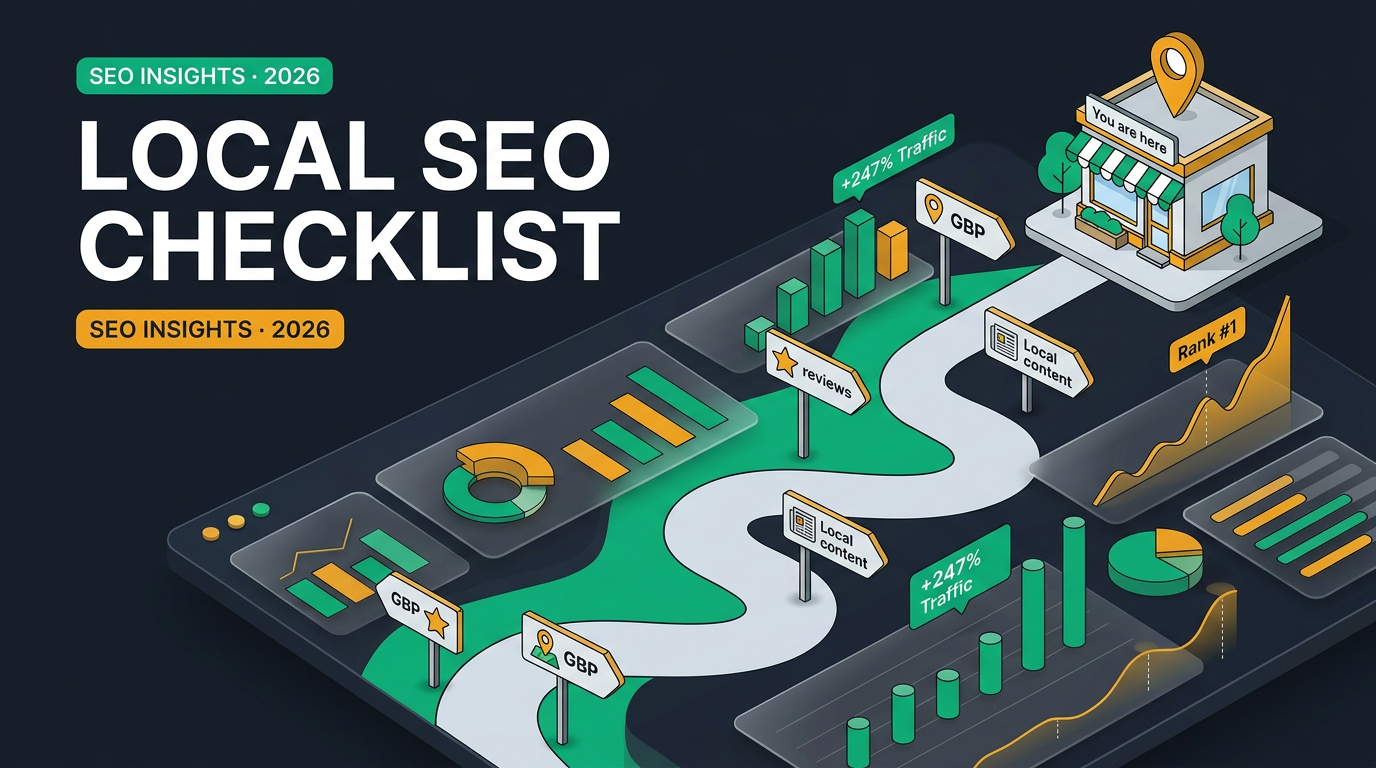
Getting lost in the complexities of search algorithms is easy, but it doesn't have to be that way. Forget the jargon and the endless fluff. This simple but powerful local SEO checklist is your 2026 roadmap. We've distilled everything down to seven actionable steps that will move the needle, attract more local customers, and help you dominate your local search results—no advanced degree required.
Step 1: Master Your Google Business Profile (GBP)
Your Google Business Profile is no longer just a listing; it's your digital storefront, front desk, and customer service hub rolled into one. In 2026, it is the undisputed cornerstone of local search visibility. Simply filling it out once is not enough. To truly stand out, you must treat your GBP as a dynamic, living profile that constantly signals activity and relevance to Google and your customers.
Go beyond the basics of Name, Address, and Phone number. Fill out every single section with as much detail as possible. This includes adding specific services with descriptions, loading your products with high-quality images and prices, and activating features like booking and messaging. Pay special attention to your business categories. As recommended in many guides for small businesses, choose the most accurate primary category, then add all relevant secondary categories to cast a wider net for customer searches. In 2026, Google's AI is more sophisticated, using profile attributes (e.g., "woman-owned," "outdoor seating") to answer increasingly specific user queries, so select everything that applies to your business.
The visual element is paramount. Customers are more likely to engage with a profile that has a rich library of recent photos and videos. Don't just upload your logo; show off your work, your team, your space, and happy customers. Short, vertical videos (like Instagram Reels) are particularly effective for virtual tours or showcasing a product in action. Proactively use the Q&A feature by seeding it with common customer questions and providing clear, helpful answers—this turns your profile into a valuable FAQ resource.
- Complete 100% of your profile: This includes business hours, holiday hours, detailed service areas, and accessibility information.
- Upload new photos/videos weekly: Show activity. Post pictures of new products, completed jobs, or team members.
- Enable messaging and set up auto-replies: Immediate engagement shows Google and customers you're responsive.
- Use Google Posts weekly: Announce offers, events, or share updates. These posts expire, so consistency is key.
- Pre-load the Q&A section: Ask and answer your top 5-10 frequently asked questions yourself.
Step 2: Build a Rock-Solid On-Page Local SEO Foundation
While GBP is critical, your website is the home base you completely control. Optimizing your site's pages tells Google exactly where you are, what you do, and why you're the best choice in the area. This process, known as on-page SEO, is about weaving your location into the very fabric of your website's content and code.
Start with your title tags and meta descriptions—the text that appears in Google search results. These need to be compelling for both users and search engines. Instead of a generic title like “Plumbing Services,” opt for a locally optimized one like “Expert Drain Cleaning in Scottsdale | Pete’s Plumbing.” This immediately tells both Google and a potential customer that you’re relevant to their specific need and location. For businesses serving multiple distinct neighborhoods or towns, creating individual “location pages” or “service-in-location” pages is a power move. A page dedicated to “HVAC Repair in North Austin” will rank far better for that specific query than a generic “Services” page.
Finally, you need to speak Google's native language using structured data, also known as schema markup. As noted by resources like the Local SEO Checklist hub, adding this code to your website helps search engines understand your information perfectly. LocalBusiness schema allows you to explicitly label your NAP, hours, reviews, and more in a format Google can easily parse and display in search results, sometimes as a rich snippet that makes your listing stand out.
- Optimize Title Tags: Use the formula: [Primary Service] in [City/Neighborhood] | [Business Name].
- Localize Website Content: Mention local landmarks, cross-streets, and community involvement naturally within your page copy.
- Embed a Google Map: On your contact or location page, embed a Google Map of your business address. This is a strong, tangible location signal.
- Implement LocalBusiness Schema: Use a tool like Google’s Structured Data Markup Helper to generate the code, and add it to your website's header or footer.
- Display your NAP prominently: Ensure your full Name, Address, and Phone Number are visible on every page, typically in the footer, and are identical to your GBP listing.
Step 3: Ensure Absolute NAP Consistency Across the Web
Imagine explaining who you are, but you use a slightly different name or address every time. It would be confusing and untrustworthy, right? Google feels the same way about your business information online. NAP consistency—ensuring your Name, Address, and Phone number are 100% identical everywhere—is a fundamental trust factor for local search engines.
Inconsistencies, such as using “St.” in one place and “Street” in another, or having an old phone number on a forgotten directory, can create confusion and dilute the authority of your real-world location. Your first task is to establish a single, canonical version of your NAP and use it exclusively. The most important places to get this right are your own website and your Google Business Profile. From there, you need to audit and clean up your presence on the web's most important directories, often called “citations.”
These citations act as third-party verifications of your business data. Focus on the major data aggregators (like Data Axle and Neustar/Localeze) and top-tier consumer directories first. Then, look for high-quality directories specific to your industry (e.g., Avvo for lawyers, Houzz for home contractors) and your city (e.g., your local Chamber of Commerce website). Consistency across these platforms builds a powerful web of trust that solidifies your business's legitimacy in Google's eyes.
- Top-Tier Directories: Ensure your NAP is correct on Apple Maps, Yelp, Bing Places, and Facebook.
- Industry-Specific Sites: Identify and claim your profile on the top 3-5 directories for your specific profession.
- Local Directories: Get listed on your city's Chamber of Commerce site and other local business association pages.
- Use a Tool (Optional): Services like BrightLocal or Semrush can audit and help clean up citations at scale, saving dozens of hours.
Step 4: Execute a Proactive Review Generation Strategy
Reviews are one of the most powerful local ranking factors and, more importantly, the single biggest influence on a customer's decision to choose you over a competitor. In 2026, a passive approach to reviews—hoping customers leave one—is a recipe for being invisible. You need a proactive, systematic strategy to generate a steady stream of positive, authentic feedback.
The key is to make it incredibly easy for happy customers to leave a review. Don't just ask; provide a direct path. You can create a unique short link to your Google review page and share it via a QR code at your checkout counter, in a follow-up email, or through an SMS message after a service is completed. The timing is crucial: ask when the positive experience is still fresh in their mind. This simple act of removing friction can dramatically increase your review volume.
Responding to reviews is equally important. It shows prospective customers that you care and are engaged. Always respond professionally to both positive and negative reviews. For positive reviews, thank the customer and try to naturally mention the service or location (e.g., “We’re so glad you enjoyed the A/C repair service at your downtown Phoenix home!”). For negative reviews, respond quickly, empathetically, and take the conversation offline to resolve the issue. This public display of customer service can often turn a negative into a positive.
- Create a Direct Review Link: Find your business in Google Maps, click "Write a review," and copy the long URL. Use a service like Bitly to shorten it.
- Implement a Post-Service Ask: Automate an email or text message that goes out 24 hours after a purchase or service, thanking the customer and providing your review link.
- Leverage QR Codes: Print a QR code that leads to your review link on receipts, business cards, or in-store signage.
- Respond to Every Review: Aim for a 24-hour response time. This engagement is a positive signal to Google and users.
Step 5: Create Content That Answers Local Questions
Content is how you capture customers who aren’t just searching for “[your service] near me.” They have questions, concerns, and problems specific to their local context, and if you can provide the answers, you win their trust and their business. Stop thinking about blogging and start thinking about being the go-to local expert resource.
Instead of writing a generic post like “The Importance of a Good Roof,” a roofer in Denver should write “Choosing the Best Roofing Material for Colorado Hail Seasons.” A financial planner in a college town could create “A Student's Guide to Banking in [City Name].”
This hyper-local content positions you as an authority and captures valuable long-tail keywords—the longer, more specific phrases people use when they are closer to making a decision. Think about the unique challenges and opportunities in your area. Does your city have specific building codes? Are there famous local events your business can tie into? Create project case studies from jobs you've done in specific, named neighborhoods. This not only provides great content but also serves as social proof.
- Neighborhood-Specific Guides: Write a guide about your service as it relates to a specific neighborhood you serve (e.g., “The Ultimate Landscaping Guide for [Neighborhood]'s Clay Soil”).
- Local Project Spotlights: Showcase a recent project with photos and a description of the work done in a recognizable local area.
- Answer Local FAQs: Create a page or post titled “How Much Do [Your Service] Cost in [Your City]?” and provide a detailed, helpful breakdown.
- Community Involvement Posts: Write about your sponsorship of a local team, your participation in a community event, or your partnership with another local business.
Step 6: Earn Powerful Local Backlinks
A backlink is simply a link from another website to yours. In the world of SEO, links are votes of confidence. For local SEO, links from other local websites are super-votes. These links signal to Google that your business is a legitimate, recognized, and important part of the local community. While high-authority links are great, you don't need a link from the New York Times; a link from the local brewery you partnered with can be far more valuable for local rankings.
The key is to think in terms of community relationships, not just digital links. The best local link-building opportunities arise from real-world activities. Do you sponsor a local charity run? Ask them to include a link to your website on their sponsors' page. Are you a member of the Chamber of Commerce or a Business Improvement District? Ensure your profile in their directory links to your site. You can also host a local event or workshop, or offer a discount to members of a local organization, creating natural opportunities for them to link to you.
This approach, as touched upon by many small business SEO strategies, is about embedding yourself in the local ecosystem. Reaching out to local bloggers who review businesses like yours and offering them a free trial or tour is another fantastic, proactive way to earn both a review and a powerful local link.
- Sponsor a local event or sports team: This is one of the easiest and most effective ways to get a high-quality local link.
- Host a local workshop or meetup: Create an event page and share it with local community calendars and news outlets, which will often link back.
- Partner with non-competing businesses: Offer a cross-promotion with a nearby business and write a blog post about it, encouraging them to do the same and link to you.
Step 7: Track What Matters (And Ignore the Noise)
You can't improve what you don't measure. But as a busy small business owner, you don't have time to get lost in a sea of data. For local SEO in 2026, you only need to focus on a few key performance indicators (KPIs) that directly reflect business impact. The good news is that Google provides the most important tools for free.
Your primary dashboard should be the Performance report within your Google Business Profile. This tells you exactly how many people are finding you and how they're engaging. The three most important metrics here are:
- Search Views: How many people saw your business in search results? Is this number trending up?
- Website Clicks: How many people clicked through to your website from your GBP?
- Direction Requests & Calls: How many people requested directions to your physical location or called you directly from your profile? These are high-intent actions that often lead directly to revenue.
Your second tool is Google Search Console. Once set up, the "Performance" report here shows you the exact search queries people are using to find your website. Look for queries that include your city or “near me.” Are you ranking well for them? Are you getting clicks? This insight is invaluable for refining your on-page and content strategy. By focusing on these core, business-centric metrics, you can effectively track your local SEO success without the overwhelm.
Key Takeaways for Your 2026 Local SEO Strategy
Dominating local search is a marathon, not a sprint. It's about building a strong, consistent, and trustworthy presence over time. By focusing on these seven core areas, you'll be building a foundation that pays dividends for years to come.
- Google Business Profile is your #1 priority. Optimize it completely and engage with it weekly.
- Weave your location into your website's pages through titles, content, and schema code.
- Ensure NAP consistency everywhere. A clean, consistent business identity builds trust with Google.
- Proactively ask for and respond to all customer reviews. They are your most powerful social proof.
- Create content that answers specific local questions, positioning you as the go-to expert.
- Earn local backlinks by engaging with your community. Real-world relationships create powerful digital signals.
- Track business-focused metrics like calls, direction requests, and local keyword performance.