
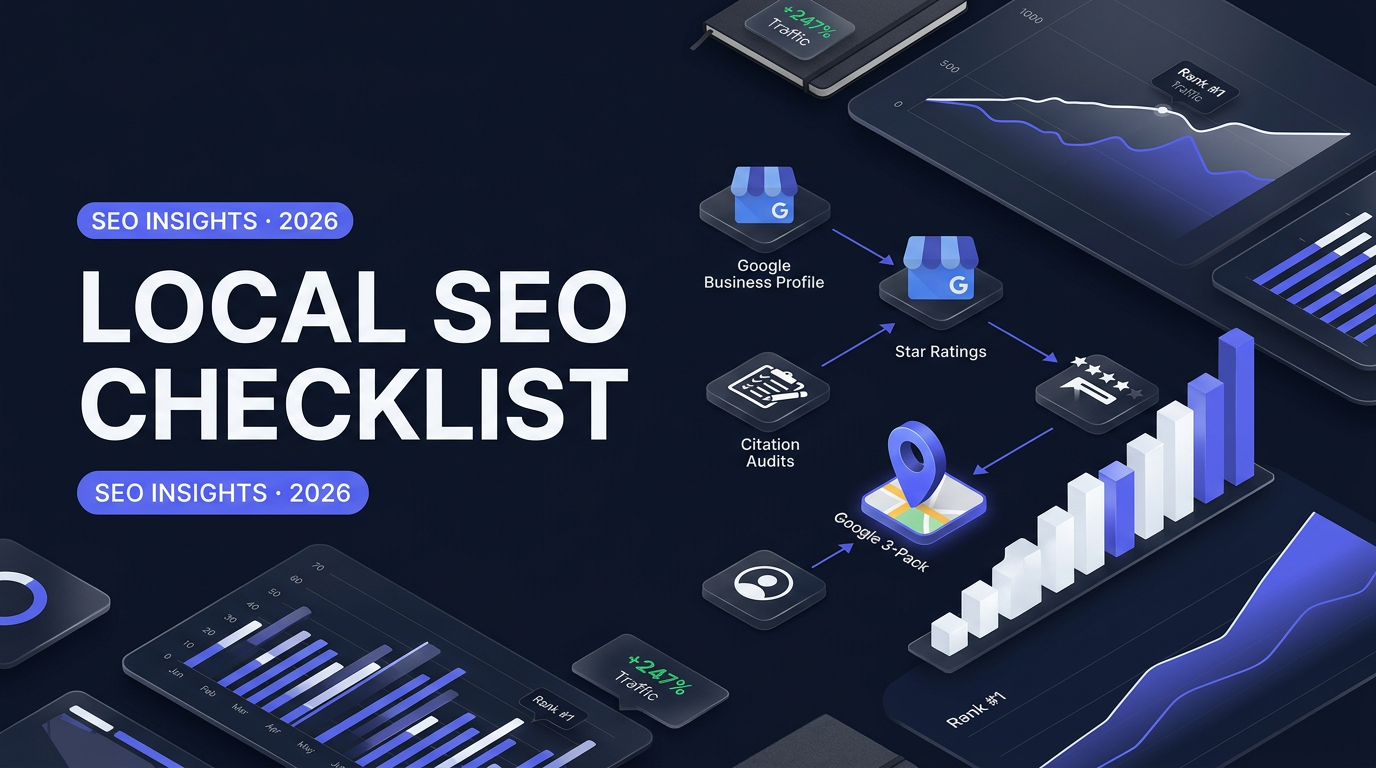
Mastering the Local SEO Checklist to Own the Google 3-Pack
For small business owners, appearing at the top of organic search is no longer enough. The real battleground for qualified calls, store visits, and booked appointments happens within the Google 3-Pack—the prominent map block highlighting the top three local service providers. Implementing a methodical local seo checklist is the fastest, most cost-effective way to secure this prime digital real estate.
As search algorithms evolve to favor hyper-local contextual relevance and authentic user feedback, traditional ranking shortcuts no longer work. Whether you run a single-location dental clinic, an independent auto shop, or an expanding regional HVAC company, following this rigorous, execution-ready guide will elevate your visibility and outpace your local rivals in 2026.
Phase 1: Google Business Profile (GBP) Core Optimization
Your Google Business Profile serves as the direct data source powering the Map Pack. Skipping or rushing through your profile setup limits your geographic reach before potential customers even find you. Completing every field ensures that Google recognizes your operational footprint and matches your profile against intent-driven searches.
The foundation rests on selecting the precise primary category. Google assigns significant algorithmic weight to primary categories compared to secondary ones. If you are an emergency plumber, setting "Plumber" or "Emergency Plumbing Service" accurately defines which query sets trigger your profile. Avoid spamming extraneous keywords into your registered business name, as Google's algorithmic spam filters actively penalize naming infractions.
- Category Selection: Lock in your primary category with surgical precision, then add up to 9 secondary categories that reflect genuine auxiliary services.
- Visual Assets: Upload weekly geocoded, authentic photographs of your team, storefront, branded vehicles, and completed work rather than generic stock photography.
- Product & Service Menus: Flesh out every service item with thorough 150-word descriptions that integrate localized anchor phrases and clear pricing models.
- GBP Messaging & Booking: Turn on real-time chat integrations and link your direct appointment scheduling software to streamline conversion friction.
Phase 2: Local On-Page Architecture and Technical Signals
Your website provides the algorithmic proof Google needs to validate your Google Business Profile. Without cohesive local on-page signals, Google lacks the confidence to rank your listing beyond your immediate street corner. According to technical frameworks outlined in the Local SEO Checklist field guide, unifying technical hygiene with localized schema produces enduring search equity.
A critical misstep among multi-location or expanding service brands is clumping multiple towns onto a single homepage. To capture regional demand, you must create dedicated location landing pages. Each page must feature distinct, helpful content—such as area-specific project galleries, staff bios, customer testimonials, and localized service guarantees—rather than simply swapping town names on cloned copy.
- Hyper-Local Title Tags: Structure title tags using a proven hierarchy: [Primary Service] in [City, State Abbr] | [Brand Name].
- JSON-LD Schema Markup: Implement robust
LocalBusinessor specific subtype markup (e.g.,Dentist,HVACBusiness) indicating your exact geo-coordinates, operating hours, and accepted payment types. - NAP Consistency in Footers: Display your legal business name, physical street address, and local area code phone number consistently across every site template.
- Core Web Vitals for Mobile: Ensure mobile load times clock under 2.5 seconds on Largest Contentful Paint (LCP), as the majority of high-intent local queries originate from handheld devices.
Phase 3: Building Authoritative Citations and NAP Ecosystems
Data aggregators constantly scan the open web to compile information about your entity. When your Name, Address, and Phone number (NAP) match identically across core directories, search engines build strong confidence in your physical legitimacy. Discrepancies like outdated suite numbers or mismatched phone numbers create algorithmic confusion that demotes your Map Pack placement.
Strategic citation distribution involves claiming tier-one platform profiles before securing hyper-local community listings. As noted by the strategists at Virtual Stacks Systems, your information must match across foundational networks like Apple Maps, Yelp, and Bing Places to establish systemic verification.
- Core Data Aggregators: Push clean entity data through primary networks like Data Axle, Neustar Localeze, and Foursquare to distribute records downstream.
- Tier-1 General Directories: Manually audit and claim profiles on Apple Business Connect, Bing Places for Business, Yelp, Better Business Bureau (BBB), and YellowPages.
- Industry-Specific Portals: Secure niche directories that Google trusts implicitly (e.g., Avvo for legal, Angi or Houzz for home contractors, Healthgrades for medical practitioners).
- Chamber of Commerce & BNI: Register with local commercial organizations to gain trusted .org or civic backlinks tied directly to your physical address.
Phase 4: Customer Review Velocity and Sentiment Management
Customer reviews represent both a critical organic ranking signal and your primary conversion catalyst. Google assesses overall review quantity, star ratings, review velocity (the frequency of new reviews), and the specific keywords reviewers use in their feedback. A dormant profile with five-star reviews from three years ago routinely loses position to a business generating multiple detailed reviews every week.
Systematizing your review acquisition workflow ensures steady review velocity without running afoul of anti-gating policies. Never incentivize customers with discounts or sweepstakes, as this violates consumer review compliance regulations and risks profile suspension.
- Automated SMS Requests: Trigger direct review requests via SMS or email within 2 to 4 hours of completing a job while client satisfaction is peak.
- Keyword-Rich Prompts: Coach clients casually by asking questions like: "Could you mention what neighborhood we served you in and which plumbing fixture we repaired?"
- Complete Response Protocol: Reply to 100% of incoming reviews—both glowing and critical—within 24 to 48 hours, weaving localized services naturally into your public answers.
- Mitigating Negative Feedback: De-escalate negative experiences politely in public, moving complex conversations offline to protect your public reputation.
Phase 5: Local Link Building and Hyper-Local Content Strategy
Broad, un-targeted backlinks from national publications rarely move the needle for local map positions. What search engines look for are geo-contextual backlinks from organizations situated within your immediate county or market. Earning five backlinks from local youth sports leagues, non-profits, or neighboring merchants delivers far more localized domain authority than dozens of generic guest posts.
Small business local SEO is not a contest of domain size; it is a demonstration of neighborhood authority and verified physical presence.
Pair link acquisition with locally oriented educational content. Instead of writing generic posts on basic maintenance, draft guides addressing localized problems—such as seasonal winterization for homes built during specific local eras or navigating regional building permit processes. This signals deep, practical community expertise that search bots recognize.
- Local Sponsorships: Sponsor regional 5K runs, community festivals, or high school sports teams to earn high-authority community `.org` and `.edu` links.
- Vendor Partnerships: Trade profile features and case studies with non-competing businesses you regularly source materials or services from locally.
- Local Press Releases: Distribute newsworthy milestones—such as company anniversaries, charity fund drives, or new facility launches—to regional print and digital journalists.
Key Takeaways: Your Local SEO Action Plan
- Verify and Enhance GBP: Treat your Google Business Profile as a secondary homepage by updating photos, services, and offers weekly.
- Align Technical On-Page Elements: Create unique, geo-targeted service pages with validated LocalBusiness JSON-LD schema markup.
- Enforce Exact NAP Uniformity: Remove duplicate citations and standardize address abbreviations across every directory network.
- Drive Ongoing Review Velocity: Implement an automated follow-up process to harvest steady feedback containing organic local search keywords.
- Prioritize Community Authority: Build localized backlinks through area sponsorships, commercial partnerships, and hyper-local resource guides.