Local SEO Checklist: Rank Higher for Small Businesses in 2026
For a small business, showing up in local search isn't just a marketing goal; it's a lifeline. When a potential customer searches for “plumber near me” or “best coffee shop in downtown,” you want to be the first name they see. But between running your business and serving your customers, navigating Google's ever-changing rules can feel like a full-time job. The good news? You don’t need a massive budget to compete. You just need the right plan.
This comprehensive local SEO checklist is designed specifically for busy small business owners in 2026. We'll cut through the noise and give you a prioritized, step-by-step framework to improve your local rankings, attract more ready-to-buy customers, and build a dominant presence in your community. Forget temporary tricks; these are the foundational pillars that drive sustainable growth.
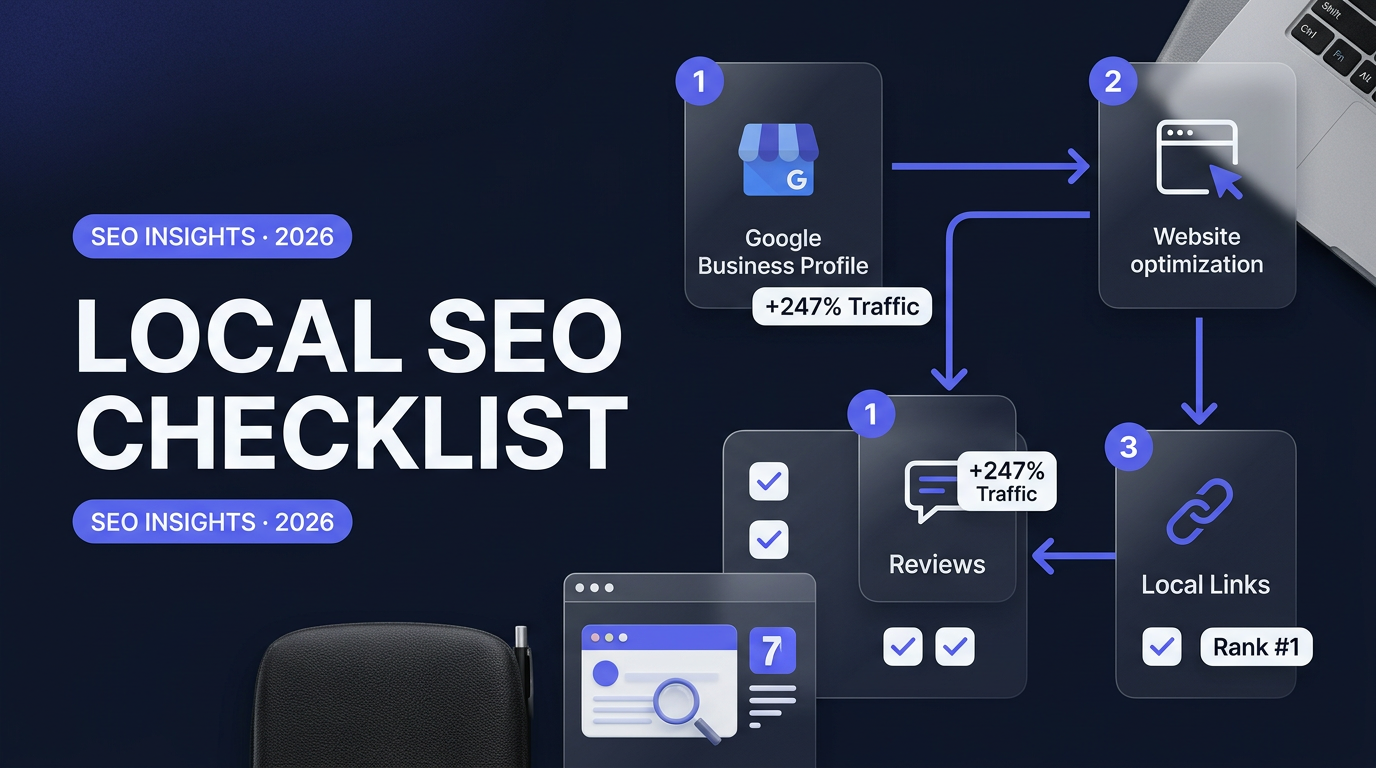
Foundation: Master Your Digital Storefront (Google Business Profile)
Think of your Google Business Profile (GBP) as your digital storefront. It's often the very first interaction a customer has with your business, and it's the single most critical element for ranking in Google's local pack and Maps results. In 2026, GBP is more than a simple listing; it's an interactive profile that directly feeds Google's AI Overviews and answers customer queries before they even click to your site. Getting this right is non-negotiable.
Go beyond just filling out your name and address. A fully optimized profile signals to Google that you are active, legitimate, and the best answer for a searcher's needs. Dedicate time to making your GBP a rich, helpful resource for your community.
- Complete Every Single Field: Don't skip the details. Add your services with descriptions, select all relevant attributes (e.g., “wheelchair accessible,” “free Wi-Fi,” “women-led”), define your service area, and add your business hours. The more data you give Google, the more queries you can rank for.
- Leverage Google Posts and Updates: Regularly share updates, special offers, new product announcements, or event details using Google Posts. These posts appear directly on your profile and signal to Google that your business is active. They expire, so aim for at least one new post per week.
- Upload High-Quality, Geotagged Media: A profile with 100+ photos gets significantly more engagement. Upload clear photos of your storefront, your team, your products, and your work in action. Use a free online tool to geotag your images with your business's coordinates before uploading to add another powerful location signal.
- Proactively Use the Q&A Section: Don't wait for customers to ask questions. Seed your GBP Questions & Answers section with your most common FAQs. Ask the question yourself, then answer it immediately with a clear, helpful response. This lets you control the narrative and provide instant value.
On-Page SEO: Signal Your Local Relevance
Once your GBP is in top shape, it's time to ensure your website reinforces the same local signals. The goal of on-page local SEO is to make it unmistakably clear to both users and search engines what you do and where you do it. Google is smart, but you still need to connect the dots. As one guide for small businesses notes, you have to know who you’re optimizing for and why, which for local businesses, means customers in a specific geographic area.
Every relevant page on your site should have local identifiers. This doesn't mean stuffing your city name into every sentence. It means strategically placing location-based keywords where they have the most impact and creating content that speaks directly to your local audience.
- Perform Local Keyword Research: Think like a customer. They search with terms like “[service] in [city],” “[neighborhood] [service],” or “[service] near me.” Use Google's own search bar and Maps search for auto-complete suggestions. These are the exact phrases people are using. Target these intent-driven keywords.
- Optimize Title Tags and Meta Descriptions: Your page's title tag is a powerful ranking signal. A great format is: Primary Service in City, ST | Your Brand Name. For your meta description, include your main keyword, location, and a compelling call-to-action, like “Get a free quote.”
- Embed a Google Map: On your contact page and your homepage footer, embed an interactive Google Map of your business location. This is a simple but powerful visual and technical signal that confirms your physical address.
- Create Localized Service Pages: If you serve multiple distinct areas or have a primary service area, create dedicated pages for them. For example, a page for “Roofing in Springfield” and another for “Roofing in Shelbyville.” Each page should feature unique content relevant to that specific location, such as testimonials from local clients or notes about local building codes.
Content & E-E-A-T: Prove You're the Local Expert
Google's quality guidelines revolve around E-E-A-T: Experience, Expertise, Authoritativeness, and Trust. For a local business, this is a golden opportunity. You can demonstrate your first-hand experience and expertise within your community in a way that a national chain never can. Your content is how you prove it. Stop thinking of a blog as an optional extra; it's your primary tool for building authority.
Instead of generic posts, create genuinely helpful content that solves local problems. This strategy helps you rank for long-tail keywords (longer, more specific search queries) and builds trust with potential customers before they even contact you. A simple local SEO checklist suggests creating “best of” guides and covering local events, which are great starting points.
- Create Hyper-Local Content: Write blog posts that answer questions specific to your area. A landscaper in Phoenix could write “The 5 Best Drought-Resistant Plants for Phoenix Backyards.” A financial advisor in a college town could create a “Student's Guide to Budgeting at [University Name].” These articles attract highly qualified local traffic.
- Showcase Project Case Studies: Document your work with detailed case studies. Take before-and-after photos, describe the customer's problem, explain your solution, and include a testimonial. Tag the post with the neighborhood or city where the work was done. This demonstrates real-world experience.
- Implement Local Business Schema: Schema markup is code you add to your website to explicitly tell search engines what your data means. Use LocalBusiness schema to clearly define your name, address, phone number (NAP), hours, and service area. This removes any ambiguity for Google and helps ensure you appear correctly in search results.
The Trust Factor: Citations and Customer Reviews
Trust is the currency of local SEO. Google needs to trust that your business is legitimate, located where you say it is, and valued by its customers. The two main ways it measures this are through citations and reviews. Consistency and positive social proof are what separate businesses in the map pack from those on page five.
A citation is any online mention of your business's Name, Address, and Phone number (NAP). Google cross-references these mentions across the web to verify your information. Inconsistencies, like an old address on a directory, can confuse search engines and hurt your rankings. Meanwhile, reviews are a direct ranking factor and heavily influence customer decisions.
- Ensure 100% NAP Consistency: Your Name, Address, and Phone number must be identical everywhere online. Check your website footer, contact page, social media profiles, and major directories. Use a consistent format, including details like “Street” vs. “St.”
- Build Foundational Citations: Make sure your business is listed correctly on major data aggregators and core platforms like Bing Places, Apple Maps, and Yelp. These high-authority directories feed hundreds of other smaller sites.
- Find Niche and Hyper-Local Directories: Go beyond the basics. Are you a member of the local Chamber of Commerce? Get a listing. Are you a contractor? Get listed on industry-specific sites like Houzz or Angi. A link from a local neighborhood blog is often more valuable than one from a generic national directory.
- Systematize Your Review Generation: Actively ask every happy customer for a review. Use a simple, automated email or text message that sends a day or two after your service is complete. Provide a direct link to your Google review page to make it easy for them.
- Respond to Every Review: Thank customers for positive reviews. For negative reviews, respond professionally and publicly. Offer to take the conversation offline to resolve the issue. How you handle criticism shows potential customers that you care.
Advanced Plays: Local Link Building
With a solid foundation, you can move on to the most powerful (and most challenging) part of local SEO: building local backlinks. A backlink is a link from another website to yours. Google views these as votes of confidence. Links from other relevant, authoritative, and local websites are signals that your business is a respected part of the community.
Forget spammy link schemes. The goal is to earn links naturally by getting involved in your local community, both online and off.
- Sponsor a Local Event or Team: Sponsoring a local 5k run, a youth sports team, or a community festival almost always results in a link from their website's sponsor page back to yours. This is a powerful, locally relevant link.
- Host a Community Workshop: Offer a free workshop related to your expertise. A hardware store could host a “DIY Home Repair Basics” class. A bakery could offer a cake decorating session. Promote it to local news outlets, bloggers, and community calendars, many of which will link back to your registration page.
- Partner with Non-Competing Businesses: Team up with a neighboring business on a joint promotion or a piece of content. A real estate agent and a mortgage broker could co-author a “First-Time Home Buyer's Guide for [City].” They promote it to their audience, you promote it to yours, and you both link to each other.
- Join Local Business Associations: Organizations like the Chamber of Commerce or a Downtown Business Alliance typically have member directories with links back to your site. These are highly relevant and authoritative local links.
Key Takeaways
Dominating local search in 2026 is about building a strong, consistent, and trustworthy presence across multiple fronts. By following this local SEO checklist, you can systematically improve your visibility and drive real business growth. Remember these core principles:
- Your Google Business Profile is your #1 priority. Optimize it completely and keep it active.
- Your website must clearly signal your location and services. Make it obvious what you do and where you do it.
- Create content that proves your local expertise and experience. Answer your customers’ questions and solve their problems.
- Build trust with consistent citations and a steady stream of positive reviews. Manage your reputation proactively.
- Engage with your community to earn powerful local backlinks. Get involved online and offline.
Local SEO is not a one-time task but an ongoing process. Consistent effort across these key areas will compound over time, establishing your business as the go-to choice in your community for years to come.