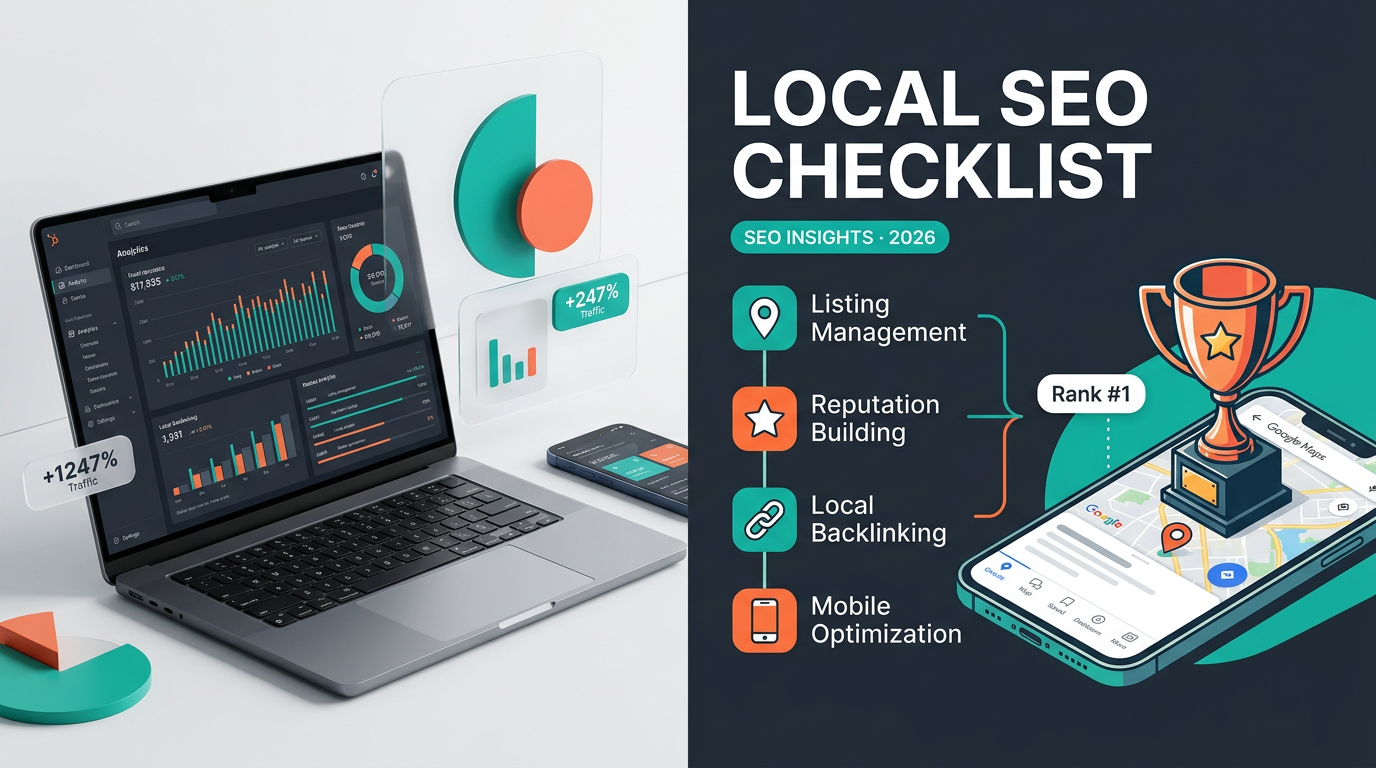
Local SEO Checklist: Rank Your Small Business on Google Maps
Is your small business invisible online? When customers search “pizza near me” or “best plumber in Austin,” you want to be the first name they see. Showing up in the Google Maps “local pack” isn't magic; it’s the result of a smart, targeted strategy. This comprehensive local SEO checklist is your roadmap to climbing the local search rankings in 2026 and turning those digital lookers into loyal customers.
Forget vague advice and outdated tactics. We’re diving deep into the actionable steps that move the needle. From optimizing your digital storefront to building unshakable local authority, these are the exact tasks you need to focus on to win the local search game. Let's get started.
Foundation First: Master Your Google Business Profile (GBP)
Your Google Business Profile is your digital front door and the single most critical element of local SEO. Simply creating a profile isn't enough. For 2026, a fully optimized and actively managed profile is non-negotiable. Google's AI-driven search results, like the Search Generative Experience (SGE), will pull directly from this data to answer user queries, so completeness and accuracy are paramount.
Start by ensuring every field is meticulously filled out. This goes beyond your business name and address. Google's ranking factors of relevance, distance, and prominence begin here. A complete profile signals high relevance to Google, making it more confident in showing your business for related searches. Pay special attention to your business categories. Choose the most specific primary category possible (e.g., “Italian Restaurant” instead of just “Restaurant”), and then add all relevant secondary categories.
Your GBP setup checklist:
- Claim and Verify: Ensure you have full ownership of your profile.
- NAP-W Consistency: Your Name, Address, Phone number, and Website must be identical across your entire online presence. No variations like “St.” vs. “Street.”
- Categories: Select a specific primary category and 5-10 highly relevant secondary categories.
- Service Area vs. Physical Address: If you're a service-area business (like a plumber or landscaper), define your service areas precisely. If you have a storefront, make sure your map pin is placed correctly.
- Hours of Operation: Keep your regular hours, holiday hours, and special hours updated religiously.
- Attributes: Add all relevant attributes, such as “Women-led,” “Wheelchair accessible,” or “Outdoor seating.” These act as filters in search results.
Content is King, Even on Google Maps
Static profiles get stale. In 2026, local search is dynamic, and your content strategy needs to reflect that. This means treating your Google Business Profile less like a phone book listing and more like a social media profile, while also ensuring your website supports your local ambitions. Fresh, relevant content keeps you top-of-mind for both customers and Google's algorithm.
Use GBP's built-in features to showcase your business activity. Google Posts, which are like mini-blog posts that appear on your profile, are perfect for announcing promotions, new products, or company news. They expire, so a consistent weekly cadence is key. The Q&A section is another goldmine; proactively add your own frequently asked questions and provide thorough answers. This prevents misinformation and allows you to frame the conversation around your key selling points.
Your local content checklist:
- Weekly Google Posts: Create at least one post per week with a clear call-to-action (e.g., “Book Now,” “Learn More”).
- High-Quality Photos & Videos: Upload new, high-resolution photos weekly. Show your storefront, team, products, and work-in-progress. For 2026, optimize filenames with keywords (e.g., `best-croissant-brooklyn-ny.jpg`) and enable geotagging on your phone's camera.
- Seed Your Q&A: Add and answer 5-10 of your most common customer questions.
- Enable Messaging: Turn on the GBP messaging feature and respond to inquiries promptly.
- Create Local Landing Pages: On your website, create dedicated pages for each service in each primary location (e.g., `/emergency-plumbing-in-dallas`). Embed a Google Map of your location on these pages.
The Art and Science of Earning Customer Reviews
Reviews are a massive trust signal and a direct ranking factor. Google wants to recommend businesses that customers love. Your goal is a steady stream of authentic, positive reviews. By 2026, Google's AI will be even more adept at analyzing the sentiment and specific keywords within your reviews to gauge quality and relevance.
You have to ask for reviews, but you must do it strategically and within Google's guidelines (no incentivizing). Make it incredibly easy for happy customers. Generate a direct review link from your GBP dashboard and share it. Respond to every single review, positive or negative. A thoughtful response to a negative review can win over future customers, and thanking a positive reviewer reinforces good customer relationships. When appropriate, naturally include keywords and location mentions in your responses (e.g., “We’re so glad you enjoyed our deep-dish pizza here in Chicago!”).
- Create a Review Link: Get your direct review link from your GBP dashboard.
- Ask at the Right Time: Ask for a review right after a positive customer experience—after a successful project, a great meal, or positive feedback.
- Use Multiple Channels: Share your review link via email follow-ups, on receipts, or through a QR code at your place of business.
- Respond to All Reviews: Thank positive reviewers. Address negative reviews professionally and offer to resolve the issue offline. Aim to respond within 24 hours.
Build Local Prominence and Authority
Prominence, as Google defines it, is about how well-known your business is. Online, this translates to how often your business is mentioned across the web. The foundation of this is building consistent “local citations.” A citation is any online mention of your business's Name, Address, and Phone number (NAP). Consistency is key.
Go beyond just having citations; aim for local backlinks. A backlink is a clickable link from another website to yours. Links from other relevant, local websites are pure gold for local SEO. They act as a vote of confidence, telling Google that your business is a legitimate and respected part of the local community. Think quality over quantity.
Your prominence-building checklist:
- Audit Your Citations: Use a tool to find and clean up any inconsistent NAP information across the web.
- Build Foundational Citations: Ensure you are listed correctly on major platforms like Apple Maps, Yelp, and Bing Places.
- Find Niche Directories: Get listed in industry-specific directories (e.g., Avvo for lawyers, Houzz for contractors).
- Sponsor a Local Event: Sponsoring a local charity run or festival often comes with a link from their website.
- Partner with Local Bloggers: Offer a product or service to a local influencer or blogger in exchange for an honest review and a link.
- Join Local Business Associations: Memberships like the Chamber of Commerce often include a listing in their online directory.
Gain an Edge with Local Technical SEO
While content and your GBP are the stars of the show, a little technical SEO can provide a significant competitive advantage. Most of your competitors are probably ignoring it. These optimizations help search engines understand the context of your website more deeply and ensure a good user experience—especially on mobile, where most local searches happen.
The most powerful tool here is `LocalBusiness` schema markup. This is a snippet of code you add to your website that explicitly labels your business information—like your address, hours, and phone number—for search engines. It’s like spoon-feeding Google the exact data it needs, reducing ambiguity and increasing its confidence in your information. You can use Google’s own Structured Data Markup Helper to generate this code without being a developer.
Your technical SEO checklist:
- Implement Local Schema: Add `LocalBusiness` schema markup to your website's homepage and contact page.
- Ensure Mobile-Friendliness: Your website must be fast, responsive, and easy to use on a smartphone. Test it with Google's Mobile-Friendly Test tool.
- Optimize Page Speed: A slow website will hurt your rankings. Compress images and leverage browser caching to improve your Core Web Vitals scores.
- Website Structure: Ensure your NAP-W information is clearly visible in the footer of every page on your site.
Key Takeaways
Dominating local search in 2026 requires a consistent, multi-faceted approach. Don't just set it and forget it. By working through this local SEO checklist regularly, you can build a powerful and defensible position in the Google Maps pack.
- Optimize Everything: A complete and active Google Business Profile is your number one priority.
- Create Continuously: Use GBP Posts, photos, and Q&A to keep your profile fresh and engaging.
- Manage Your Reputation: Proactively seek and respond to all customer reviews.
- Build Authority: Grow your online footprint with consistent citations and high-quality local backlinks.
- Be Technically Sound: Ensure your website is mobile-friendly, fast, and uses schema markup.