The Foundation: Your Google Business Profile is Everything
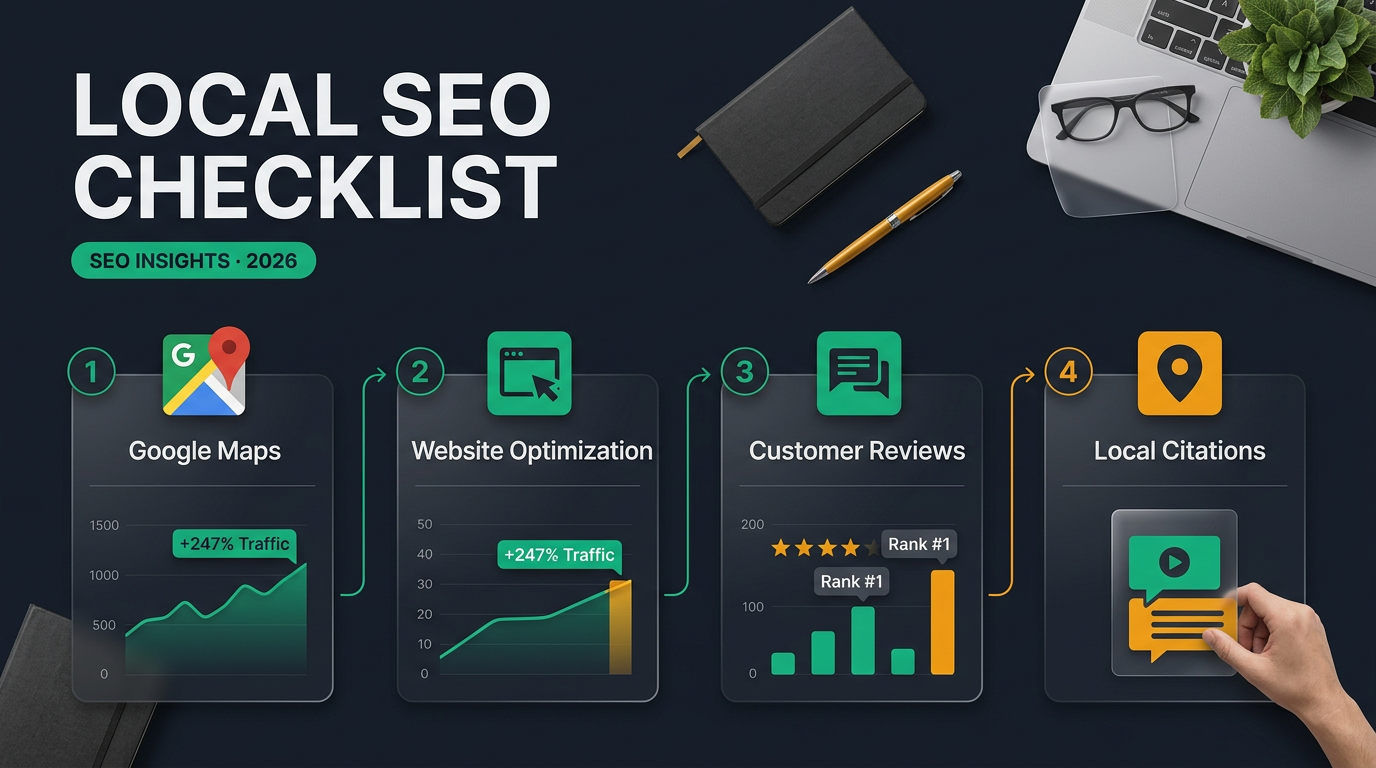
Forget everything else for a moment. If you only do one thing from this entire local SEO checklist, it should be optimizing your Google Business Profile (GBP). Your GBP is your digital storefront, your virtual billboard on Google Maps, and the single most critical element for ranking in the local pack (the map results at the top of Google). Getting this right is not optional; it's the price of entry for local visibility in 2026.
A sparse, unloved profile is a red flag to Google and a turn-off for customers. A fully optimized profile, however, tells Google you are active, legitimate, and relevant to local searchers. It's a living profile that needs consistent attention. As one guide from Virtual Stacks points out, your GBP is the cornerstone of local SEO. Treat it like one.
Your GBP Optimization Checklist:
- Claim and Verify Immediately: Use Google's standard verification process. Expect video verification to be common in 2026, where you'll need to show your storefront, business license, and branded vehicle to prove your legitimacy. Get this done first.
- Perfect Your Core Information (NAP+W): Your Name, Address, Phone Number, and Website must be 100% accurate and absolutely identical to the information on your website and other online directories. No variations like "St." vs "Street".
- Choose Categories Wisely: Your primary category is crucial. It unlocks specific GBP features and tells Google your main function. For example, selecting "HVAC Contractor" over a generic "Contractor" makes a huge difference. Use all relevant secondary categories to capture more niche searches.
- Utilize Every Feature: Fill out everything. Add your products, list your services with detailed descriptions and prices, enable the direct messaging and booking features, and upload high-quality photos and videos weekly. The more data you give Google, the more it trusts and rewards you.
- Seed Your Q&A Section: Don't wait for customers to ask questions. Proactively add your own frequently asked questions and provide thorough answers. This allows you to control the narrative and naturally include important keywords about your services, hours, and policies.
- Leverage GBP Posts Daily/Weekly: Treat GBP Posts like social media. Post updates, offers, events, and news at least once a week. These posts expire, so consistent activity shows Google your business is active and engaged.
On-Page SEO: Turning Your Website into a Local Authority
Your Google Business Profile and your website are a team. Your GBP gets the initial attention, but Google uses your website to confirm the details, understand the depth of your services, and gauge your authority. If your website is a mess—slow, not mobile-friendly, or vague about your location—your local rankings will suffer, no matter how great your GBP is.
Think of your website as the central hub for all your local signals. It's where you can expand on the information in your GBP and prove you are the best choice for customers in your specific service area. Optimizing your site's pages is a fundamental part of any serious local campaign, as detailed in this comprehensive field guide.
Your On-Page Local SEO Checklist:
- Integrate Local Keywords Naturally: Don't just target "plumber." Target "emergency plumber in downtown San Diego." Include these city- and neighborhood-specific keywords in your page titles, meta descriptions, headlines (H1s, H2s), and throughout your page content.
- Create Location-Specific Service Pages: If you serve multiple towns or neighborhoods, create a dedicated page on your website for each one. For example, `your-plumbing.com/scottsdale-leak-detection` and `your-plumbing.com/phoenix-leak-detection`. These pages should have unique content about that specific area, not just swapped city names.
- Embed Your GBP Google Map: On your contact page and in your website's footer, embed the HTML of your actual Google Business Profile map. This creates a powerful and direct signal that connects your physical address to your website.
- Implement Local Business Schema: Schema markup is code that helps search engines understand your content. Specifically, `LocalBusiness` schema explicitly tells Google your NAP, hours, and business type in a language it can easily process. This is crucial for appearing in rich results and being understood by AI-driven search, a key focus for 2026.
- Ensure NAP is Crawlable Text: Make sure your business name, address, and phone number are listed as plain HTML text in the footer of every page on your site. Do not use an image for this information, as search engines can't read it. Make the phone number click-to-call.
Citations and Directory Management: The Consistency Game
A citation is any online mention of your business's Name, Address, and Phone number (NAP). Think of them as digital footprints across the web. Google uses these footprints to verify your location and business identity. The more consistent and authoritative these footprints are, the more confident Google becomes in your listing, and the higher you're likely to rank.
The goal is not to be everywhere, but to be everywhere that matters, and to be perfectly consistent. Inconsistencies—like an old address, a tracking phone number, or a slightly different business name—confuse search engines and erode trust. Your first step should be an audit to find and fix these errors. Then, you can focus on building new, high-quality citations.
Your Citation Management Checklist:
- Secure Tier-1 Directory Listings: These are the major data aggregators and high-authority platforms. Ensure your business is listed correctly on:
- Google Business Profile (the most important one)
- Bing Places
- Apple Maps
- Yelp
- Build Industry-Specific Citations: These niche directories carry significant weight because they are highly relevant. Examples include Houzz or Angi for home services, TripAdvisor for hospitality, or Zocdoc for medical professionals. Find the top 3-5 directories for your specific industry and get listed there.
- Find and Replicate Competitor Citations: Use an SEO tool or manually search for where your top-ranking local competitors are listed. If a directory is important enough for them, it's important enough for you. This helps close the gap and ensures you aren't missing any key opportunities.
- Perform a Citation Audit & Cleanup: Use a service like BrightLocal or Semrush, or manually search for your business name and variations, to find all existing citations. Create a spreadsheet and meticulously correct any inconsistencies. This is a tedious but vital task for a clean local SEO foundation.
Reviews: Your Most Powerful Social Proof and Ranking Factor
In 2026, reviews are non-negotiable. They are the most potent combination of a direct ranking factor and a conversion factor. Google's own data shows that businesses with a higher quantity of recent, positive reviews rank better in the local pack. More importantly, real customers use them to decide whether to contact you or your competitor.
A proactive review strategy is no longer a "nice to have"; it's a core business function. You need a system for generating new reviews and a process for responding to them. This creates a virtuous cycle: more reviews lead to higher rankings, which leads to more customers, who then leave more reviews.
Your Review Strategy Checklist:
- Systematize the "Ask": Don't just hope for reviews. Build the request into your process. The best time to ask is right after a successful job or positive customer interaction. Use tools like a custom GBP review link generator and send it via email or SMS (with permission). In-store, use QR codes on receipts or signs.
- Respond to Every Review—Quickly: Respond to positive reviews with gratitude and personalization. Respond to negative reviews with professionalism, empathy, and an offer to resolve the issue offline. Your public response is not just for that one customer; it's for every future customer who reads it.
- Encourage Descriptive Feedback: When you ask for a review, gently guide the customer to be specific. A review that says "Great service" is good. A review that says "They fixed my leaking pipe in our downtown apartment quickly and professionally" is SEO gold because it contains valuable keywords and location signals.
- Showcase Reviews on Your Website: Use a widget or plugin to automatically display your latest 5-star Google reviews on your homepage or service pages. This builds immediate trust and social proof for visitors who land on your site.
Creating Hyper-Local Content & Building Local Links
If you've mastered the first four sections, you're ahead of 90% of your competitors. This final section is how you build an unassailable moat around your business and dominate the local search landscape. Creating content specifically for your local community and earning links from other local entities establishes you as a true local authority, not just another business.
A link from another website is like a vote of confidence. A link from a relevant, local website—like the local newspaper, a popular community blog, or the Chamber of Commerce—is a super-vote. These links are hard to get, which is why they are so valuable. The best way to earn them is by becoming a genuine part of your local community and creating content that serves it.
Your Local Content & Link Building Checklist:
- Sponsor Local Events or Teams: Sponsoring a little league team, a local 5k charity run, or a community festival almost always results in a link back to your website from their partners page. It's great for SEO and brand visibility.
- Partner with Neighboring Businesses: Team up with a non-competing business that serves a similar clientele. You can co-host a webinar, write a guest post on each other's blogs, or offer a joint promotion, all of which can generate valuable local links and referrals.
- Create Hyper-Local Resource Guides: Instead of another generic blog post, create "The Ultimate Guide to Dog-Friendly Patios in [Your Neighborhood]" or "A Calendar of Free Summer Events in [Your City]." This type of content attracts links naturally and positions you as a helpful local expert.
- Join and Participate in Local Associations: Your local Chamber of Commerce, Better Business Bureau (BBB), and other business associations often provide a high-authority directory link to members. It's one of the easiest and most valuable local links you can get.
Key Takeaways: Your 2026 Local SEO Action Plan
Tackling local SEO can feel overwhelming, but it's a game of consistent, focused effort. Don't try to do everything at once. Work through this local SEO checklist systematically. Start with the fundamentals and build from there. Small, incremental improvements across these areas compound over time to produce massive results.
- Master Your Google Business Profile: Fill out every single field, keep it updated weekly with posts and photos, and make it the undisputed source of truth for your business information.
- Align Your Website: Ensure your website's on-page elements, from titles to schema markup, clearly signal what you do and where you do it. Create dedicated pages for your most important service areas.
- Enforce NAP Consistency: Audit and clean up your citations across the web. Every mention of your name, address, and phone number must be identical to your GBP.
- Build a Review Engine: Create a simple, repeatable process for generating a steady stream of customer reviews and make it a policy to respond to every single one.
- Become a Local Authority: Move beyond basic SEO by creating hyper-local content and earning backlinks from other local businesses and organizations. This is the ultimate competitive advantage.