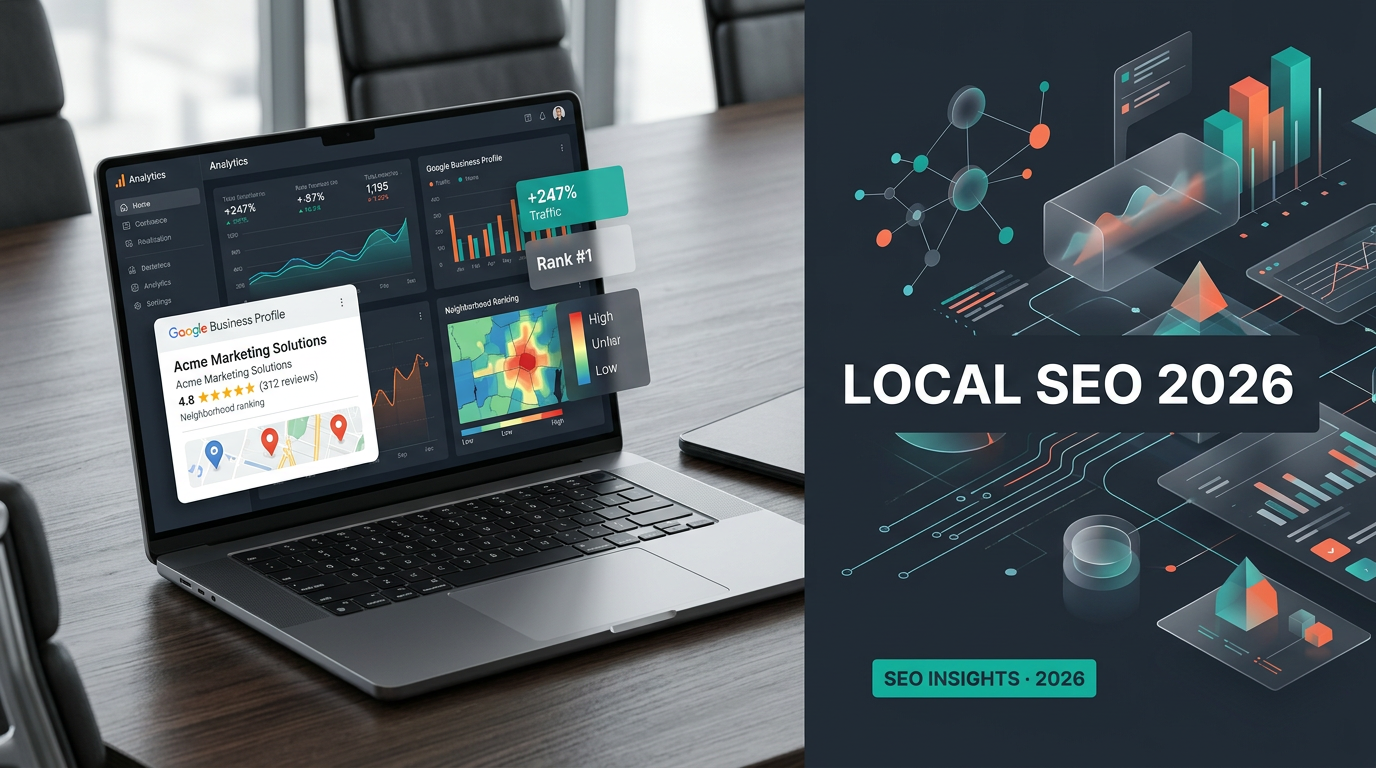
For a local small business — a restaurant, dental clinic, plumber, boutique — ranking in Google's Map Pack is worth more than ranking #1 for a national keyword. Here are the 12 local SEO moves that consistently push small businesses into the top 3 local results, based on what actually works in 2026.
Move 1: Complete your Google Business Profile to 100%
Every field. Categories (primary and secondary), services, products, attributes, business description with keywords, hours (including holidays), phone, website, appointment link. Add at minimum 20 photos across exterior, interior, team, and products. Businesses with complete profiles get roughly 7x more clicks. This is the single highest-leverage local SEO move.
Move 2: Choose your primary category carefully
Your primary GBP category is the strongest single ranking factor for Map Pack visibility. Do not be vague. "Restaurant" is worse than "Italian restaurant." "Contractor" is worse than "Concrete contractor." Google offers thousands of categories — pick the most specific one that accurately describes your core service. Then add secondary categories for adjacent services.
Move 3: Get reviews consistently and reply to every one
Volume, velocity, and recency all matter. A business with 200 reviews from 3 years ago loses to one with 80 reviews from the last 6 months. Automate review requests via SMS after every transaction. Reply to every review — positive and negative — within 24 hours. Use natural language that mentions the service they received; this creates keyword-rich content Google reads.
Move 4: Post weekly Google updates
GBP posts (offers, events, updates) are one of the most under-used ranking signals. Businesses that post weekly consistently outrank identical competitors that don't. Post specials, new products, seasonal reminders, community involvement. Each post is another content signal telling Google you are active.
Move 5: Build citations on the sources that still matter
Not all citations are equal in 2026. Focus on: Apple Maps, Bing Places, Yelp, Facebook, industry-specific directories (Healthgrades for medical, Avvo for legal, Houzz for home services), and local Chamber of Commerce. Skip the low-quality citation packages — they do more harm than good. Ensure NAP (Name, Address, Phone) is byte-identical across every source.
Move 6: Create location-specific landing pages
If you serve multiple neighborhoods or cities, build a unique page for each with genuinely different content: local landmarks, neighborhood-specific service details, embedded Google Map, local testimonials. Cookie-cutter pages with only the city name swapped get filtered as doorway pages.
Move 7: Earn local backlinks
Local links carry disproportionate weight for Map Pack ranking. Sponsor a local sports team, partner with a nearby non-profit, host a workshop and get press coverage, join local business associations. Five links from local newspapers, chambers, and community sites outperform 50 generic directory listings.
Move 8: Optimize for "near me" and voice search
Voice searches are inherently local. Structure content to answer conversational questions: "Is there a 24-hour pharmacy near me?" becomes an FAQ on your site. Use natural language, include neighborhood names, and add FAQPage schema. This also improves your AEO for local queries handled by ChatGPT and Google Assistant.
Move 9: Get on-page basics right
Every page should have: the city name in the title tag, an address in the footer with LocalBusiness schema, service pages that explicitly mention the geographic area served, and at least one embedded Google Map on the contact or service area page.
Move 10: Photos and videos as ranking signals
Businesses that upload new photos weekly to their GBP see measurably higher click-through rates. Short-form videos (under 30 seconds) uploaded directly to GBP are increasingly weighted. Show real customers (with permission), your team, your process, and your space. Authenticity outperforms polish.
Move 11: Q&A section on Google Business Profile
The Q&A section is public. Anyone can ask a question about your business — including competitors trying to plant misleading info. Seed it yourself: post the 10 most common questions you receive and answer them with keywords. This becomes rankable content that also stops bad-faith questions from appearing first.
Move 12: Track the right local metrics
In GBP Insights: search views, discovery searches, direction requests, phone calls, website clicks. In Search Console: impressions on local-intent queries. Monthly cadence. If direction requests are climbing while calls are flat, your listing is working but your website is failing to convert — a fixable, specific problem.
Wrapping up
Local SEO in 2026 is still winnable by any small business willing to be consistent. There is no algorithmic secret — just twelve unglamorous moves executed weekly. Businesses that show up in the Map Pack are the ones that treat their Google Business Profile like a full-time storefront, because it is.