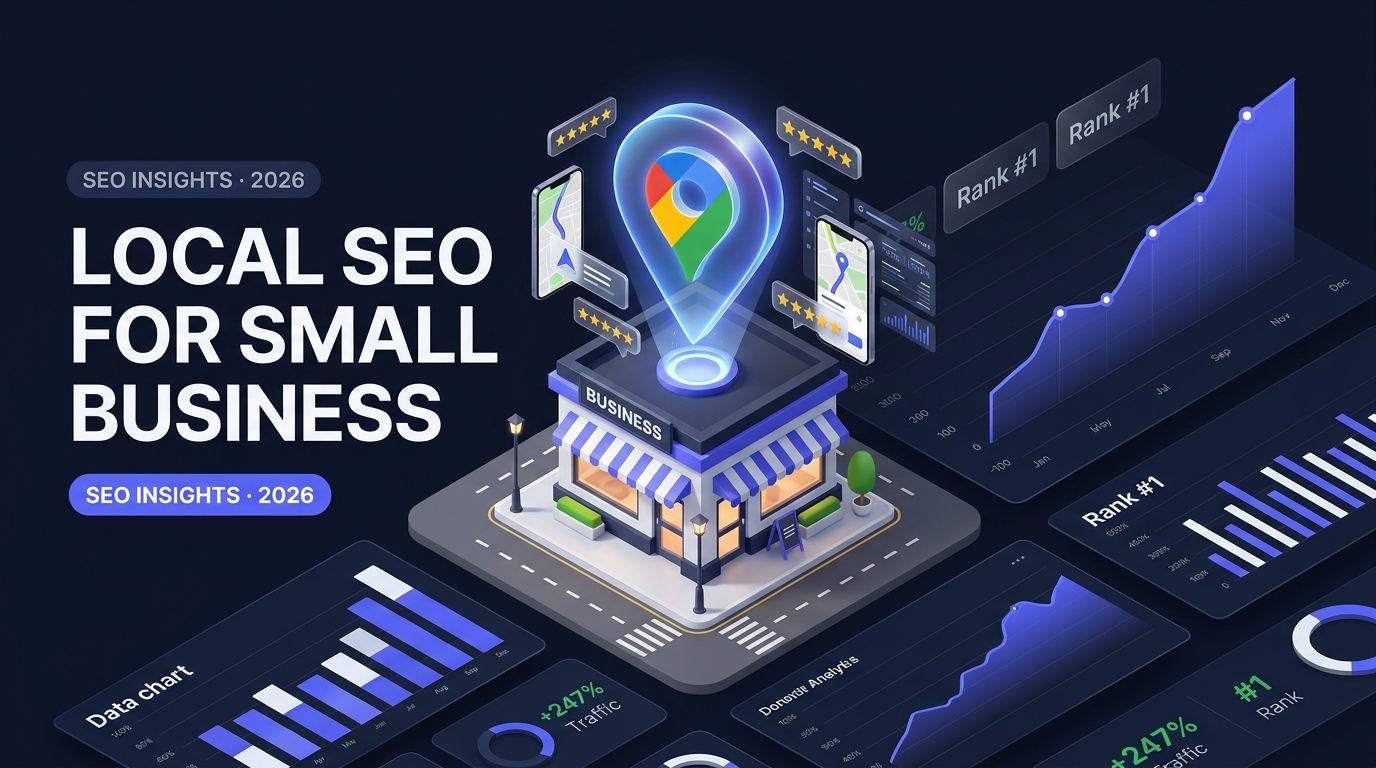
Securing prime digital real estate has become the single most reliable growth driver for independent companies. Implementing effective local seo for small business is no longer just about having an online business card; it is about guaranteeing that your storefront or service vehicle appears at the precise moment a qualified local prospect reaches for their phone with buying intent.
When prospective buyers search for services in your geographic area, they rarely scroll down to traditional organic results. Instead, their eyes lock onto the Google Map Pack—the high-converting 3-pack of local listings displayed alongside an interactive map. If your company is not ranking in those top three positions, your closest competitors are capturing virtually all the high-intent phone calls, booking requests, and foot traffic.
The Anatomy of the 2026 Google Map Pack
Google evaluates local businesses using three primary algorithmic pillars: relevance, distance (proximity), and prominence. Understanding how these pillars interact is critical before adjusting a single setting in your marketing dashboard. Proximity measures how close your verified business address is to the searcher or the geographic centroid of the search query. While you cannot physically move your storefront to chase every mobile user, you can decisively influence relevance and prominence.
Relevance determines how well your business profile and website content match what a user is actively searching for. Prominence reflects how well-known, trusted, and authoritative your business appears across the digital ecosystem. In recent years, local search has shifted from simple keyword matching to deep entity verification. As highlighted by local search strategist Sam Sarsten in his breakdown of local SEO for beginners, search engines prioritize brands that establish unambiguous authority: telling the algorithm exactly what you do, where you do it, and proving customer satisfaction through verified data.
Furthermore, conversational AI engines like ChatGPT Search, Perplexity, and Google Gemini now index Google Business Profiles and local web pages to answer localized voice and chat prompts. When an AI agent recommends a local provider, it relies on structured data, review sentiments, and verified local prominence. Ranking in the Map Pack directly secures your visibility across both traditional map interfaces and emerging conversational discovery platforms.
Step 1: Mastering Your Google Business Profile (GBP) Foundation
Your Google Business Profile (GBP) is the nucleus of your local visibility. An incomplete or poorly categorized profile will neutralize even the most expensive website designs. Securing top placement requires meticulous setup and ongoing management rather than a one-time setup checklist.
The single most powerful lever within your GBP dashboard is your Primary Category. Google weighs this field above almost every other on-profile element. If you operate an HVAC business, setting your primary category to "HVAC Contractor" instead of generic "Air Conditioning Contractor" can dramatically alter which queries trigger your profile. Audit the top three ranking competitors in your target territory to determine which primary category Google favors for your core money keywords.
- Category Architecture: Select one hyper-accurate Primary Category, followed by 3 to 5 Secondary Categories that reflect your secondary revenue streams. Avoid adding irrelevant categories, as diluted categorization weakens your topical focus.
- Name Integrity: Keep your business name identical to your real-world legal entity or registered DBA. Do not stuff keywords or city names into your title unless they are legally registered. Algorithmic filters and competitor redressal complaints routinely trigger suspensions for keyword-stuffed titles.
- Complete Data Attributes: Populate every available field, including service zones, specialized attributes (e.g., wheelchair accessible, veteran-owned), detailed service descriptions with realistic price ranges, and verified business hours.
- Visual Proof: Upload high-resolution, unedited photos of your physical facility, staff, branded vehicles, and completed work weekly. Profiles with active, geo-consistent image uploads experience higher engagement signals, which Google rewards with expanded Map Pack coverage.
Step 2: On-Page Architecture — Telling Search Engines What You Do and Where
Many business owners mistakenly believe that Map Pack rankings depend solely on the Google Business Profile dashboard. In reality, Google cross-references your listing with the website linked to your profile. The organic strength and geographic architecture of your website heavily dictate how far your Map Pack pin reaches across your city.
To build topical and geographic relevance, you must abandon single-page service summaries. Create a dedicated page for every distinct service you offer, as well as distinct location pages if you serve multiple distinct towns or suburbs. For example, a plumbing business should not rely on a single "Services" page; it requires separate, fully developed URLs for drain cleaning, water heater repair, and pipe relining.
- Localized URL and Content Hierarchy: Structure your URLs logically (e.g.,
domain.com/locations/seattle-plumbinganddomain.com/services/water-heater-repair). Ensure each page includes local customer testimonials, project summaries, and regional references rather than generic boilerplate copy. - Schema Markup Implementation: Deploy nested JSON-LD structured data on your website. Use the
LocalBusinessor specific subtype schema (such asDentist,Plumber, orLegalService) specifying your exact legal name, address, phone number (NAP), geo-coordinates, opening hours, and service catalogs. - Strategic Internal Linking: Link your localized service pages directly to your primary location pages using natural, location-specific anchor text. Embed your official Google Maps listing onto your primary contact and location pages to reinforce entity alignment.
Discussions surrounding localized web structures within marketing communities—including practical breakdowns shared on Reddit's digital marketing community—consistently show that sites with comprehensive geographic content outrank thin websites on local map searches by significant margins.
Step 3: Engineering Review Velocity and Neighborhood Geo-Spread
Google’s algorithm has evolved past simply tallying overall star ratings. To conquer local search in competitive markets, small businesses must master review velocity (how consistently you collect new reviews) and review sentiment (the natural inclusion of service terms and neighborhood names inside customer feedback).
Proximity is an unbendable barrier if your business remains static; searchers 10 miles away will naturally see closer competitors unless your prominence is overwhelming. The primary way to break out of your immediate geographic boundary on local geo-grid rank trackers is by acquiring genuine reviews from customers spread across target neighborhoods. When a customer writes, "They fixed our AC unit in North Park the same afternoon," Google extracts semantic proof that your services reliably extend into North Park.
- Implement an Automated Review Funnel: Send automated SMS or email requests within two hours of completing a job or transaction. Friction kills response rates, so supply a direct shortlink to your GBP review form.
- Prompt Descriptive Feedback: Train your service technicians or front-desk staff to ask open-ended questions that prompt descriptive responses. Ask: "Would you mind mentioning which service we provided and which neighborhood we visited you in?"
- Respond Professionally to Every Review: Reply to all reviews within 48 hours. Integrate natural service keywords and regional context into your public responses (e.g., "Thank you for trusting our team with your roof replacement in Lakewood!"). For negative reviews, address concerns calmly and offer an offline resolution path to demonstrate proactive customer care.
Step 4: Building Local Citations and Entity Backlinks
Consistency across the broader web acts as an external verification mechanism for Google. If your Name, Address, and Phone number (NAP) vary between major directories and industry databases, search engines lose confidence in your data, suppressing your Map Pack visibility.
The era of buying hundreds of cheap, automated directory submissions is over. Modern local SEO requires authoritative, accurate citations from primary data aggregators and high-trust, locally relevant platforms. A citation on your local Chamber of Commerce website or an established regional trade directory delivers vastly more ranking impact than dozens of low-quality spam directories.
Small business local search victory is not won by volume; it is won by local relevance and data consistency. A single editorial backlink from a neighborhood news outlet or charity sponsorship will elevate your map pack ranking far faster than generic link building packages.
Prioritize your citation profile in distinct phases:
- Primary Data Aggregators: Ensure your NAP data is cleanly registered with foundational platforms like Data Axle, Neustar Localeze, and Foursquare, which syndicate business records across navigation apps, GPS devices, and in-car systems.
- Tier-1 Online Directories: Claim and harmonize your listings on Apple Maps, Bing Places, Yelp, YellowPages, Better Business Bureau (BBB), and industry-specific hubs (such as Avvo for lawyers, Houzz for remodelers, or Healthgrades for physicians).
- Hyper-Local Backlink Acquisition: Sponsor local youth sports teams, partner with neighboring non-competing businesses for joint promotions, join regional business alliances, and pitch stories to local journalists to earn genuine neighborhood-level links pointing directly to your localized landing pages.
Step 5: Optimizing for AI Overviews and Voice Search Readiness
Voice assistants and AI discovery systems increasingly process multi-condition queries like: "Find a reliable emergency plumber near me that is open past 8 PM and takes commercial jobs." Meeting these search requirements requires your business data to be machine-readable, precise, and transparent across every digital channel.
AI models synthesize listings by assessing both your GBP attributes and the raw text on your web pages. If your GBP says you are open 24/7, but your website's contact page states your office closes at 5:00 PM, AI-driven search features may discard your business as a recommendation due to conflicting information.
- Publish Clear Pricing and Policy FAQs: Create an FAQ section on each core service page marked up with
FAQPageschema. Answer pricing methodologies, service guarantees, emergency availability, and exact service boundaries in concise, declarative sentences. - Align Your Digital Footprint: Verify that operating hours, accepted payment methods, and specific service licenses remain identical across your website, GBP, social profiles, and directory listings.
- Target Conversational Intent: Write website copy that mirrors natural speech patterns. Instead of targeting only short-tail keywords like "HVAC repair," answer conversational questions like "How fast can an HVAC technician arrive for emergency heating repair in downtown?"
Key Takeaways for Dominating Local Search
- Treat GBP as a Primary Asset: Select the most accurate primary category, avoid keyword stuffing in your legal business name, and upload weekly high-resolution operational photos.
- Build Out Service and Location Pages: Create individual, high-value pages on your website for every service and territory, supported by clean
LocalBusinessJSON-LD schema markup. - Prioritize Review Velocity and Context: Collect reviews systematically via post-job automation, encouraging clients to mention specific services and neighborhoods.
- Maintain Absolute NAP Consistency: Submit clean data to core aggregators, industry directories, and prioritize locally relevant backlinks over sheer link volume.
- Format for AI Search Engines: Resolve data discrepancies across platforms and use direct, conversational answers to capture emerging AI-driven local discovery.