Local SEO for Small Businesses: 7 Essential Steps to Dominate Nearby Searches
Is your small business struggling to connect with customers right in your neighborhood? In today's digital-first world, the battle for local foot traffic and service calls is won online, often within the top three results of a Google search. If you’re not visible there, you’re effectively invisible to the majority of potential customers actively looking for what you offer. For any brick-and-mortar store or service-area business, a powerful local SEO small business strategy isn't just a marketing tactic—it's a fundamental requirement for survival and growth.
Forget vague advice and outdated checklists. The local search landscape is more competitive than ever, and Google's algorithm is smarter, prioritizing businesses that provide the most direct, trustworthy, and comprehensive answers. This guide provides seven essential, up-to-date steps for 2026 that you can implement right now to climb the local rankings, attract more qualified customers, and solidify your place as the go-to provider in your community.
Step 1: Master Your Google Business Profile for 2026
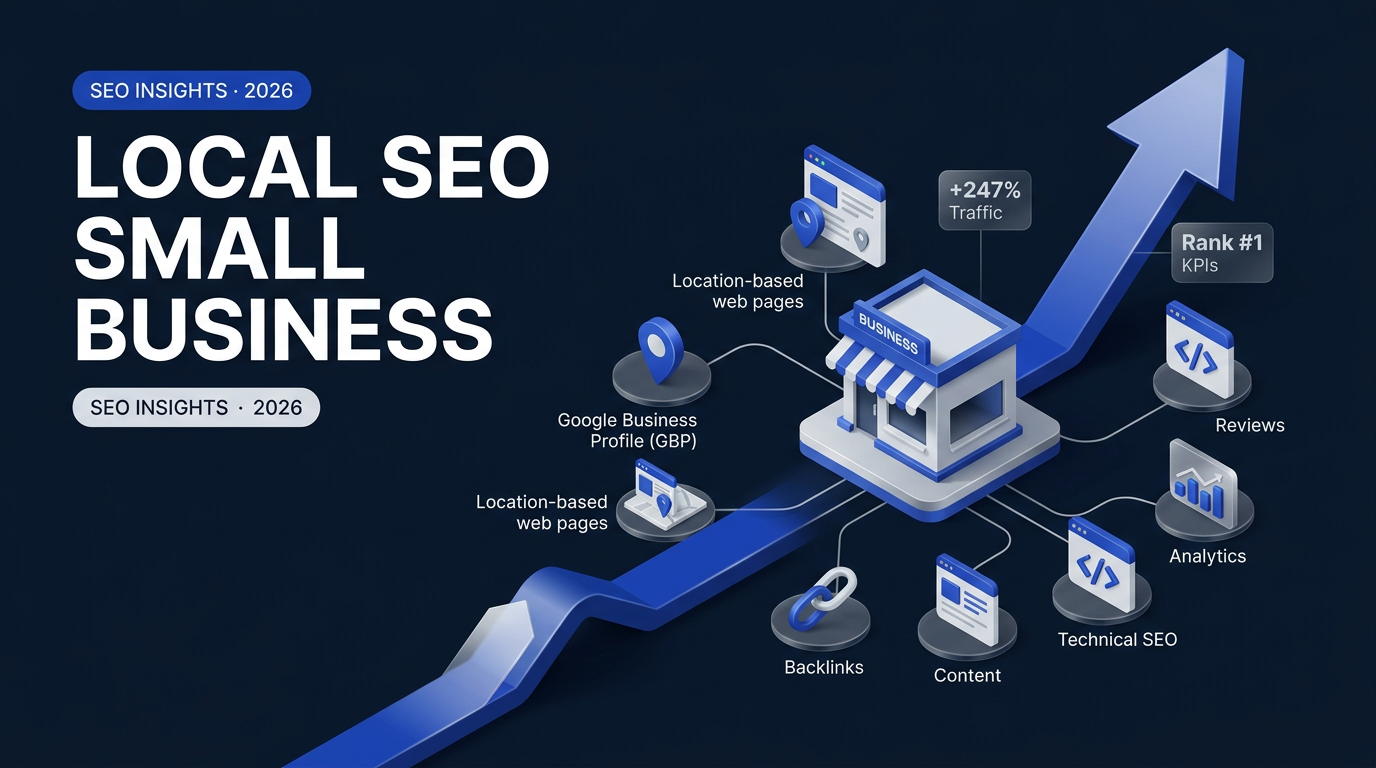
Your Google Business Profile (GBP) is no longer a simple digital business card; it's an interactive, dynamic storefront and your single most important local ranking factor. Simply filling out your Name, Address, and Phone number (NAP) is table stakes. To dominate in 2026, you must treat your GBP as a primary communication channel and leverage its advanced features to build trust and relevance before a user even considers clicking to your website.
Go beyond the basics by proactively using Google Posts to announce promotions, events, or new products. Use the Q&A feature to seed your own frequently asked questions and provide thorough, keyword-rich answers. Fully build out your Products and Services sections with high-quality images, detailed descriptions, and prices. In 2026, it's also crucial to select every relevant attribute, from “wheelchair accessible entrance” to more modern ones like “AI-assisted services” or “uses sustainable materials,” as these can surface in filtered searches.
Visuals are paramount. Upload geotagged, high-resolution photos of your storefront, team, and work in action. A game-changer for service businesses is to upload short video walkthroughs of completed projects or a behind-the-scenes look at your process. Finally, make it a policy to respond to every single review—positive and negative—within 24 hours, naturally incorporating relevant keywords into your responses (e.g., “We’re so glad you enjoyed our deep dish pizza here in Chicago!”).
- Primary & Secondary Categories: Be specific. Choose “Wedding Photographer,” not just “Photographer.”
- Services/Products: Detail every single service you offer with descriptions.
- Attributes: Select all applicable attributes; Google adds new ones frequently.
- Photos & Videos: Add new, geotagged media weekly to signal activity.
- Google Posts: Publish at least one post per week.
- Q&A Section: Proactively ask and answer the top 5-10 questions customers have.
Step 2: Build Hyper-Local Landing Pages
A single “Contact” or “Service Area” page on your website is not enough to convince Google of your authority in the specific communities you serve. To truly compete, you must create hyper-local landing pages—dedicated pages on your site for your most important services in your most important neighborhoods or towns. For example, a roofer in Denver should have separate pages for “Metal Roofing Repair in Highlands Ranch” and “Asphalt Shingle Replacement in Aurora.”
These pages signal extreme relevance to Google and the user. Each page should feature unique content tailored to that specific location. Mention local landmarks, cross-streets, or community-specific problems you solve (e.g., “Protecting Boulder homes from high-wind damage”). This demonstrates genuine local expertise, not just keyword stuffing. These pages are powerful assets for ranking in organic results just below the map pack, capturing clicks from users who scroll past the initial map results.
A perfect hyper-local page is a conversion machine. It combines localized SEO with a clear user experience, guiding the visitor from information gathering to taking action. Embed a Google Map of the specific area, include testimonials from customers in that neighborhood, and feature a clear call-to-action (CTA) that’s easy to find.
- Unique URL and Title Tag: Use a structure like `yourwebsite.com/service-location` (e.g., `denverroof.com/roof-repair-aurora`) and a title like “Expert Roof Repair in Aurora, CO | Denver Roofing Co.”
- Localized H1 Heading: Your main heading must include the service and location.
- Unique, Localized Body Content: Write at least 500 words discussing your service in the context of that specific area.
- Local Proof: Include testimonials or project photos from that neighborhood.
- Embedded Google Map: Embed a map centered on the neighborhood or city.
- Clear Call-to-Action: Add a contact form and a clickable phone number.
Step 3: Earn High-Impact Local Citations & Links
A citation is any online mention of your business’s name, address, and phone number (NAP). While ensuring your NAP is consistent across major directories like Yelp, Apple Maps, and Bing Places is crucial, the “more is better” approach to citations is outdated. For 2026, the strategy is quality over quantity. Your focus should be on securing citations and, more importantly, actual links from sources that are highly relevant to your location and industry.
Think beyond generic directories. Is there a well-regarded local blogger who reviews businesses in your niche? A local news site that features community businesses? A professional association for your industry in your state? A link or mention from one of these authoritative sources is worth more than 100 low-quality directory listings. As noted in a helpful guide on mastering local SEO, building local authority is key, and this is where strategic outreach pays off.
Get creative with your local link-building efforts. Sponsor a local charity 5k or a little league team in exchange for a link on their website. Host a free workshop or webinar for the community and partner with the local chamber of commerce to promote it. Collaborate with a non-competing local business on a joint promotion, and link to each other’s websites as partners. These activities not only generate powerful local backlinks but also build real-world brand awareness and goodwill.
- Hyper-Niche Directories: Find directories specific to your industry (e.g., a directory for certified plumbers or wedding vendors).
- Local Sponsorships: Youth sports teams, community events, and school fundraisers often have websites where they thank sponsors with a link.
- Chamber of Commerce & BNI Chapters: Join and get listed in your local chapter’s directory.
- Local News & Blogs: Pitch a story about your business’s unique angle, new hire, or community involvement.
- Host a Local Event: Offer a free class or workshop and list it on local event sites like Eventbrite and community calendars.
Step 4: Create Content That Answers Local Questions
Your potential customers are not just searching for “landscaper near me.” They are asking specific, long-tail questions: “how much does it cost to install a paver patio in Austin?” or “best drought-tolerant plants for Southern California gardens.” Your goal is to create content that directly answers these questions. This positions you as the local expert, builds trust, and captures highly qualified traffic that is often close to making a purchasing decision.
To find these questions, go where locals talk. Browse your neighborhood's subreddit or local Facebook groups. Use free tools like AnswerThePublic and add local modifiers (e.g., “for Chicago homeowners”). Pay close attention to the “People Also Ask” section on Google’s search results for your main keywords. Each of these questions is a potential blog post, FAQ page, or video topic for your business.
Once you have your topics, create in-depth resource guides. A blog post titled “The Ultimate Guide to Choosing a Sump Pump in the Pacific Northwest” is far more valuable than a generic “Sump Pump Services” page. Within your content, include local context, reference local regulations or weather patterns, and link to your relevant service pages. This content strategy fuels your entire SEO effort, providing assets to share on social media, in newsletters, and for link-building outreach.
- Cost-Related Guides: “How Much Does [Your Service] Cost in [Your City] in 2026?”
- Comparison Posts: “[Product A] vs. [Product B]: Which is Better for [Your City] Homes?”
- Seasonal Checklists: “Your Fall Home Maintenance Checklist for [Your Region].”
- Problem-Solving Articles: “How to Deal with [Common Local Problem] in [Your Neighborhood].”
Step 5: Systematize Reviews and User-Generated Content
Reviews are a direct and powerful ranking factor for the local pack. Google uses the quantity, velocity (how frequently you get them), and quality (the star rating) of your reviews to determine your business’s prominence. Simply hoping for good reviews is not a strategy. You need a simple, repeatable system to consistently generate positive feedback from your happy customers.
The best time to ask for a review is immediately after a successful transaction or service completion when the customer's satisfaction is at its peak. Implement a system using email or SMS automation to send a follow-up message a day or two after the service. The message should thank them for their business and provide a direct, single-click link to your GBP review page. Make it as easy as possible for them to leave feedback.
Don't just collect reviews—showcase them. Use a website widget to display your latest 5-star reviews on your homepage and local landing pages. This user-generated content (UGC) serves as powerful social proof. You can also encourage customers to share photos of your work or product on social media using a branded hashtag, creating a stream of authentic content that you can reshare.
- Identify the happy moment: The point of peak satisfaction (e.g., project completion, product delivery).
- Automate the request: Use your CRM, invoicing software, or a dedicated tool to send an email or text 1-3 days later.
- Provide a direct link: Link directly to the “Leave a Review” pop-up on your Google Business Profile.
- Respond to all reviews: Thank customers for their feedback to show you are engaged.
- Showcase positive reviews: Embed a feed of your best reviews on your website.
Step 6: Implement Critical Technical Local SEO Signals
While content and links are crucial, the technical foundation of your website can be the deciding factor that pushes you ahead of a close competitor. Many small businesses overlook these signals, making it a key area of opportunity. The most important technical signal for local SEO is schema markup.
Schema is a type of code (specifically, JSON-LD is the preferred format) that you add to your website's backend to explicitly tell search engines what your content is about. For a local business, you should implement `LocalBusiness` schema. This markup allows you to label your NAP, hours, service area, and even your customer reviews in a way Google can easily understand and trust. This increases your chances of appearing in rich results and reinforces your geographic relevance.
Beyond schema, two other technical factors are non-negotiable for local SEO in 2026: mobile-friendliness and page speed. The vast majority of local searches happen on mobile devices, often when someone is out and about. If your site is slow to load or difficult to navigate on a phone, you will lose that customer. Use Google’s PageSpeed Insights to test your site and follow its recommendations to improve loading times. Ensure your site has a responsive design that looks great on all screen sizes.
- LocalBusiness Schema: Use a tool like Merkle’s Schema Markup Generator to create the code. Include as many details as possible, such as `geo` coordinates and `hasMap`.
- Mobile-First Design: Your website must be fully responsive and easy to use on a smartphone.
- Core Web Vitals: Aim for a “Good” score on Google’s Core Web Vitals report, focusing on loading speed (LCP), interactivity (FID/INP), and visual stability (CLS).
- Crawlable Site Structure: Ensure all your hyper-local landing pages are linked from your main navigation or a primary service area page so Googlebot can easily find and index them.
Step 7: Analyze, Adapt, and Iterate
Local SEO is not a “set it and forget it” project. It’s a continuous cycle of implementation, analysis, and adaptation. Your competitors are constantly working to outrank you, and Google's algorithm is always evolving. Regularly monitoring your performance is the only way to ensure your efforts are paying off and to identify new opportunities for growth.
Your primary tool for analysis will be your Google Business Profile Insights. Pay close attention to the search queries people use to find you—this is a goldmine for new content ideas. Track your performance metrics: How many people found you on Maps vs. Search? How many clicked to call your business? How many requested directions? A month-over-month increase in these actions is a clear sign of success.
For more advanced tracking, use a rank tracking tool that offers local grid reporting. This will show you how your business ranks for a target keyword from various points within your city, block by block. This helps you identify weaknesses in your visibility and can inform where to focus your next hyper-local landing page or content effort. Continuously test elements on your GBP, like your main cover photo or the CTA on your Google Posts, to see what drives the most engagement.
- GBP Insights: Review monthly. Look at search queries, map views, website clicks, and calls.
- Local Rank Tracking: Use a tool with grid tracking to monitor keyword rankings across your service area.
- Google Search Console: Monitor clicks and impressions for your local landing pages.
- Competitor Analysis: Periodically review the GBP profiles and websites of your top 3 local competitors. What are they doing that you aren't?
Key Takeaways
Winning at local SEO in 2026 requires a focused, multi-faceted strategy. By prioritizing these seven steps, your small business can build a powerful moat against the competition and become the obvious choice for customers in your area.
- Optimize GBP Completely: Treat your Google Business Profile as your primary local marketing channel.
- Build Hyper-Local Pages: Create dedicated pages for each service in each target neighborhood.
- Earn Quality Links: Focus on relevant, local link-building opportunities over generic directories.
- Answer Local Questions: Create content that solves your local customers' specific problems.
- Systematize Reviews: Implement an automated process to consistently generate new reviews.
- Fix Technical SEO: Use LocalBusiness schema and ensure your site is fast and mobile-friendly.
- Analyze & Adapt: Constantly monitor your performance and adjust your strategy based on data.