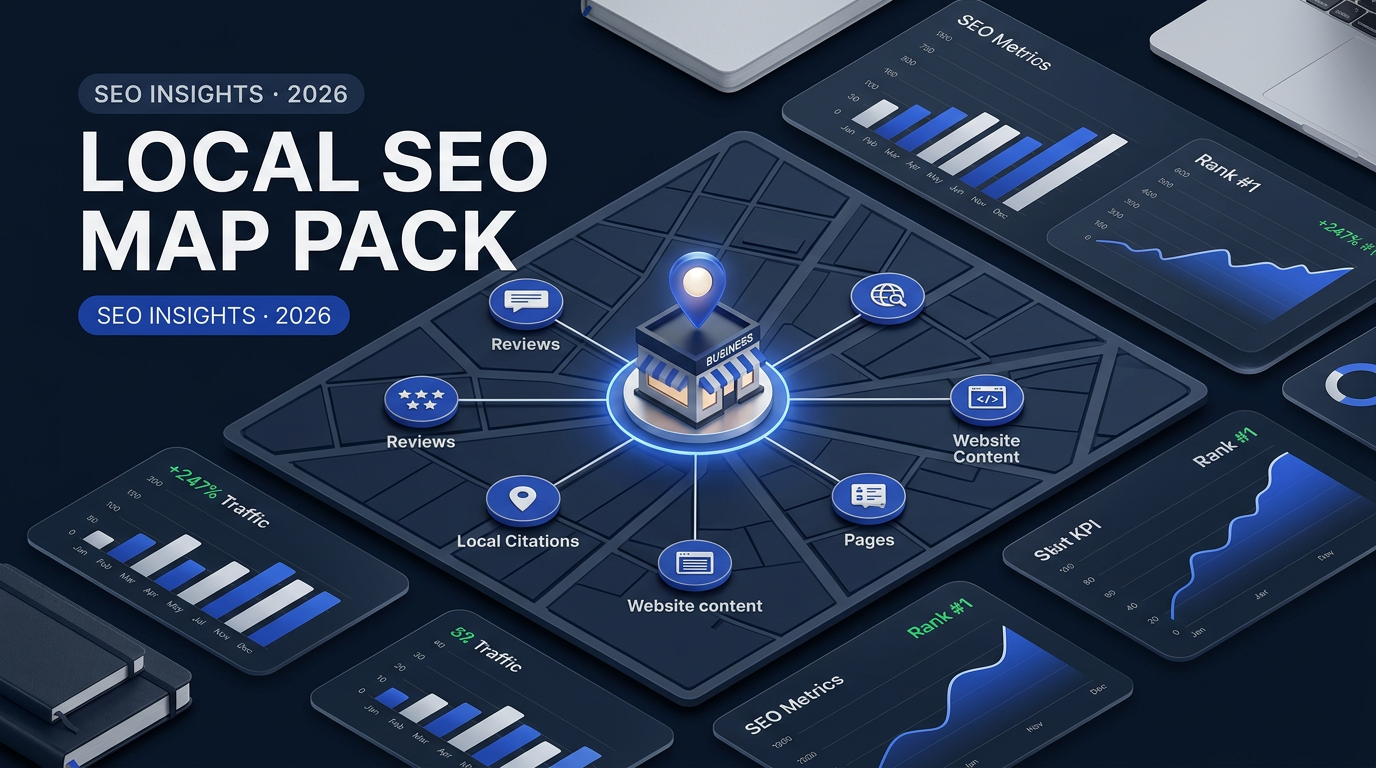
Local SEO Map Pack: Your Small Business Blueprint
Picture this: a potential customer is walking down the street, phone in hand, searching for “coffee shop near me.” A small map appears at the very top of their Google search. Three businesses are listed, complete with star ratings, hours, and a direct link for directions. Is your business one of them? If not, you're missing out on your most valuable, ready-to-buy customers. That coveted space is the digital equivalent of a prime corner storefront, and it's called the Google Map Pack.
For a small business in 2026, mastering the local SEO map pack isn't just a good marketing tactic; it's a fundamental survival strategy. It’s the battleground where you can outmaneuver bigger brands with giant advertising budgets. This blueprint will give you the expert, actionable strategies you need to not just appear, but to dominate that critical space and turn searchers into loyal customers.
What is the Map Pack (And Why It's Your Golden Ticket)?
The Google Map Pack (also known as the "Local Pack" or "3-Pack") is a special search engine results page (SERP) feature that displays the top three local business listings most relevant to a user's search query. It’s that interactive map and list you see above the traditional blue-link organic results. This prime real estate is powered by your Google Business Profile (GBP), formerly known as Google My Business.
Its importance cannot be overstated. In an era of “zero-click searches,” where users find their answers directly on the results page, the Map Pack is often the first and only interaction a customer has with local businesses online. Ranking here means immediate visibility, increased foot traffic, more phone calls, and a direct line to customers at the exact moment they need what you offer. Google determines who gets these coveted spots based on three core pillars: Relevance (how well your profile matches the search), Proximity (how close you are to the searcher), and Prominence (how well-known your business is).
Think of it as Google’s vote of confidence. A spot in the Map Pack tells a user, “We trust this business to solve your problem right now.” The rest of this guide is dedicated to earning that trust.
Foundational Blueprint: Your Google Business Profile in 2026
Your Google Business Profile isn't a static listing; it’s a dynamic, living profile for your business. In 2026, a “mostly filled-out” profile is invisible. You need to treat it like your primary local landing page and use every feature to its fullest. Google's AI is smarter than ever, parsing every piece of data you provide to gauge your relevance.
Start with the basics, but do them with an obsessive level of detail. Your business name, address, and phone number (NAP) must be perfectly consistent everywhere online. Choose the most specific primary category possible (e.g., “Neapolitan Pizza Restaurant” instead of just “Restaurant”), then add every relevant secondary category. From there, it's time to leverage 2026’s advanced features.
These elements are no longer optional for businesses serious about Map Pack visibility:
- Complete All Attributes: Go beyond “woman-owned” or “free Wi-Fi.” In 2026, Google’s AI suggests hyper-specific attributes based on your category and user data, like “AI-assisted menu recommendations” for a tech-forward cafe. Actively check for and select every single one that applies.
- Activate AI-Powered Chat: Google's “Chat with a Business” feature is now a primary contact method. Enable it and, more importantly, pre-load it with high-quality, keyword-rich answers to frequently asked questions. This not only helps customers but also feeds Google's AI with data about your services.
- Leverage Visual Confirmation: Don't just upload photos. Use the specific sections for “Menu,” “Products,” and “Services” and upload high-quality, tagged images for each item. This visually confirms to Google that you do, in fact, offer what you claim.
- Use Google Posts Weekly: Treat Google Posts like a social media feed. Post updates, offers, event announcements, and new blog content weekly. It signals to Google that your business is active and engaged.
Beyond the Basics: Advanced Relevance & Prominence Signals
Once your GBP is a fortress of information, it's time to build your authority across the web. This is where you create a web of signals that all point back to your business, reinforcing to Google that you are a prominent, trustworthy entity in your local area. Many so-called “tricks” to rank higher have been discussed for years, but the core principle has always been about demonstrating local relevance.
Hyper-Local Content Strategy
Your website is a critical tool for proving your local relevance. Don't just create a generic “Services” page. Build out individual pages for each core service, optimized for local search terms. A plumber in Denver should have pages for “emergency plumbing in Capitol Hill,” “water heater repair in Wash Park,” and “drain cleaning in LoDo.” These pages give Google highly specific content to rank for neighborhood-level searches.
Citations & NAP Consistency
Citations are mentions of your business's NAP (Name, Address, Phone number) on other websites. Think of directories like Yelp, Angi, or industry-specific sites. In 2026, the game isn't about the sheer quantity of citations. It’s about the quality and consistency. Your goal is to be listed on major data aggregators and top-tier, relevant local and industry directories with a 100% consistent NAP. Mismatched information erodes Google's trust in your location data.
Earning Backlinks with Local Intent
A backlink is a link from another website to yours. It's a vote of confidence. For local SEO, the most powerful backlinks come from locally relevant sources. One link from the local Chamber of Commerce or a popular neighborhood blogger is worth more than 100 links from irrelevant, generic websites.
- Sponsor a local youth sports team and get a link from their website.
- Host a charity event and get coverage (and a link) from a local news outlet.
- Partner with a complementary, non-competing local business for a cross-promotion that includes links.
- Offer a scholarship to a local high school and get a link from the school's `.edu` website.
Cracking the Proximity Puzzle: Expand Your Radius
Proximity has always been the most challenging ranking factor to influence. If the searcher is five miles away, and your competitor is one mile away, your competitor has a massive advantage. While you can't move your physical store, you can expand the digital borders of your service area. This isn't a new problem—SEOs have been trying to solve the riddle of expanding map pack rankings beyond a few miles for over a decade. The modern solutions are just far more sophisticated.
First, be clear with Google about how you operate. If you're a brick-and-mortar store (e.g., a bakery), your verified address is your service area. If you're a Service Area Business or SAB (e.g., a plumber), you can hide your address and define specific zip codes or cities you serve. Don't try to cheat this—Google will catch on.
Your goal is to build strong relevance signals in the adjacent neighborhoods and towns you want to rank in, proving to Google that you are the best result for customers there, too.
The most effective strategy is to build hyper-local landing pages for these expansion areas. If your physical therapy clinic is in the “Central” neighborhood but you want clients from “Northwood,” create a dedicated page on your site titled “Physical Therapy for Northwood Residents.” This page should feature testimonials from Northwood clients, mention local landmarks, and discuss travel times or routes. This gives Google a highly relevant page to show for a search like “physical therapist in Northwood.” It's about demonstrating legitimate service and connection to that area.
The Trust Factor: Mastering Reviews and User Engagement
Reviews are the currency of local trust. They are a direct, powerful ranking signal and are often the deciding factor for a customer choosing between you and a competitor. A steady stream of positive, recent reviews is non-negotiable for Map Pack success. Your goal should be to build a simple, repeatable process to generate them.
Make it easy for happy customers. Provide a direct link or a QR code to your Google review page on receipts, in follow-up emails, or via text message. A key tactic for 2026 is to actively respond to every single review, positive or negative. In your responses to positive reviews, work in keywords about the service they received (e.g., “We’re so glad you enjoyed our iced vanilla latte and vegan pastry!”). This reinforces your relevance. For negative reviews, a prompt, professional response shows you care and can mitigate damage.
Beyond reviews, Google closely watches user engagement signals. These actions tell Google that your listing is valuable:
- Clicks-to-Call: How many people click the “Call” button on your profile?
- Direction Requests: How many users ask Google Maps for directions to your business?
- Website Clicks: How many people click through to your website?
- Photo Engagement: High views and engagement on your photos signal interest. Keep them fresh and high-quality.
Encouraging this engagement—through compelling Google Posts, great photos, and a complete profile—sends strong positive signals that help you climb the Map Pack rankings.
Key Takeaways: Your Map Pack Action Plan
Feeling overwhelmed? Don't be. Start with the foundations and build from there. Here is your action plan for dominating the local SEO map pack:
- Obsessively Optimize Your GBP: Fill out every single field, enable AI chat, upload high-quality photos to specific categories, and post weekly updates. This is your number one priority.
- Build Hyper-Local Website Content: Create dedicated pages for each service and for each neighborhood you want to rank in. Prove your relevance beyond your physical address.
- Ensure NAP Consistency and Quality Citations: Use a tool to clean up your online business listings. Ensure your Name, Address, and Phone number are 100% consistent everywhere.
- Create a Review Generation Machine: Develop a simple process to ask every happy customer for a review. Respond to all reviews, using keywords naturally in your responses.
- Earn Local Links: Get active in your community. Sponsor, partner, and network to earn powerful backlinks from other local websites.
Mastering the local SEO map pack is an ongoing process, not a one-time fix. But by following this blueprint, you can build a powerful, sustainable presence that puts your small business on the map—literally—and drives real, measurable growth for years to come.