
When your website scales past one million URLs, indexing stops being an organic byproduct of publication and becomes an infrastructure constraint. Mastering enterprise crawl budget management is the dividing line between multi-million-dollar catalog updates generating immediate revenue or languishing undiscovered in server logs for quarters on end.
Search engine spiders do not have limitless compute cycles. As search engines allocate resources among billions of web documents while balancing the computational surge of AI retrieval engines, enterprise architecture must proactively guide, restrict, and accelerate crawler interactions. Here is the technical playbook for engineering 1M+ page platforms to optimize crawl throughput, eliminate bot traps, and maximize indexation efficiency.
The Core Mechanics: Crawl Capacity vs. Crawl Demand
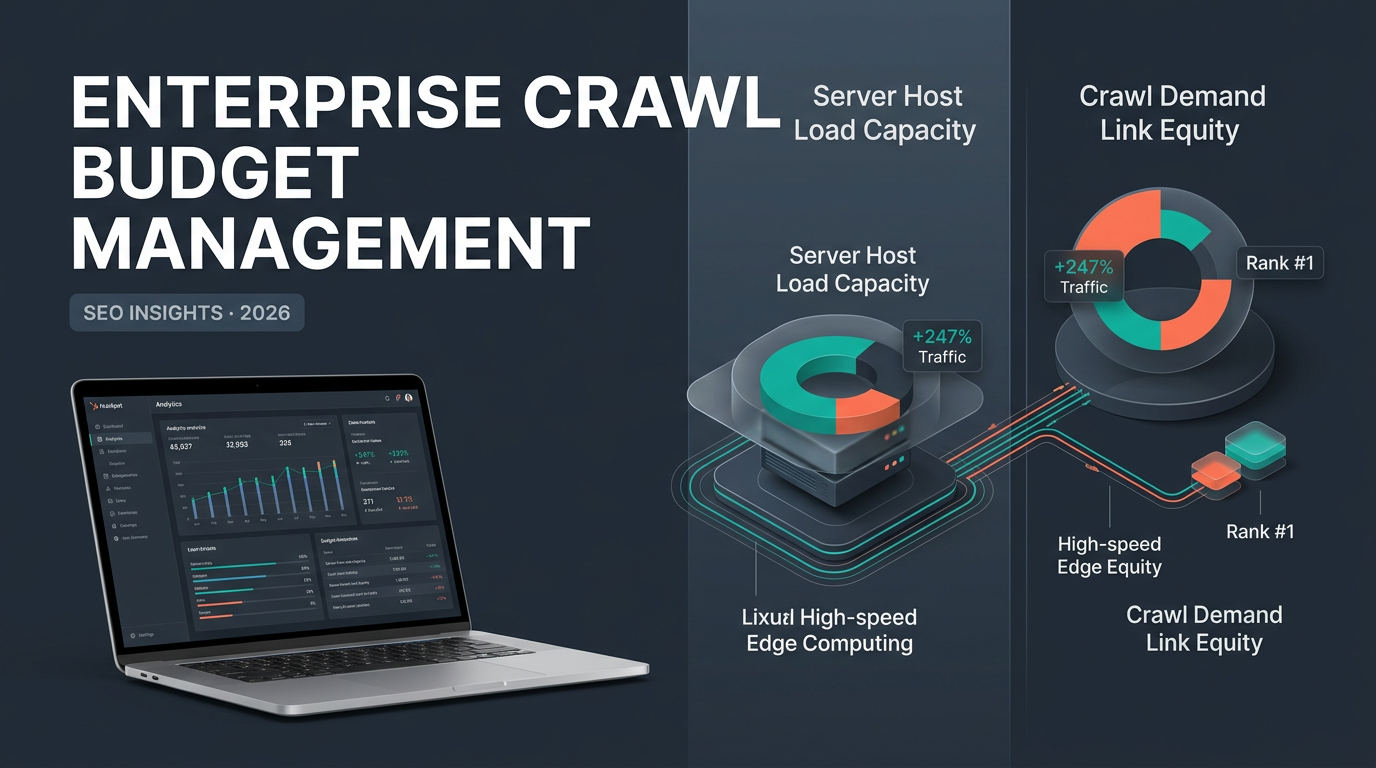
To control search engine behavior, architects must first demystify how bots prioritize infrastructure requests. According to Google's technical crawl budget documentation, crawl allocation is governed by two interacting forces: crawl capacity limit (host load) and crawl demand (interest and freshness requirements).
Crawl capacity limit represents the ceiling of simultaneous requests a crawler issues without degrading server performance. If your origin responds with HTTP 503 errors, spikes past a 600ms Time to First Byte (TTFB), or drops TCP connections, Googlebot throttles its crawl rate immediately. Conversely, sub-100ms response times consistently expand that capacity envelope.
Crawl demand represents the urgency with which crawlers wish to revisit URLs. As analyzed by Conductor's crawl budget reference guide, demand is heavily informed by internal link equity, historical update frequency, external popularity, and real-world search impressions. Enterprise sites typically suffer not from a lack of potential demand, but from squandering high-demand crawl quotas on low-value architectural bloat.
- Host Load Throttling: Triggered by unoptimized database calls, cold cache misses, or bloated rendering pipelines during bot hits.
- Demand Saturation: Occurs when millions of expired, faceted, or parameterized URLs siphon crawler attention away from core business inventory.
- Resource Contention: Caused by unmonitored commercial AI aggregators and SEO spiders competing for the exact same socket pools as commercial search engines.
Edge-Layer Faceted Navigation and Query String Pruning
Faceted search is the primary culprit behind crawl bloat on large-scale e-commerce, travel, and directory websites. A product category with 30 filters, sorting options, and pagination generates combinatorial permutations numbering in the tens of millions—virtually all of which provide zero additive organic value.
Relying exclusively on the robots.txt file or rel="canonical" tags after dynamic parameter generation is a flawed defensive approach. Canonical tags require search bots to fetch and evaluate the full payload before executing the canonicalization directive, burning full fetch capacity on junk URLs. Instead, enterprises must intercept and resolve faceted routing directly at the CDN edge (e.g., Cloudflare Workers, Fastly VCL, or AWS CloudFront Functions).
- Edge Parameter Normalization: Enforce alphabetized query strings and strip non-functional session tracking, UX toggles, and marketing analytics tags (e.g.,
utm_*,aff_id,sort=default) before the request ever touches the origin. - Selective Indexable Faceting: Expose only primary single-attribute filters (such as
/shoes/running/or/shoes/nike/) as static, crawlable HTML links with dedicated SEO metadata. - Client-Side Multi-Select Handling: Convert multi-attribute filtering (e.g., brand + color + size + price range) into asynchronous, non-anchor UI elements or POST requests that crawlers cannot automatically parse into link graphs.
Eliminating the 'Discovered – Currently Not Indexed' Backlog
The dreaded "Discovered - currently not indexed" status in Google Search Console indicates that search engines are aware of your URLs through internal links or XML sitemaps, but their crawl scheduler determined that accessing them would not be an efficient use of system resources. On platforms with over one million pages, this status is an explicit signal of an internal equity deficit.
To clear backlogs exceeding hundreds of thousands of stale URLs, execute an aggressive structural audit. URLs trapped in discovery purgatory typically suffer from a flat internal architecture, poor internal PageRank distribution, or cannibalistic thin content.
"Crawlers will not spend finite capacity rendering pages that mimic the semantic footprint of thousands of existing documents. Indexation rate is intrinsically tied to unique value density."
Implement programmatic hierarchy pruning. If an e-commerce catalog holds 250,000 legacy or out-of-stock product detail pages (PDPs), avoid soft-404 antipatterns. Either serve an explicit 410 Gone status header to release the crawl commitment permanently, or execute clean HTTP 301 redirects to the nearest parent category if historical equity warrants preservation.
Edge Caching, HTTP 304 Optimization, and Conditional Fetching
Every millisecond saved in bot interaction latency preserves host load. Modern enterprise crawl budget management relies on edge caching strategies that serve pre-rendered HTML to verified bot user agents while maintaining sub-50ms TTFB.
A critical, frequently overlooked efficiency lever is the rigorous implementation of conditional HTTP requests using the If-Modified-Since and If-None-Match (ETag) request headers. When a crawler re-evaluates an unmodified document, your server infrastructure must respond with an empty 304 Not Modified status rather than streaming a redundant 150KB HTML document.
- Stale-While-Revalidate Headers: Serve cached static HTML instantly to bots while updating the edge cache asynchronously in the background.
- Bot User-Agent Validation: Use cryptographic reverse-DNS lookups at the edge to verify legitimate Googlebot, Bingbot, and Applebot requests, guaranteeing that optimized server resources are not claimed by spoofed scrapers.
- Prerendering Dynamic Applications: For platforms powered by client-side JavaScript frameworks (React, Next.js, Angular), implement server-side rendering (SSR) or edge hydration. Forcing search engine web rendering services to execute dynamic scripts costs 10x to 20x more compute resources, slowing your site's crawl cadence drastically.
Partitioning Log Files and AI Scraper Ingestion
You cannot manage what you do not measure in real time. Standard analytics suites like Google Analytics provide zero visibility into crawl frequency or bot latency. An enterprise SEO tech stack must include automated log file analysis streaming via pipelines like Datadog, Splunk, or an ELK (Elasticsearch, Logstash, Kibana) stack.
Modern log analysis requires segregating classic search engine crawlers from aggressive LLM retrieval bots (such as GPTBot, ClaudeBot, PerplexityBot, and Common Crawl). If non-indexing AI bots consume 40% of your origin's ingress sockets, your legitimate search engine crawl capacity will drop proportionally.
- Log Ingestion Stream: Configure your CDN or load balancers to write JSON-formatted access logs containing IP address, User-Agent, status code, response time (TTFB), bytes sent, and canonical request URI to a centralized streaming sink.
- Bot Segmentation: Filter logs by validated search bot versus unvalidated scrapers. Calculate daily crawl share, tracking the ratio of 200 OK, 301/302 redirects, 404/410 removals, and 5xx errors by page type (PDP, PLP, content).
- WAF Rate Limiting: Use your Web Application Firewall (WAF) to aggressively rate-limit or drop unauthorized AI scrapers that crawl thousands of uncached dynamic queries per minute, protecting the origin's crawl capacity for search indexing.
Dynamic Sitemaps, Search Engine APIs, and lastmod Integrity
At 1M+ URL scale, XML sitemaps cannot remain monolithic static files updated once a week. They must function as dynamic, modular indexing pipelines organized logically by template type, publish velocity, and business revenue priority.
The most important operational requirement for enterprise sitemaps is strict <lastmod> tag hygiene. Search engines actively downgrade or ignore sitemaps when they detect false positives—such as updating the timestamp across two million URLs simply because a global footer CSS file changed. The <lastmod> tag must strictly reflect meaningful, substantive updates to the underlying on-page content.
- Sitemap Partitioning: Cap XML sitemaps at 10,000 URLs per file (well beneath the theoretical 50,000 URL limit) to simplify correlation with Search Console coverage errors.
- Categorical Segmentation: Separate newly published inventory, core canonical catalog pages, and historical archives into distinct sitemap indexes.
- IndexNow Protocol Integration: For search engines supporting rapid ingest APIs (such as Bing, Yandex, and Naver), trigger immediate push notifications upon critical URL additions or removals.
- Search Console API Automation: Build programmatic feedback loops using the URL Inspection API to sample indexation coverage across large directories, proactively uncovering crawl drops before quarterly reporting reveals traffic loss.
Key Takeaways for 1M+ URL Platforms
- Crawl Capacity is Performance-Driven: Sub-100ms response times and zero 5xx server errors directly increase the upper limits of how many URLs search engines will fetch per day.
- Block Traps at the Edge: Never depend on post-render canonicals to solve infinite faceted search; strip parameters and isolate filter logic using CDN edge computing.
- Respect HTTP 304 Semantics: Accurate ETag and Last-Modified headers allow bots to confirm page freshness with zero document transfer overhead.
- Govern AI Scraper Access: Restrict unmanaged commercial LLM scrapers at the WAF level so they do not starve the origin host load required by core commercial search engines.
- Enforce Squeaky-Clean Sitemaps: Break sitemaps into smaller 10k-URL batches and preserve 100% integrity on
<lastmod>timestamps to maintain crawl trust.