From BERT's Words to MUM's World: The Semantic SEO Evolution by 2026
Remember 2019? Google's BERT update was a seismic shift, forcing us to move from rigid keywords to conversational intent. Fast forward to 2026, and that shift seems like a first step on a much longer journey. Today, the conversation is dominated by AI-driven search, a landscape fundamentally shaped by its powerful successor, the Multitask Unified Model (MUM). If you're still building your digital strategy around the old rules, you're not just falling behind; you're speaking a different language than Google. Mastering MUM BERT SEO isn't just an advanced tactic anymore—it's the baseline for survival and growth.
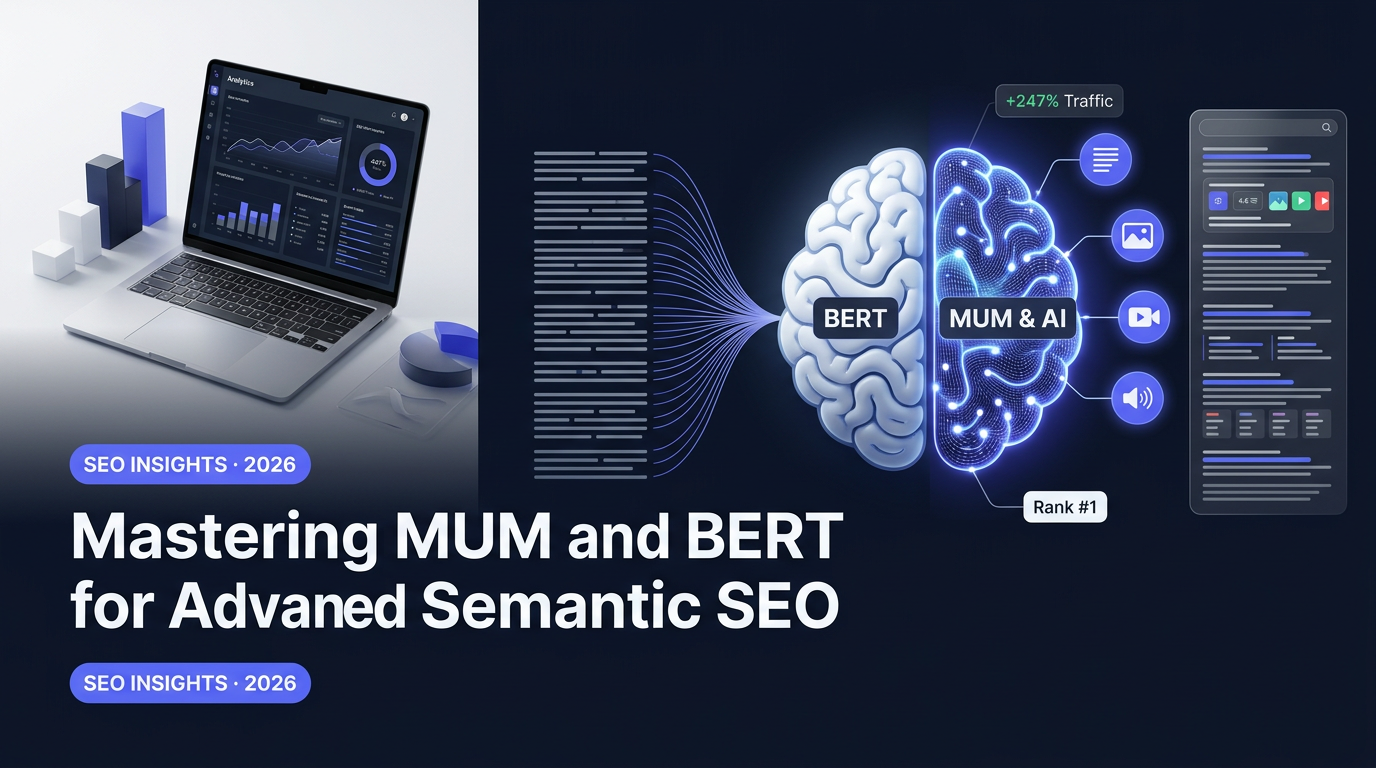
This guide cuts through the historical hype to give you a clear-eyed, actionable roadmap for 2026. We’re moving beyond basic definitions. BERT taught Google to understand the nuances of human language; MUM taught it to understand the complexities of the human world. Think of BERT as your brilliant linguistics professor and MUM as your polymath research guide who is fluent in 75 languages and can interpret charts, videos, and podcasts as easily as text. Your job is to create content that satisfies both.
MUM is Not an "Update"—It's Your New Search Environment
The first mistake many businesses still make is thinking of MUM as a single event, like a traditional algorithm update. It's crucial to reframe this thinking. As early analysis from experts suggested, MUM was never just one update; it was a new technological paradigm. It's the AI foundation that powers many of the advanced features you now see in Google Search, from AI Overviews (formerly SGE) to the incredible capabilities of Google Lens visual search.
Unlike BERT, which primarily focused on improving the understanding of text-based queries, MUM was designed from the ground up to be multimodal and multitask. What does this mean in practice? It means Google can now understand a concept by synthesizing information from disparate sources and formats. It can see a picture of hiking boots, read a forum post about rainy season trails on Mt. Fuji, and listen to a podcast about high-altitude gear, then combine that information to answer a complex query like, "what gear do I need for a fall hike on Mt. Fuji if I'm used to hiking Mt. Adams in the summer?"
This paradigm shift toward a semantic search engine has massive implications. Google isn't just matching keywords to documents anymore. It's building a deep, multi-faceted understanding of topics, or "entities," and using that understanding to directly answer user needs, often without a traditional click-through. Your goal is no longer just to rank; it's to become an indispensable source of information within Google's own understanding of a topic.
Actionable MUM BERT SEO Strategy #1: Mastering Multi-Format Content Ecosystems
In the pre-MUM era, you might have written a blog post. In 2026, that blog post is merely the anchor for a multi-format content ecosystem. To dominate in an AI-driven search environment, you must demonstrate your expertise across different media, all reinforcing a central topic. Google's AI consumes and connects information from text, images, video, and audio; your content strategy must reflect this reality.
Consider a B2B software company selling a project management tool. A 2026 content strategy looks like this:
- The Anchor Post: A comprehensive, long-form guide on "Agile Project Management for Remote Teams." This is your text-based foundation, deeply researched and expertly written.
- The Video Component: An embedded YouTube video demonstrating the key workflows described in the post, showing the software in action. The video's title, description, and transcript are optimized to mirror the concepts in the post.
- The Audio Component: A podcast episode interviewing a known expert on remote agile methodologies. The transcript is published on the same page or a linked page, and key quotes are used in the main article.
- The Visual Component: High-quality infographics in the post that visualize the agile framework. You create a shareable image gallery of project management templates. All images have descriptive alt text and file names related to the core topic.
Each piece of content validates the others. The video demonstrates the concept, the podcast adds third-party authority, and the infographics make the information digestible. This ecosystem signals to Google that you are a comprehensive authority on the topic, making your content the most reliable source to use for generating complex answers in AI Overviews.
Actionable MUM BERT SEO Strategy #2: Building Bulletproof Entities, Not Just Keywords
If there's one concept to tattoo on your marketing brain for 2026, it's entity SEO. An entity is a distinct, well-defined thing or concept: your brand, your CEO, your flagship product, a specific location. Google's goal is to move from a web of strings (keywords) to a web of things (entities). Your job is to establish your brand and its offerings as robust, authoritative entities within this web, known as the Knowledge Graph.
Focusing on entities means you're building brand equity that transcends individual keyword rankings. When Google fully understands *who you are* and *what you are an authority on*, it will surface your content for a vast range of relevant queries, even those that don't contain your target keywords. This is the essence of advanced MUM BERT SEO.
How to build your entity:
- Schema Markup on Steroids: Go beyond basic Organization and LocalBusiness schema. Use `Person` schema for your key executives, `Product` schema with detailed properties, `Service` schema, and `Article` schema. Use the `@id` attribute to link these entities together, creating a machine-readable map of your expertise.
- Create a Definitive "About" Hub: Your about page is no longer a footnote. It should be a hub that clearly defines your company as an entity. It should link out to your founders' profiles (also marked up with schema), major press mentions, awards, and your core topic pages.
- Consistent Digital Footprint: Ensure your Name, Address, and Phone number (NAP) are identical everywhere. But go further: make sure your mission statement, company description, and key product benefits are consistent across your website, your Google Business Profile, LinkedIn, Wikipedia (if applicable), and major industry directories.
- Reinforce with Internal Linking: Use your primary anchor content (like the multi-format ecosystems above) as a hub, and use clear, descriptive internal links from related content back to that hub. This tells Google which pages are the most important for a given topic.
Actionable MUM BERT SEO Strategy #3: Winning the "Complex Journey" Query
At its inception, MUM was demonstrated with a famously complex query comparing hiking two different mountains. As Google initially explained, the goal was to reduce the 8-10 searches a user might perform down to one. In 2026, with AI Overviews becoming a primary feature, this mission is being realized. To win, you must anticipate and answer the entire user journey within a single, cohesive experience.
Stop thinking about a single search intent. Instead, map out the entire *problem-solving journey* for your customer. What is the initial question they ask? What is the follow-up question? What comparisons do they need to make? What do they need to know to prepare? What are the potential pitfalls?
For an e-commerce site selling high-end cameras, this means going beyond a simple product page:
- Initial Query: "best mirrorless camera for travel" -> Create a detailed comparison guide.
- Comparative Follow-up: "Sony A7IV vs Fuji X-T5 for video" -> Build a dedicated page or a detailed block within your guide that directly compares specs, shows sample footage (video!), and includes testimonials (experience!).
- Preparatory Question: "what lenses do I need for a travel camera" -> Create a section on lens ecosystems for each camera, linking to bundle deals or lens guides.
- Post-Purchase Support: "how to clean a camera sensor" -> Offer a detailed tutorial with video, which establishes you as an expert not just during the sale, but after.
By structuring your content this way, you are creating the perfect source material for a rich AI-generated answer. When Google's AI needs to build a response for a complex journey query, it will pull information from the source that most comprehensively covers that journey. Be that source.
E-E-A-T in the Age of AI Search: Your Ultimate Trust Signal
In a world where AI can generate plausible-sounding (but often incorrect) information in seconds, Google's emphasis on Experience, Expertise, Authoritativeness, and Trustworthiness (E-E-A-T) has become more critical than ever. MUM, Gemini, and future AI models are incredibly powerful, but they are information synthesizers, not arbiters of truth. They rely on signals from the web to determine what information is credible, and E-E-A-T provides those signals.
Your content can no longer just be well-written; it must be demonstrably trustworthy. Each claim you make must be backed by evidence, and the creator of that content must be a credible figure. This is your best defense against having your traffic siphoned off by AI Overviews and your best offense for being cited *by* them.
Demonstrating E-E-A-T in 2026:
- Show, Don't Just Tell, Experience: The "E" for Experience is your new superpower. Instead of saying your product is good, show real people using it in real-world scenarios. Include case studies with verifiable data, user-generated content, original photos and videos (not stock imagery), and personal anecdotes from the author.
- Author Bio Supremacy: Every article must have a clear author with a detailed bio. This bio should link to their social profiles (LinkedIn, X/Twitter), other publications they've written for, and a dedicated author page on your site detailing their credentials and expertise.
- Cite Your Sources: Just like a scientific paper, link out to authoritative sources, studies, and data to back up your claims. This shows Google you're part of the trusted academic and expert web.
- Update and Correct: Regularly review your content. Add update notices (`Last updated on...`) and be transparent about correcting any errors. This builds long-term trust with both users and search engines.
Key Takeaways for Your 2026 SEO Roadmap
The era of simple keyword stuffing is ancient history. Thriving in the current search landscape requires a holistic, sophisticated approach. Here's what to prioritize:
- Think Ecosystems, Not Pages: A single blog post is not enough. Build interconnected hubs of content across multiple formats (text, video, audio, images) that comprehensively cover a topic.
- Build Your Brand as an Entity: Focus on entity SEO. Use advanced schema markup, create a strong digital footprint, and build a definitive "About" hub to teach Google exactly what you are an authority on.
- Solve the Entire Journey: Anticipate user needs by mapping out their entire problem-solving journey. Create content that answers the initial query and all the likely follow-up questions in one place.
- Double Down on E-E-A-T: In an AI-driven world, trust is your most valuable asset. Showcase real-world experience, feature credible authors, cite sources, and keep content factually accurate and up-to-date.
- Embrace AI, Don't Fear It: The goal of MUM BERT SEO is not to fight AI Overviews, but to become the trusted source material *for* them. The most authoritative, comprehensive, and trustworthy content will win.