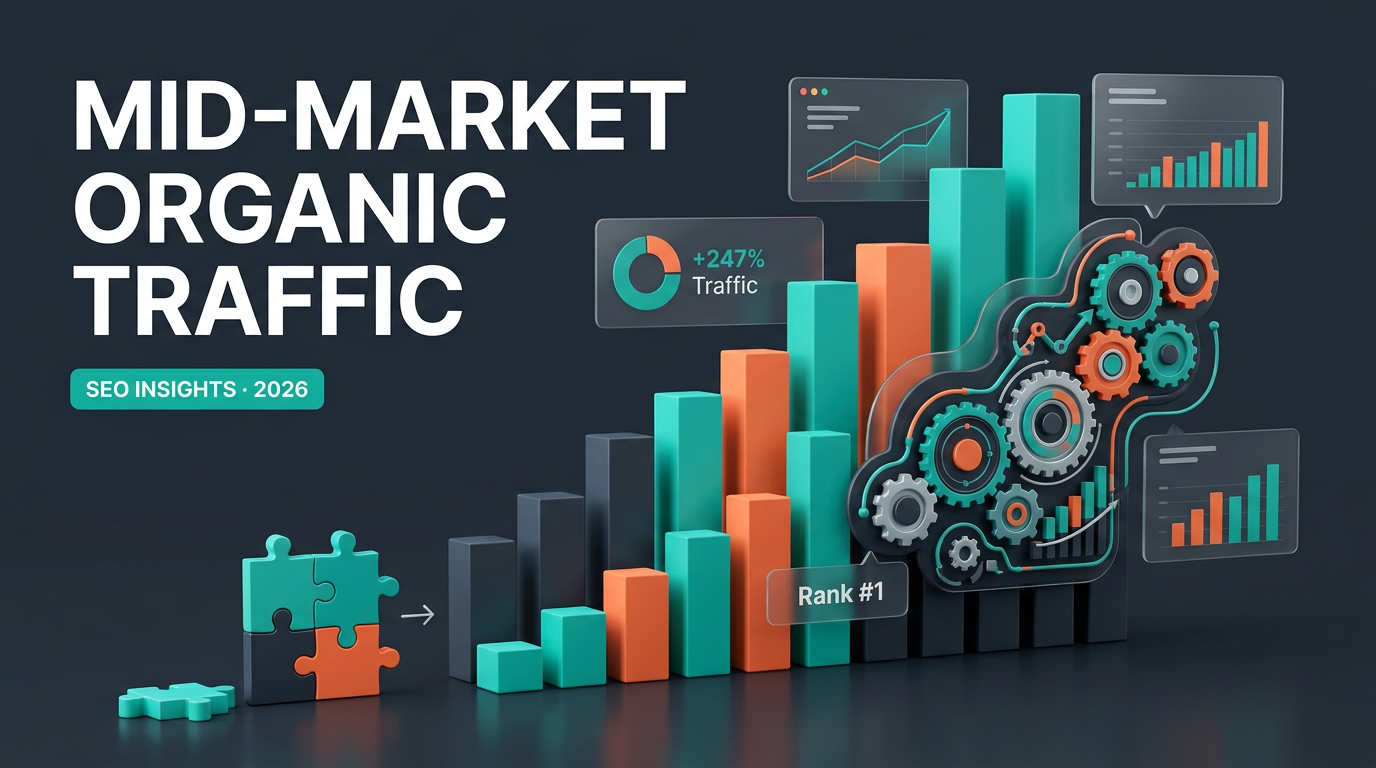
Mid-Market SEO: Scaling Organic Traffic Beyond The Basics
You’ve made it past the startup scramble. You have a product, a team, and a steady stream of customers. But your growth chart, once a steep climb, has started to look more like a gentle slope. Your tried-and-true SEO tactics—keyword-stuffing blog posts, basic link building, fixing 404s—just aren’t moving the needle anymore. Welcome to the mid-market plateau, where scaling mid-market organic traffic requires a complete evolution of your strategy.
This isn’t about doing more of what you used to do; it's about operating on an entirely different level. You're now competing with companies that have bigger budgets and established brands, but you have an advantage they often lack: agility. To win, you must blend the systematic approach of the enterprise with the nimble execution of a startup. This guide outlines the advanced, scalable strategies you need to implement in 2026 to break through the plateau and achieve exponential organic growth.
Why Your Old SEO Playbook Is Failing in the Mid-Market
The strategies that get you your first 10,000 monthly visitors are not the same ones that will get you to 100,000 and beyond. The mid-market playing field has unique challenges. You've likely outgrown basic SEO tooling and small-scale content efforts, but you don't have the nine-figure marketing budget of an enterprise competitor to simply buy your way to the top of the SERPs.
Your old playbook likely focused on high-volume, top-of-funnel keywords. Now, you face immense competition for those terms. At the same time, your product or service offerings have probably become more complex, requiring a more nuanced approach to capture long-tail and mid-funnel intent. Continuing with a generalist content strategy will only lead to diminishing returns and a frustrating lack of traction against more specialized or authoritative players.
In the mid-market, SEO stops being a marketing task and must become an integrated business system. It’s about building scalable engines for content, technical performance, and authority.
Common failure points for mid-market companies include:
- Content Dead Ends: Producing one-off articles that aren't part of a larger, interconnected topic cluster, leaving you with dozens of “orphan” pages that build no cumulative authority.
- Technical Debt: A growing website that has accumulated years of technical issues (e.g., poor crawl budget management, messy redirect chains, inconsistent schema) that now actively hinder performance at scale.
- Manual Overload: Relying on manual processes for tasks like internal linking, on-page updates, and reporting, which are impossible to maintain across a site with thousands of pages.
- Brand Signal Weakness: Underinvesting in activities that build genuine brand authority, leaving you overly reliant on manufactured link-building tactics that search engines are increasingly devaluing.
Systematizing Content with AI-Human Hybrids
By 2026, the debate isn't about if you should use AI in content, but how. The winning strategy is the AI-human hybrid model. This isn't about using generative AI to churn out low-quality articles. Instead, it’s about using AI to handle the 80% of grunt work, freeing up your human experts to focus on the 20% that drives true value: strategy, unique insights, and brand voice.
Instead of creating articles one by one, your goal is to build a “Content System.” This system uses AI for scalable research and production assistance while your team provides the critical strategic oversight. Think of it as an assembly line where AI handles the repetitive tasks and your experts perform the final quality control and customization.
A modern mid-market Content System in 2026 looks like this:
- AI-Powered SERP Analysis: Use AI tools to instantly analyze the top 20 results for a target query. The AI extracts common headings, user intent questions, semantic entities, and data points. This replaces hours of manual research.
- Automated Brief Generation: Based on the analysis, the system generates a comprehensive content brief. This brief includes a target word count, recommended structure, FAQs to answer, and key entities to include.
- Expert-Guided First Draft: Your subject matter expert (SME) or strategist reviews the brief, adding unique angles, proprietary data, or a specific brand narrative. Only then is a first draft generated, often with AI assistance under strict human guidance.
- Human Refinement and Optimization: The crucial final step. Your writer and editor take the draft, inject your brand’s voice, add real-world examples, ensure factual accuracy, and optimize for what we call Generative Snippet Optimization (GSO)—structuring answers to directly influence how Google’s AI Overviews summarize your content. For more on this, consult official guidance on structuring content for AI, like the resources available from Google Search Central.
Mastering Programmatic & Templated SEO
To truly scale mid-market organic traffic, you cannot rely solely on manually created blog posts. Programmatic SEO is the practice of creating hundreds or even thousands of targeted pages at scale by using templates and databases. This isn't about spam; it's about serving highly specific user needs that are too numerous to address manually.
Think about companies like Zillow (city + neighborhood pages), Zapier (app + integration pages), or Yelp (service + location pages). They use programmatic SEO to dominate long-tail search. As a mid-market company, you have unique datasets—product variations, service locations, industry use-cases, software integrations—that are perfect for this approach. The key is to ensure each page offers unique value, not just swapped-out keywords.
To launch a successful programmatic SEO project:
- Identify Your Dataset: What unique data do you possess? It could be product SKUs, geographic service areas, job roles you serve, or compatibility data between products.
- Find Your “Head” and “Tail” Modifiers: Determine the keyword patterns users search for. For example, “{service} in {city}” or “{software} alternatives” or “how to integrate {product A} with {product B}”.
- Design a Value-Driven Template: Your template must be more than just text. Include unique data points, user-generated content like reviews, maps, pricing tables, or comparison charts. The goal is for each permutation to be the best possible answer for that specific query.
- Plan Your Internal Linking: Programmatically generated pages can create a site architecture nightmare if not planned. Create hub pages that link down to the programmatic pages (e.g., a “Services in California” page linking to pages for LA, SF, and SD) and ensure the programmatic pages link back up and to each other where relevant.
Winning with Advanced Technical SEO & Internal Linking
As your site grows, technical SEO becomes less about one-off fixes and more about building a robust, crawlable, and understandable foundation for search engines. At the mid-market level, you need to go beyond basic schema and a clean robots.txt file. Your focus must shift to advanced tactics that give you a competitive edge.
One of the most underutilized assets you have is your internal link structure. A well-planned internal linking strategy can create “moats” around your most important commercial pages, funneling authority from informational content and signaling to Google which pages are your top priority. Instead of randomly linking between posts, you must be surgical. We recommend using a Topic Cluster model, where a central “Pillar Page” covering a broad topic links out to several in-depth “Cluster Pages” on related sub-topics, and all cluster pages link back to the pillar.
Advanced technical initiatives to prioritize in 2026 include:
- Log File Analysis: Analyzing your server logs shows you exactly how Googlebot and other crawlers are interacting with your site. Are they wasting crawl budget on faceted navigation filters or old, unimportant pages? Log files give you the data to optimize crawlability with precision.
- Advanced Schema Markup: Go beyond `FAQPage` and `Article` schema. Implement more specific types like `Product` with `Offer` and `Review` details, `VideoObject`, or even `Action` schema to indicate what users can do on a page. This detailed markup helps search engines understand your content at a deeper level and can unlock rich results.
- Website Performance Audits: Your Core Web Vitals are table stakes now. In 2026, performance optimization means looking at every aspect of user experience, from optimizing image formats with AVIF to implementing speculative prefetching for likely next-page navigations. Tools like PageSpeed Insights are just the starting point.
Building a Defensible Authority Flywheel
Aggressive link building is a short-term game with diminishing returns and increasing risk. To build a lasting competitive advantage, you need to shift from building links to earning them. This means focusing on activities that build your brand's perceived Experience, Expertise, Authoritativeness, and Trustworthiness (E-E-A-T) and generate natural, high-quality backlinks as a byproduct.
This is your Authority Flywheel. It starts with creating something truly valuable and then leveraging it to build brand signals, which in turn makes it easier to create the next valuable asset. For a mid-market company, this is your most defensible SEO moat. Your enterprise competitors are often too slow to be interesting, and startups lack the resources to create truly authoritative content.
Components of an effective Authority Flywheel:
- Create Linkable Assets: This is the fuel. It's not another blog post. It’s a free tool, a data-rich industry report based on your internal data, a comprehensive statistical roundup, or a piece of pillar content so good it becomes the definitive resource on a topic.
- Strategic Promotion & Outreach: Promote this asset to a targeted list of industry journalists, bloggers, and partners who would find it genuinely useful for their audience. The key is relevance, not volume.
- Amplify Expert Voices: Feature your in-house experts (engineers, product managers, sales leaders) on your blog, on podcasts, and at industry webinars. Building the authority of your people builds the authority of your brand.
- Leverage Digital PR: Actively monitor trends and news cycles for opportunities to offer your expert commentary or data to journalists. A single quote in a major publication can be more valuable than dozens of manufactured guest post links.
Key Takeaways for Scaling Mid-Market SEO
Breaking your traffic plateau requires moving beyond the basics and adopting a more systematic, scalable, and sophisticated approach. The mid-market is a battle of agility and intelligence, not just budget. By focusing on the right strategies, you can build a powerful engine for sustainable organic growth.
- Evolve Your Playbook: Recognize that SMB tactics have a ceiling. Adopt a mindset of building scalable systems, not just executing one-off tasks.
- Embrace the AI-Human Hybrid: Use AI to scale research and drafting, but rely on human expertise for strategy, insight, and brand voice.
- Scale with Programmatic SEO: Turn your unique data into hundreds of high-intent landing pages that are impossible for competitors to replicate manually.
- Master Advanced Technical SEO: Use log file analysis, advanced schema, and aggressive performance optimization to create a technically flawless site.
- Build an Authority Flywheel: Shift from link building to link earning by creating truly valuable assets and building your brand's expertise and trustworthiness.