
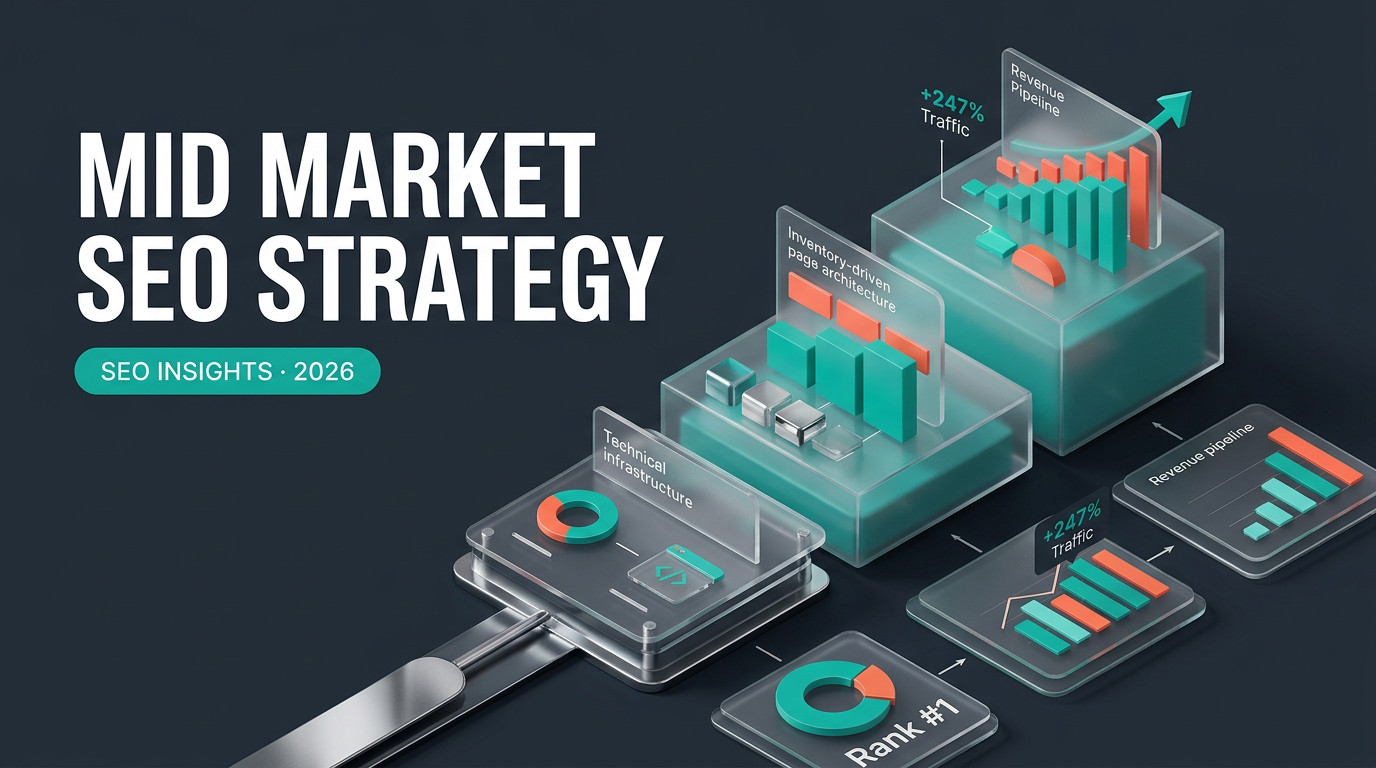
Mid-market companies face a brutal ceiling in organic search. You have outgrown early-stage hacks, yet you cannot match the nine-figure backlink profiles and army of engineers deployed by enterprise market leaders. Implementing an effective mid market SEO strategy is the only sustainable mechanism to break through this growth plateau and transform organic search into a predictable revenue channel.
In 2026, search algorithms reward technical precision, proprietary entity authority, and high-conversion intent over raw content volume. Relying solely on informational blog posts no longer scales; mid-market leaders must combine inventory-driven technical architecture, programmatic page modeling, and revenue-aligned keyword prioritization to dominate commercial search results.
The Anatomy of the Mid-Market SEO Plateau
Most mid-sized businesses reach $20M to $150M in annual revenue by scaling founder-led sales or aggressive performance advertising. However, customer acquisition costs on paid channels continue to spike, while early organic gains stall. This plateau occurs because early-stage SEO tactics—such as publishing broad, top-of-funnel informational blog posts—stop generating marginal returns once search engines exhaust easy ranking opportunities for your domain.
Compounding this issue is the reality of modern search engine result pages. As recent industry analysis points out, zero-click searches account for up to 60% of Google queries, and AI Overviews frequently summarize generic top-of-funnel definitions. Mid-market marketing leaders can no longer justify publishing thousands of generic glossary pages that deliver zero pipeline.
- Top-of-funnel decay: Generic queries are absorbed by AI Overviews and answer engines, reducing organic click-through rates.
- Technical architecture debt: Legacy CMS configurations, orphaned taxonomy pages, and slow rendering throttle crawl efficiency.
- Disjointed content execution: In-house teams produce disconnected assets without building comprehensive topical entity networks.
- Misaligned attribution: Organic traffic reporting focuses on raw sessions rather than pipeline velocity and customer lifetime value.
Shift from Content-Driven to Inventory-Driven Search Architecture
Traditional SEO consultants often recommend writing more blog articles to break through traffic plateaus. For mid-market brands, this is a fatal resource trap. As highlighted in CXL's breakdown of scalable organic growth strategies, high-performing websites frequently scale via inventory, user-facing tools, and modular page templates rather than endless editorial production.
Inventory-driven SEO treats your website as a software product rather than an editorial publication. By exposing structured internal data, product capabilities, or user workflows to search engines, you unlock hundreds of indexable landing pages with high commercial relevance without drafting individual articles from scratch.
- Integration directories: If you offer software or technical services, generate dedicated, indexed pages for every integration, API connection, and partner workflow.
- Template and workflow libraries: Build public repositories of industry blueprints, calculation sheets, or workflow diagrams that solve precise operational bottlenecks.
- Comparison matrices: Construct dynamic head-to-head feature comparisons between your platform and competitors, capturing high-intent bottom-of-funnel searches.
- Programmatic dataset hubs: Expose proprietary internal benchmarks, aggregated data metrics, or industry pricing indexes that naturally attract citations and authoritative links.
Mastering Bottom-of-Funnel (BOFU) Intent and AI Engine Optimization
In 2026, mid-market businesses win by hyper-focusing on Middle-of-Funnel (MOFU) and Bottom-of-Funnel (BOFU) queries. Enterprise competitors often neglect niche buyer journeys because their massive revenue targets force them to target high-volume, generic search phrases. This dynamic creates an open window for mid-market businesses to capture high-intent buyers who are ready to purchase.
Furthermore, capturing market share requires optimizing for both traditional search crawlers and large language model (LLM) search engines. To ensure your brand appears inside AI citations and synthesis engines like ChatGPT Search and Google AI Overviews, your technical team must enforce rigorous semantic structure across every page template.
- Entity schema engineering: Deploy deep JSON-LD markup that maps your organization, executive authors, software capabilities, and product relationships explicitly to Wikidata and schema vocabularies.
- Direct answer formatting: Structure page headers to pose distinct commercial problems, followed immediately by concise, factual 40-word solutions before expanding into technical breakdowns.
- Alternative and migration queries: Target specific operational alternatives (e.g., "[Competitor] alternative for mid-market manufacturing") to capture disaffected enterprise accounts looking to downsize vendor overhead.
Eliminating Mid-Market Technical Debt and Crawl Waste
As mid-market websites expand, legacy CMS implementations and dynamic URL parameters create severe crawl budget waste. Search engine bots spend valuable resources indexing non-converting taxonomy tags, duplicate filtering facets, and obsolete staging domains, while your core revenue-generating pages suffer from delayed crawling and updates.
Conducting an aggressive technical overhaul restores domain authority distribution and accelerates indexation of critical commercial assets. Technical optimization for mid-sized organizations must go beyond basic checklist audits to address deep architectural bottlenecks.
- Faceted navigation pruning: Apply strict canonicalization or
robots.txtparameter rules to ecommerce and catalog filters, preventing search bots from indexing infinite parameter permutations. - Subfolder consolidation: Migrate fragmented subdomains (such as
blog.company.comorresources.company.com) into a consolidated root domain directory structure to concentrate link equity. - Server-side rendering (SSR): Ensure dynamic JavaScript-driven web frameworks render fully server-side, eliminating crawler latency caused by complex two-wave rendering pipelines.
- Internal link graph pruning: Run log-file analyses to identify orphaned core pages and redistribute internal equity through contextual breadcrumb structures and semantic footer hubs.
- Interaction to Next Paint (INP) optimization: Modernize client-side scripting to maintain sub-200ms user interaction speeds across high-value checkout and lead forms.
Building Authority Through Digital PR and Original Data Assets
Generic outreach and low-tier guest posting no longer yield meaningful organic search authority. Mid-market companies cannot compete with enterprise backlink volume through manual link building; instead, you must earn editorial links passively through proprietary industry data and technical thought leadership.
By conducting annual customer surveys or aggregating anonymized product usage metrics, your organization can release proprietary market benchmark reports. Journalists, industry publications, and research analysts naturally cite these primary data points, creating a sustainable inbound backlink acquisition engine that elevates entire domain authority tiers.
"Modern enterprise-grade link acquisition requires zero direct outreach. When you publish non-replicable industry benchmarks and primary research datasets, you turn your domain into an authoritative primary source that automatically captures Tier-1 editorial citations."
Aligning Organic Traffic to Pipeline and Closed-Won Revenue
The ultimate failure of mid-market search strategies is reporting on vanity metrics. Organic traffic charts that trend upward without a corresponding increase in Sales Qualified Leads (SQLs) or closed-won revenue signal misallocated resources. Advanced mid-market organizations integrate SEO tooling directly into CRM platforms like HubSpot and Salesforce.
By mapping multi-touch organic attribution, marketing leaders can clearly demonstrate how technical optimizations and intent-focused content accelerate sales pipeline velocity and reduce paid media dependence.
- Pipeline-weighted keyword mapping: Prioritize content updates based on the historical closed-won rate of the associated keyword cluster, not raw monthly search volume.
- Content decay mitigation: Establish automated quarterly reviews to refresh and consolidate landing pages that drop below page-one positions for primary commercial terms.
- Multi-touch conversion paths: Track organic search as an assist channel across the mid-market sales cycle, proving ROI to executive stakeholders and securing long-term budget.
Key Takeaways
- Break the plateau with technical architecture: Stop relying on generic informational content; deploy inventory-driven directories, comparison pages, and programmatic templates.
- Target high-intent conversions: Win bottom-of-funnel and migration searches that enterprise market leaders ignore due to lower relative search volumes.
- Engineer for modern search retrieval: Implement deep semantic JSON-LD entity schema to dominate both traditional rankings and AI-generated overviews.
- Prune technical dead weight: Eliminate faceted crawl bloat, consolidate disparate subdomains, and ensure fast server-side rendering.
- Tie search to business pipeline: Replace session-based vanity metrics with CRM-integrated attribution that maps organic performance directly to closed-won revenue.