Optimizing for Generative AI: The Future of Answer Engine Optimization (AEO)
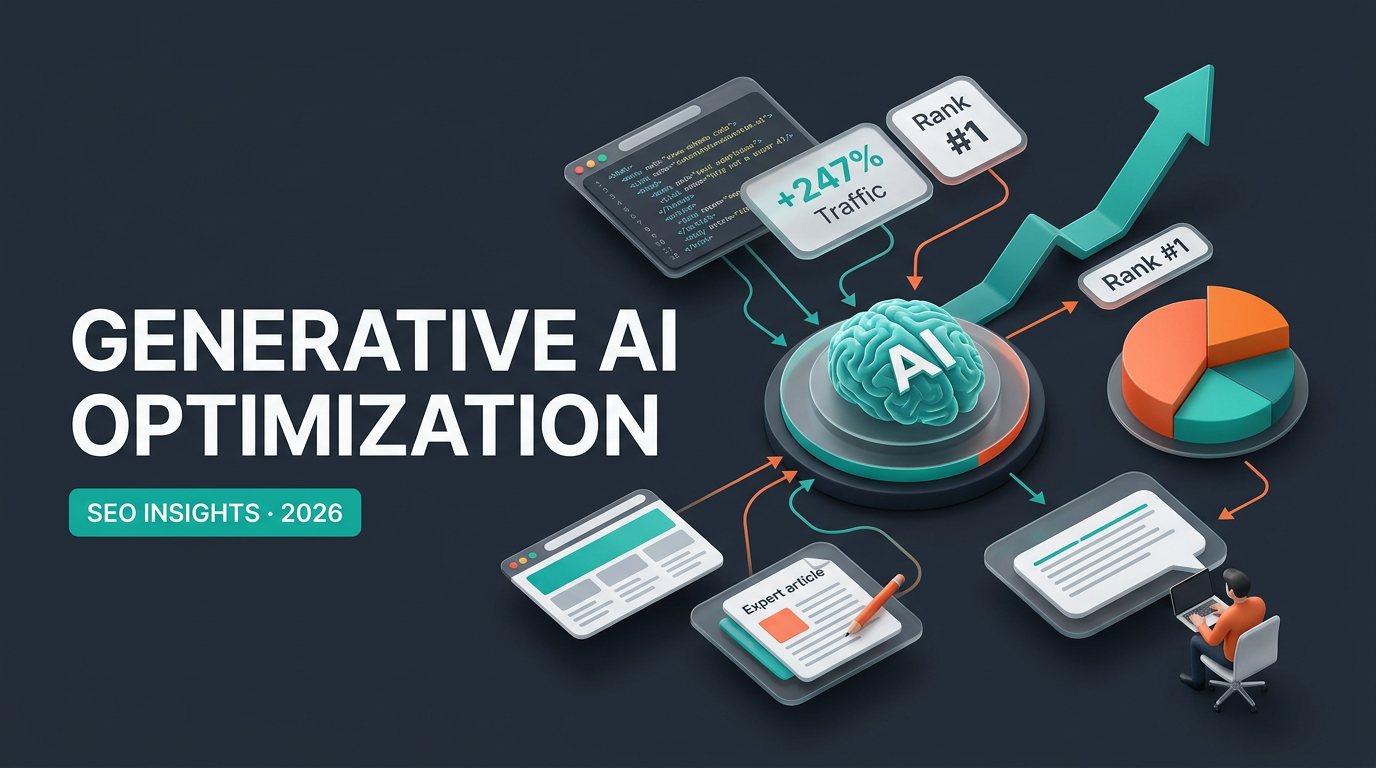
The familiar blue links of search are fading into the background. For a growing number of queries, users are no longer getting a list of options; they're getting a direct, synthesized answer generated by AI. This paradigm shift marks the dawn of a new discipline: Answer Engine Optimization (AEO). If your business is still solely focused on ranking #1, you're playing yesterday's game. The future of digital visibility lies in mastering Generative AI Optimization and becoming the trusted source that fuels these new answer engines.
This isn't about abandoning SEO. It's about evolving it. The core principles of search engine optimization are the very foundation upon which AEO is built. But to win in 2026 and beyond, you must adapt your strategy from simply attracting clicks to actively informing AI models. This guide will walk you through the expert strategies you need to implement now to ensure your brand's voice is heard in this new conversational landscape.
What is Answer Engine Optimization (AEO)? A 2026 Perspective
Answer Engine Optimization (AEO) is the strategic process of making your content and data the most credible, comprehensive, and easily extractable source for AI-driven answer engines. Unlike traditional SEO, which focuses on achieving a high rank on a Search Engine Results Page (SERP), AEO's primary goal is to be featured and cited directly within the AI's generated response, whether that's in Google's AI Overviews, a Perplexity summary, or a ChatGPT response.
As explained in a recent Semrush guide on Generative Engine Optimization (GEO), the focus shifts from ranking to becoming part of the final output. Think of it this way: SEO gets you a seat at the table; AEO makes you the main course. The AI acts as a research assistant for the user, and your job is to be the most helpful, authoritative expert in the room that the assistant chooses to quote.
Here’s how the focus differs in practice:
- Traditional SEO Focus: Keyword density, backlink quantity, domain authority, and click-through rate from a list of links.
- AEO Focus: Factual accuracy, content extractability, entity recognition, E-E-A-T signals, and structured data integrity.
- Traditional SEO Goal: Drive traffic to your website via a user click on a ranked URL.
- AEO Goal: Secure brand mentions, citations, and direct traffic by being the definitive source within the AI-generated answer.
Ultimately, AEO is a broader discipline that encompasses both generative AI features and established answer-focused elements like featured snippets and People Also Ask boxes. It's a holistic approach to being the answer, wherever answers are given.
The New Foundation: E-E-A-T as a Trust Signal for AI
In the age of AI, trust is the most valuable currency. Generative models are designed to identify and prioritize information from sources that demonstrate strong E-E-A-T: Experience, Expertise, Authoritativeness, and Trustworthiness. What was once a concept for Google's human quality raters is now a fundamental pillar for machine learning models trying to differentiate fact from fiction. Simply put, AI needs to trust you before it will cite you.
To build this trust, you must go beyond surface-level tactics. It requires embedding E-E-A-T signals deep into your digital presence. The AI doesn't just read one page; it synthesizes information from your entire digital footprint to form an opinion about your entity (your brand).
Implement these advanced E-E-A-T strategies for AI:
- Build Your Expert Entity Graph: Create detailed author biographies for your content creators. Use `Person` schema to mark up these bios, and critically, use the `sameAs` property to link to their authoritative social profiles (like LinkedIn) and other publications. This connects the human expert to your brand in a way machines can understand.
- Publish Verifiable Proprietary Data: Become a primary source. Conduct original research, industry surveys, or data analysis. Publish your findings and, most importantly, mark them up with `Dataset` schema. When AI models look for a statistic, they will prefer to cite the original source over a secondary one.
- Ensure Corpus-Wide Consistency: An AI will assess your entire website. Your 'About Us' page, company history, team bios, and service descriptions must all tell a consistent, expert story. Contradictory or outdated information anywhere on your site erodes trust signals.
- Cultivate High-Authority Mentions: While backlinks remain important, uncited mentions of your brand, executives, or research in reputable publications (think major news outlets, academic papers, government websites) are powerful authority signals. These serve as third-party validation that your entity is a recognized authority.
Content Strategy for AI: Atomic, Extractable, and Actionable
The advice to "create high-quality content" is no longer sufficient. For AI, the *structure* and *clarity* of your content are just as important as its quality. You must shift from writing long, narrative articles to creating a library of well-organized, easily digestible information blocks. The goal is for an AI to parse your page and instantly extract a fact, a definition, or a step-by-step process.
This approach, which we call creating "atomic content," means breaking down complex topics into their smallest, self-contained components. Each paragraph, list, or table should be able to stand on its own as a potential answer. This aligns perfectly with what Google recommends in its guide to optimizing for generative AI features, which emphasizes creating valuable content for your audience.
To make your content AI-ready, focus on these formats:
- Definitional Paragraphs: Start key pages with a clear, concise paragraph that defines the core topic. Use the format "[Topic] is a..." For example, a page about AEO should begin with a direct definition of Answer Engine Optimization.
- Numbered Lists for Processes: For any "how-to" query, use a numbered list (`
- `) with clear, actionable steps. Each step should be a complete instruction. This format is easily converted into a step-by-step guide by an AI.
- Bulleted Lists for Features/Benefits: When describing a product or service, use bulleted lists (`
- `) to break out key features, benefits, or specifications. This helps AI models create comparison tables and summary highlights.
- Purposeful Use of `` and ``: Use formatting tags strategically to emphasize key terms, statistics, or names. This acts as a subtle signal to the AI about what's most important in a block of text, increasing the likelihood it will be extracted.
Advanced Technical AEO: Speaking the AI's Language with Schema
If content is what you say, structured data (schema markup) is how you say it in the AI's native language. Schema is a vocabulary of code that you add to your website to provide explicit context about your information. It removes ambiguity and allows search engines and AI models to understand your content with near-perfect accuracy. While basic schema is standard SEO practice, advanced AEO requires a more comprehensive and strategic implementation.
Think of your website as a database. Schema is the labeling system that makes your database queryable by an AI. The more precisely you label your data, the more likely an AI is to use it for complex tasks like product comparisons, finding local experts, or building itineraries.
Expand your schema strategy beyond the basics in 2026:
- Go Granular with `Product` Schema: Don't just list the product name and price. Use the full spectrum of properties: `sku`, `gtin`, `mpn`, `aggregateRating`, `review`, `brand`, and `offers`. This detailed data is exactly what AI uses to build rich comparison tables and answer specific queries like "best laptop under $1000 with a backlit keyboard."
- Leverage `ProfilePage` and `Organization` Schema: Fully build out your brand's entity in the knowledge graph. Your `Organization` schema should include your logo, social profiles (`sameAs`), address (`address`), and contact information (`contactPoint`). Connect this to your employee's `ProfilePage` or `Person` schema to build a web of trusted entities.
- Embrace `Dataset` Schema: As mentioned before, if you publish any original data, from a simple market statistic to a full-blown research paper, marking it up with `Dataset` schema is non-negotiable. This flags you as a primary source of information, a highly valuable signal for any AI.
- Master `HowTo` and `FAQPage` Schema: These are the bread and butter of AEO. Ensure every step in your `HowTo` schema is clear and complete. For `FAQPage`, provide concise, direct answers within the acceptedAnswer property. This is one of the most direct ways to be featured in answer-based results.
Preparing for the Agentic Web: From Answers to Actions
The final frontier of Generative AI Optimization is preparing for the "agentic web." This is where AI moves beyond simply providing answers and starts taking actions on behalf of the user. As Google hints at with its exploration of agentic experiences, future AI agents will be able to book appointments, purchase products, and make reservations directly from the search interface.
For your business to be compatible with this future, you need to think about not just providing information, but enabling transactions in the most seamless way possible. An AI agent won't navigate a clunky, five-page checkout process or try to figure out a confusing booking calendar. It will look for the path of least resistance. Businesses that prepare their infrastructure for these agents will capture a massive competitive advantage.
Here's how to prepare your business for agentic commerce today:
- Develop an API-First Strategy: The most direct way for an AI agent to interact with your business is through an Application Programming Interface (API). Make your core business data—such as product inventory, appointment availability, or pricing—accessible via a well-documented API.
- Simplify Your User Journeys: Audit and streamline every critical conversion path on your website. Reduce the number of clicks, form fields, and steps required to complete a purchase or booking. The simpler the process for a human, the more likely it is that an AI agent can successfully navigate it.
- Create Robust, Accessible Data Feeds: Beyond standard Google Merchant Center feeds, create comprehensive product and service data feeds in universal formats like XML or JSON. Host them in a stable, public location and document them clearly, making it easy for any future AI system to ingest and use your data.
Key Takeaways
Generative AI Optimization is the next evolution of digital marketing. While it may seem daunting, the path forward is built on an enhanced foundation of SEO best practices. To ensure your business thrives in the era of answer engines, focus your efforts on these core pillars:
- Shift Your Goal: Stop optimizing just for ranks. Start optimizing to become the definitive, cited source within the AI-generated answer.
- Build Verifiable Trust: Double down on E-E-A-T. Use expert authors, publish original data, and leverage schema to build a trusted entity that AI models will favor.
- Structure for Extraction: Write content in clear, atomic blocks. Use definitions, lists, and tables to make your information easy for an AI to parse and repurpose.
- Speak the AI's Language: Implement a comprehensive and advanced schema markup strategy. Label your data with precision to remove ambiguity and become a reliable source for AI.
- Prepare for Action: Look ahead to the agentic web. Simplify user journeys and explore API-first infrastructure to allow future AI agents to transact with your business directly.