
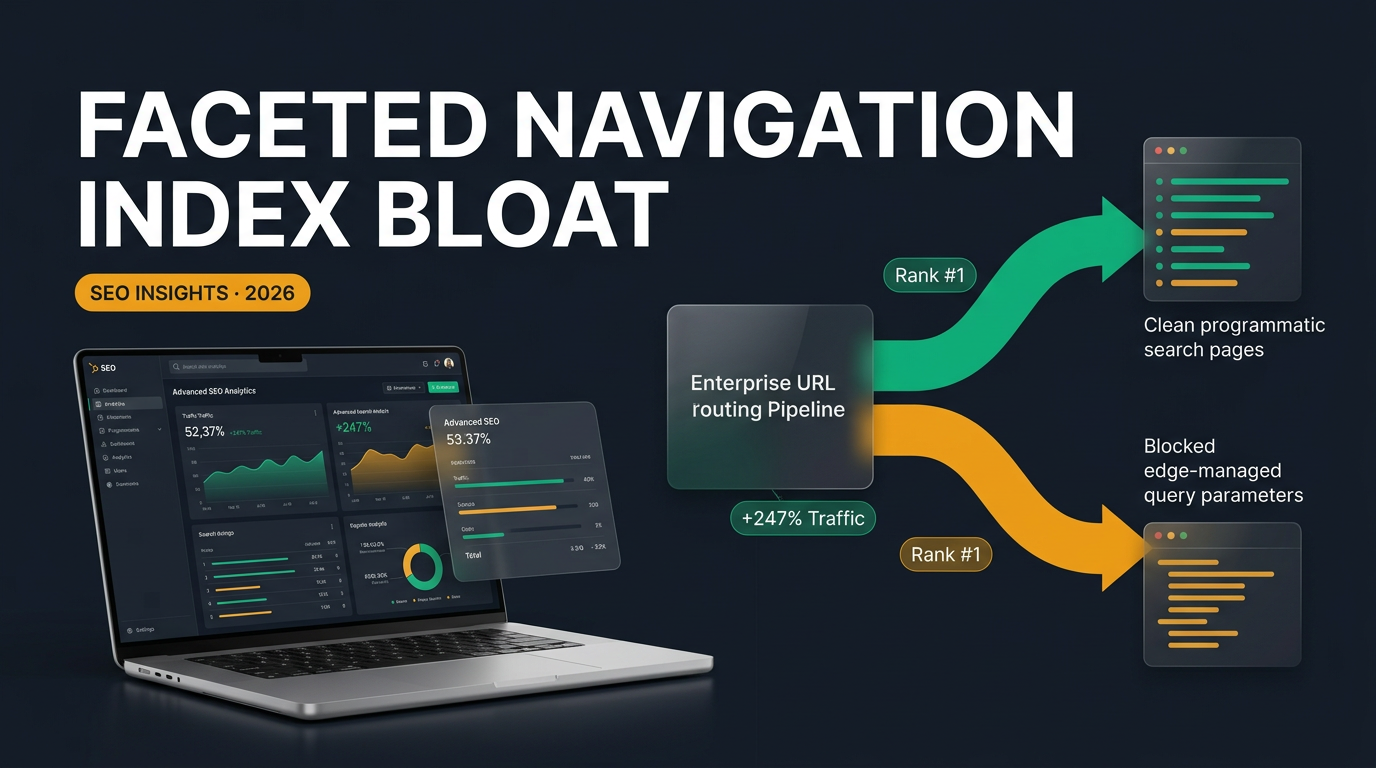
Enterprise ecommerce, travel, and marketplace platforms live and die by their product discovery engines. Yet, when multi-select filters, sorting rules, and pagination combine across thousands of categories, websites inadvertently spawn millions of duplicate, thin, and parameter-heavy URLs. Left unchecked, faceted navigation index bloat turns your site into a bottomless crawl trap, diluting link equity and dragging down the organic performance of revenue-critical pages.
Solving this dilemma in modern technical SEO is not about choosing between user experience and search engine visibility. High-performing enterprise architectures run programmatic rules that expose high-demand facet combinations as indexable, static-like routes while systematically cloaking, parameterizing, or truncating non-essential combinations from search bots. Here is the operational framework enterprise engineering and SEO teams use to scale discoverability without flooding Google's index.
The Anatomy of Faceted Navigation Index Bloat
Faceted navigation allows users to filter large product collections by dimensions such as brand, size, material, color, price range, and rating. Each filter option creates a new state in the user interface. In naive web architectures, each of these states also generates a unique, crawlable URL string.
The mathematical reality of faceted search is brutal. If a single category page contains five filter categories (such as brand, color, size, price, and fit), and each filter has five values, the possible combinations exceed several thousand permutation URLs for that single category alone. Multiply that across 10,000 subcategories, and search engines are suddenly exposed to hundreds of millions of low-value permutations.
As technical SEO analyses from platforms like Lumar point out, the resulting crawl bloat and duplicate content silently cripple site quality scores. When bots spend 80% of their crawl resources processing near-identical variations of /shoes/running?color=black&size=10.5&sort=price_asc, they miss newly added inventory, fresh editorial content, and deep canonical subcategories.
- Combinatorial Permutations: Different parameter orders (e.g.,
?color=blue&size=10vs.?size=10&color=blue) creating identical content on unique URLs. - Thin Facet Overlaps: Over-filtered combinations returning zero or single-item result pages that fail Google's helpful content thresholds.
- Session and Sorting ID Sprawl: Dynamic sorting options (high-to-low, popularity) duplicating core category items without adding search intent value.
Why Legacy SEO Quick-Fixes Fail at Enterprise Scale
Many technical teams still rely on outdated playbooks to address index bloat, applying broad brush fixes that create secondary, more insidious technical liabilities.
A common mistake is relying strictly on rel="canonical" tags pointing back to the root category. As detailed by technical SEO experts at Oncrawl, canonical tags are advisory hints, not binding directives. When the content on a filtered page differs substantially from the root category—such as displaying only three red leather jackets instead of fifty mixed jackets—Google frequently ignores the canonical tag, indexing the parameterized URL regardless.
Another historical tactic is adding noindex, follow robots meta tags to all filtered combinations. While this does prevent the page from entering the search index once crawled, it fails to solve the crawl budget dilemma. Googlebot must still download, parse, and execute every individual URL before it discovers the noindex directive, burning millions of server requests on throwaway pages.
Similarly, blunt robots.txt disallow rules (e.g., Disallow: /*?*) trigger unintended consequences. Disallowing parameterized URLs prevents Googlebot from crawling them, but if internal links or historical backlinks point to those query strings, Google cannot read page directives and will often index the bare URL without snippets, retaining index bloat while blocking link equity inheritance.
- Canonical Tag Overrides: Search engines ignore canonicals when product grids diverge significantly from the target canonical page.
- Robots.txt Equity Blocks: Blocking crawler access locks PageRank in un-crawlable parameter loops instead of channeling it back to primary category hubs.
- Noindex Crawl Consumption: Bots must repeatedly request and render noindexed pages to detect status changes, leaving crawl efficiency unaddressed.
The Hybrid Architecture: State Management vs. Indexable Paths
The standard for enterprise technical architecture separates facets into two clear technical tiers: search-demand facets that map to real customer queries, and interactive facets that serve UX refinement exclusively.
Interactive facets—such as price sliders, sorting filters, multi-select sizes, and minor physical dimensions—should never alter the crawlable DOM as traditional hyperlink tags. Instead, they must be implemented using client-side state manipulation. By using the HTML5 History API (pushState or replaceState) or URL hash fragments (e.g., #size=10), browsers can update the display and URL for user bookmarking without exposing an <a href> path that search crawlers parse.
Conversely, high-volume facet combinations (such as Brand + Category, e.g., /shoes/running/nike) are programmatically transformed into clean, hierarchical directory structures. These routes receive unique, server-rendered HTML payloads, fully customized title tags, optimized breadcrumbs, and explicit self-referential canonicals.
Treat your URL generation pipeline as a selective publishing system. If a facet combination does not have validated monthly search volume and dedicated inventory, it should not exist as an indexable, crawler-accessible URL.
Establishing a Data-Driven Programmatic Facet Matrix
To implement this hybrid architecture, enterprise sites must establish automated programmatic rules governing which facet combinations earn dedicated URLs and which remain client-side UI states.
This governance model requires an automated sync between three data streams: search demand volume from keyword research APIs, active product SKU inventory counts from your database, and crawl performance data. If a specific filter combination (e.g., "Waterproof Hiking Boots") meets a predefined search volume threshold and reliably features at least eight in-stock items, the system elevates it to a canonical, crawlable directory.
- Tier 1: Canonical Base Categories: Core categorical pages (e.g., /footwear/boots) with open crawler access and XML sitemap presence.
- Tier 2: Programmatic Landing Pages: High-demand combinations (e.g., /footwear/boots/waterproof/mens) rendered as virtual subcategories with custom metadata and self-referencing canonicals.
- Tier 3: Trapped UI States: Long-tail, zero-search combinations (e.g., size 11.5, brown, under $150, wide-fit) handled strictly through JavaScript button triggers and URL fragments that search bots ignore.
If seasonal inventory drops below your minimum SKU threshold, the system should automatically demote the page by updating internal links, removing it from XML sitemaps, and issuing a 301 redirect to the closest logical parent category to preserve external link equity.
Edge Computing and Internal Link Hygiene
Modern enterprise sites increasingly leverage edge layers (such as Cloudflare Workers, Fastly Compute, or Akamai EdgeWorkers) to enforce faceted navigation hygiene before requests ever hit the origin application servers.
At the edge, incoming parameterized requests can be dynamically sanitized. Parameter sorting rules should be enforced to eliminate permutations: any incoming request matching ?b=nike&a=black should be immediately normalized via a 301 redirect at the edge to ?a=black&b=nike or rewritten cleanly. This prevents duplicate cache entries and stops search bots from exploring multiple variations of identical URL strings.
Furthermore, enterprise development teams must audit their rendered DOM for link hygiene. Filter checkboxes must not be wrapped inside standard <a href="?filter=..."> anchors if they are not intended for indexing. Instead, modern implementations render filters as semantic <button> elements with JavaScript event listeners. Googlebot does not interact with form buttons or click dynamic filters, immediately severing the internal crawl graph that feeds index bloat.
- Button-Based Filter UI: Replace parameter-generating anchor tags with semantic button controls that load content asynchronously via fetch requests.
- Edge Normalization: Program edge workers to strip arbitrary tracking tokens, normalize parameter ordering, and drop trailing slashes.
- Canonical Enforcement: Inject dynamic, strictly validated canonical headers at the CDN edge for all parameterized queries, pointing back to the clean parent directory.
Auditing and Monitoring Facet Sprawl in 2026
Preventing faceted navigation index bloat is an ongoing operational discipline, not a one-time migration task. Dynamic product catalogs shift daily, and new front-end releases can accidentally reintroduce crawl traps through un-sanitized internal links.
Your monitoring workflow should integrate log file analysis with the Google Search Console (GSC) URL Inspection API. In your server access logs, group bot requests by URL pattern. If parameterized paths (URLs containing question marks or filter query strings) account for more than 15% to 20% of Googlebot's total monthly crawl volume, your cloaking and edge logic require immediate remediation.
Inside Google Search Console, review the Page Indexing report, paying close attention to Crawled - currently not indexed and Duplicate without user-selected canonical. A sharp increase in these categories almost always indicates that a new internal link path has exposed an unmanaged facet matrix to search engines.
- Log Ratio Metric: Ensure bot hit ratios on static category pages versus parameterized URLs maintain at least an 85:15 distribution in favor of canonical URLs.
- Search Console API Automation: Automate weekly scripts using the GSC API to detect newly discovered parameter URLs before they become entrenched in the search index.
- Staging Regression Crawls: Run automated headless browser crawls across staging environments prior to production deployments to confirm that filter elements do not introduce crawlable anchor links.
Key Takeaways: Defending Your Indexing Architecture
- Index Bloat Degrades Performance: Millions of filter permutations consume enterprise crawl budgets and dilute sitewide topical authority.
- Avoid Legacy Crutches: Relying exclusively on
noindextags or standardrel="canonical"hints fails to mitigate server strain and crawl graph pollution. - Enforce a Hybrid Facet Model: Generate static, indexable directory pages for high-demand search combinations while locking non-demand filters behind client-side state transitions.
- Strip Anchors from UI Filters: Code interactive filter elements as HTML
<button>components with async handlers rather than crawler-trapping<a href>tags. - Govern at the Edge: Deploy CDN edge computing scripts to normalize parameter syntax, handle URL canonicalization, and stop bot-generated URL loops instantly.