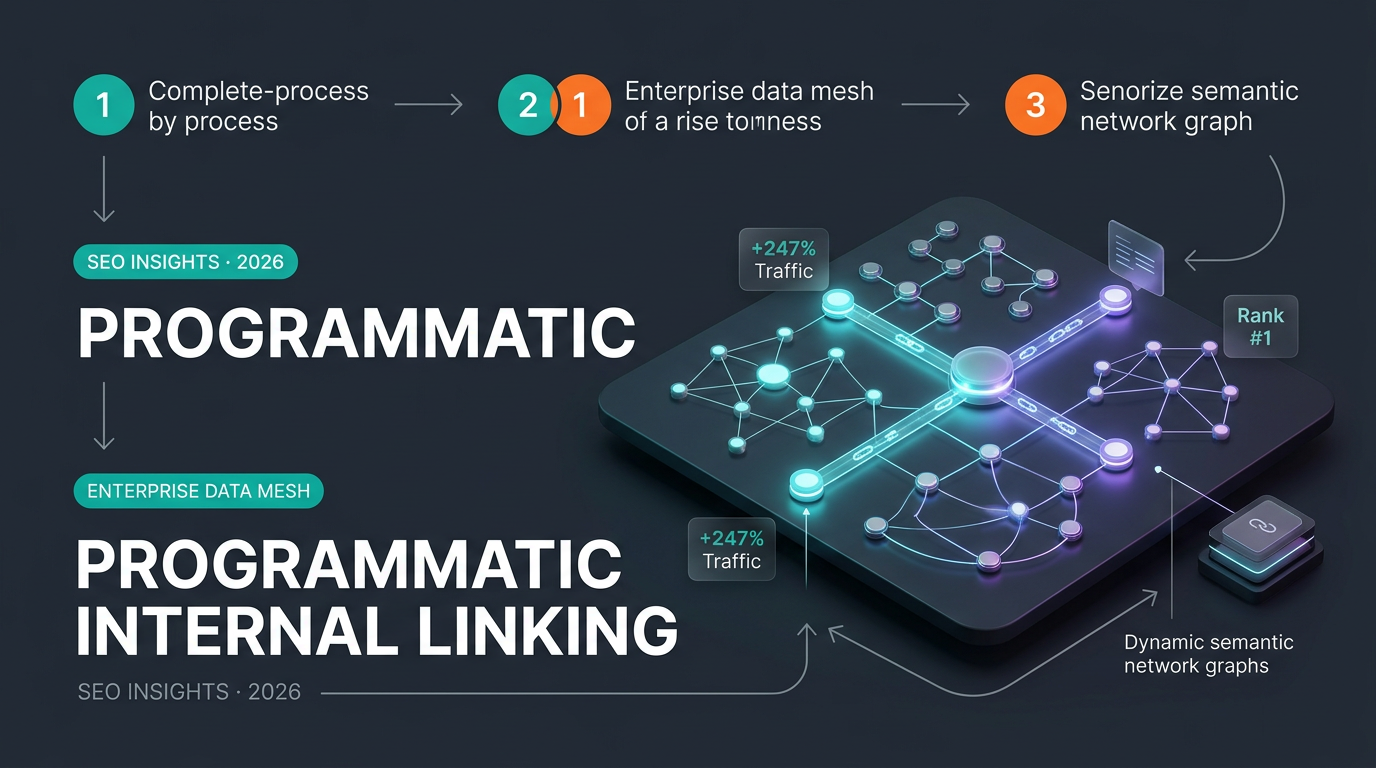
Scaling a digital catalog past 100,000 pages is trivial in modern headless stacks, but driving organic search visibility across millions of programmatic endpoints is an entirely different operational challenge. When enterprise platforms fail to capture enterprise-scale traffic, the culprit is rarely content velocity; it is architectural isolation caused by broken discovery paths.
Implementing an automated, high-precision programmatic internal linking architecture is the single most defensible lever for enterprise growth. Without an intelligent internal link mesh, search crawlers hit structural bottlenecks, dumping 30% to 50% of your generated inventory into the crawl graveyard of “Discovered – currently not indexed.” Below is the enterprise blueprint for engineering a scalable, entity-aware link graph that maximizes crawl efficiency, democratizes internal PageRank, and elevates organic performance across 100k+ URLs.
The Mathematical Reality of Scale: Hierarchical vs. Semantic Lattice
Traditional website architecture relies on rigid vertical hierarchies: homepage to category, category to subcategory, and subcategory to leaf node. While this parent-child setup provides predictable navigational guardrails, it breaks down catastrophically when applied to programmatic inventory exceeding 100,000 URLs. In a pure vertical tree, leaf pages sit at a click depth of six, seven, or eight hops from the root domain. In enterprise search, PageRank decays exponentially with each hop, leaving deep programmatic leaf nodes virtually devoid of equity.
As growth advisor Ethan Smith points out in his analysis on the power of internal linking for SEO, an inadequate internal link spread leaves massive organic opportunity untapped, making internal link remediation one of the highest-leverage growth levers available. At enterprise scale, shifting from a strict hierarchical tree to a hybrid “semantic lattice” is essential.
A semantic lattice preserves core taxonomy while establishing horizontal, cross-cluster bridges between contextually related entities across disparate categories. This architecture delivers critical operational advantages:
- Click-depth compression: Flattens the information architecture so that 95% or more of your indexable catalog resides within four clicks of the homepage.
- Equitable equity circulation: Ensures high-authority editorial pages and category hubs distribute link equity downstream to programmatic long-tail targets.
- Topical reinforcement: Validates entity relationships to search engines, proving deep topical authority across interconnected sub-niches.
Vector Embeddings and Edge-Computed Dynamic Linking
Static link modules powered by hardcoded database tags or primitive category matching inevitably create echo chambers. High-volume categories receive thousands of reciprocal links, while niche programmatic pages remain orphaned. To build scalable relevance, top engineering teams leverage dense vector embeddings combined with edge compute to dynamically calculate link graphs.
By transforming page entity data (titles, meta descriptions, primary content extracts, and structured taxonomy) into vector embeddings via models like text-embedding-3-small, you can store your entire inventory in a vector index such as pgvector, Pinecone, or Qdrant. When a page is rendered or purged in cache, the system queries the nearest semantic neighbors to surface dynamically relevant related entities.
Rather than running heavy database queries on each origin request, enterprise architectures execute this logic at the edge (via Cloudflare Workers, Fastly Compute, or Vercel Edge Middleware):
- Entity Ingestion: The programmatic pipeline creates the page record and generates a 1536-dimensional vector representing the core entity.
- Similarity Threshold Filtering: The database calculates cosine similarity against existing catalog nodes, filtering for scores between 0.78 and 0.92 to prevent both irrelevant matches and near-duplicate cannibalization.
- Link Pool Generation: The engine selects 4 to 8 sibling nodes and 2 parent/cluster nodes to return to the template.
- Edge Injection & KV Caching: The calculated links are cached at the CDN layer, ensuring sub-50ms response times without origin database load.
Eliminating Crawl Waste and Protecting Log Budgets
Search engines do not allocate infinite resources to parse enterprise architectures. Every bot request spent re-crawling an isolated, low-value parameter page or looping through bloated paginated components is a request stolen from high-converting leaf nodes. Industry research from Discovered Labs on programmatic link efficiency highlights that automated parent-child and sibling linking mitigates orphan pages that routinely squander up to 26% of enterprise crawl budgets.
Optimizing programmatic internal linking directly streamlines bot efficiency through targeted technical controls:
- Deterministic Pagination Matrices: Replace infinite scroll and traditional “Load More” interfaces with structured pagination blocks containing bi-directional jumps (e.g., Pages 1, 2, 3, 10, 50, 100) to flatten pagination depth.
- Dynamic Breadcrumb Trees: Deploy JSON-LD structured breadcrumbs paired with semantic HTML nav elements reflecting strict hierarchical parents alongside contextual taxonomies.
- Faceted Parameter Stripping: Ensure programmatic link blocks point strictly to self-canonicalizing, indexable clean URLs, never passing link equity through internal parameter-filtered variants.
“Crawl budget optimization is fundamentally a graph theory problem. If your internal links fail to guide search engine spiders systematically through every leaf node, your organic footprint will naturally compress.”
Automating Contextual Anchor Variation at Scale
A fatal failure mode in programmatic SEO is anchor text homogenization. When 150,000 localized landing pages all receive internal links with the exact, unvarying anchor text “Plumbing Services,” search algorithms detect unnatural pattern footprints. Conversely, relying on ambiguous anchor text like “Learn More” or “Click Here” strips all contextual relevance from the link graph.
Enterprise programmatic internal linking requires an automated anchor generation engine governed by structured linguistic templates. Anchor generation should dynamically pull from entity databases using predefined lexical patterns:
- Primary Entity Anchor (35% allocation): Directly reflects the core target keyword (e.g., “Commercial HVAC repair in Chicago”).
- Co-occurrence & Synonymic Anchor (30% allocation): Integrates semantic variations and service modifications (e.g., “Licensed heating technicians serving Cook County”).
- Entity Attribute Anchor (20% allocation): Focuses on specific feature, brand, or operational attributes (e.g., “24/7 emergency furnace diagnostics”).
- Navigational Hierarchical Anchor (15% allocation): Anchors grounded in contextual sub-category taxonomies (e.g., “Explore regional HVAC maintenance plans”).
By enforcing algorithmic anchor distribution rules across your programmatic template framework, you maximize semantic variety while eliminating algorithmic over-optimization risks.
Preventing Orphan Drift with Dynamic Hub Repositories
As catalogs expand, inventory turnover creates “orphan drift”—pages that once held stable positions within the internal link architecture gradually lose incoming links as seasonal inventories shift, products go out of stock, or newer content displaces them in chronological modules. In enterprise catalogs, orphan drift can silently disconnect tens of thousands of productive landing pages.
To combat this decay, establish dedicated reverse-lookup directories and rolling semantic hubs:
- Rolling Index Repositories: Programmatic archive hubs that algorithmically pool the lowest 5% percentile of linked-to URLs, surfacing them as categorized “Deep Archive” resources to guarantee continuous bot discovery.
- Inventory-State Bridge Links: When a programmatic leaf node flags an out-of-stock or dormant state, automatically convert its outgoing link module into a high-density sibling module passing equity to active related products, rather than leaving it as a dead-end terminal node.
- Automated Graph Health Audits: Continuous headless site crawls measuring inlink distribution curves across every published URL tier. If any indexable programmatic page drops below five internal inlinks, it must trigger an automated workflow that updates edge injection pools to route fresh links to the target.
Key Takeaways for Enterprise Link Architecture
- Transition from strict trees to semantic lattices: Combine vertical category paths with horizontal semantic cross-links to keep 95%+ of URLs within 3 to 4 clicks of the root domain.
- Leverage embeddings for dynamic relevance: Use vector databases and edge compute to inject hyper-relevant sibling links automatically without slow database calls.
- Preserve crawl budget systematically: Eradicate deep pagination chains and parameter links to avoid wasting up to a quarter of your crawler capacity on orphan dead-ends.
- Algorithmic anchor diversification: Enforce structured distribution formulas across your programmatic anchor text to maintain topical depth without over-optimization triggers.
- Actively remediate orphan drift: Build automated link-monitoring guardrails that inject programmatic bridge links to pages falling below internal inlink thresholds.