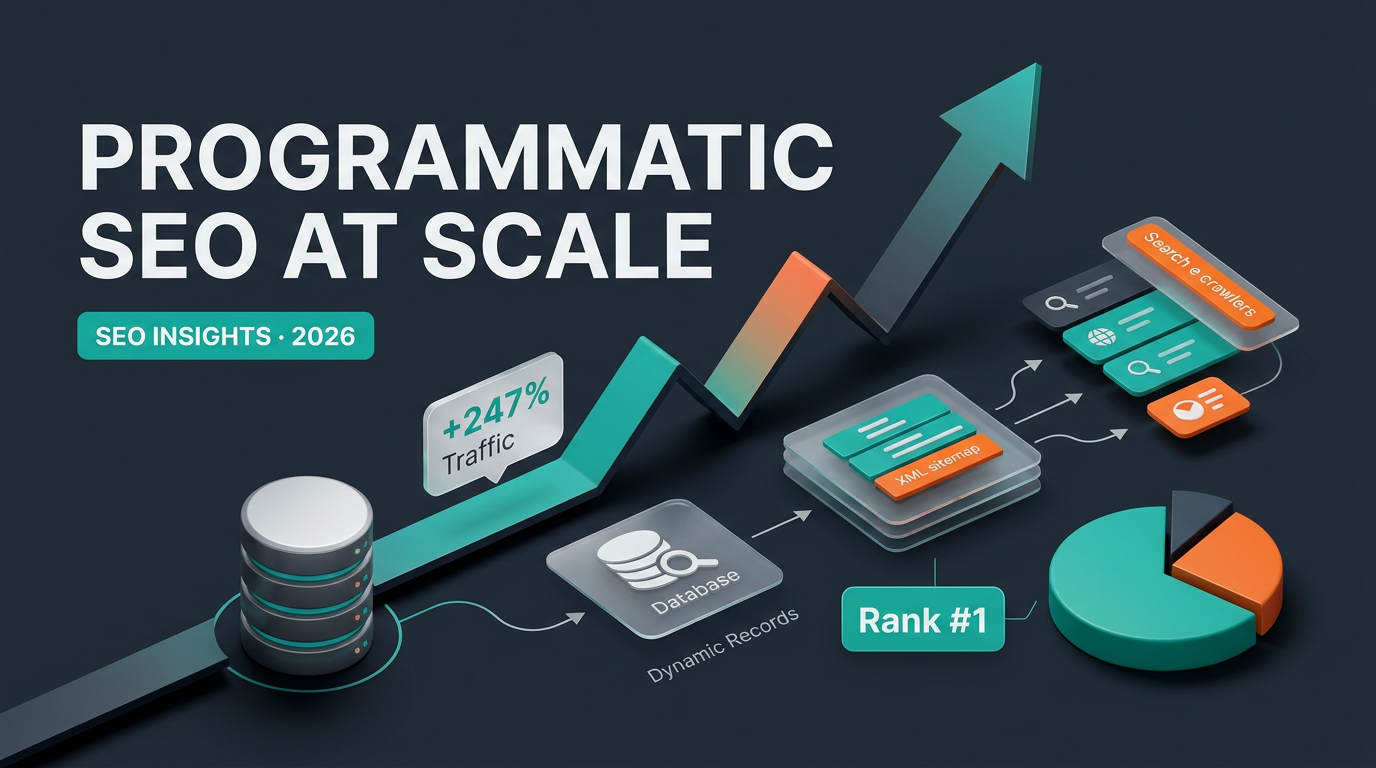
Deploying 100,000 database-driven landing pages in an afternoon has become trivial with modern frameworks and headless CMS architecture. However, getting search engines to discover, render, and index those URLs profitably remains the ultimate technical bottleneck. Executing programmatic SEO at scale requires far more than automated templates; it demands rigorous control over search engine bot traffic, site architecture, and content thresholds.
When enterprise websites scale their page inventory into the hundreds of thousands or millions, Googlebot does not scale its resource expenditure proportionately. Without strategic crawl management and strict quality gating, enterprise domains frequently find themselves stranded in Search Console limbo—watching high-priority revenue pages get trapped under "Discovered – currently not indexed" while search bots squander resources on infinite URL parameters and low-value facets.
The Modern Mechanics of Crawl Budget: Capacity Limits vs. Crawl Demand
Crawl budget is frequently misunderstood as a static metric assigned to a domain. In reality, as detailed in Google's technical documentation on crawl budget, crawling behavior is governed by two dynamic forces: crawl capacity limit (hostload) and crawl demand. Crawl capacity reflects your server infrastructure's ability to respond to Googlebot without degrading user experience, while crawl demand reflects Google's desire to crawl your content based on perceived URL value, site popularity, and content freshness.
For enterprise programmatic builds, optimizing hostload requires sub-100ms server response times (TTFB) across all edge nodes. If Googlebot encounters rising latency, timeouts, or 5xx server errors, its algorithms immediately throttle concurrent connections to safeguard your origin servers. Conversely, a lightning-fast site hosted on edge-rendered infrastructure with persistent HTTP/2 or HTTP/3 connections signals that Googlebot can safely double or triple its retrieval rate.
Crawl demand, on the other hand, cannot be artificially manufactured through aggressive sitemap pinging. It is earned through authority signals, organic search demand, and historical click-through engagement. If newly minted template pages fail to attract engagement or contain redundant information, Google rapidly downgrades crawl demand across that entire URL subfolder.
- Crawl Capacity Optimizers: Edge caching of static HTML, HTTP/3 transport, consistent server health under load, and automatic cache-purging workflows.
- Crawl Capacity Drainers: Origin roundtrips on cold starts, uncompressed payloads, complex database joins per request, and unoptimized server-rendered JavaScript.
- Crawl Demand Drivers: External backlink velocity, internal link depth, social/direct traffic signals, and verified update frequencies on existing URLs.
Solving the "Discovered – Currently Not Indexed" Bottleneck
The dreaded "Discovered – currently not indexed" status in Google Search Console is the canonical symptom of unmanaged programmatic expansion. It signifies that Google discovered the URL—typically via an XML sitemap or shallow link—evaluated its context or historical template quality, and actively decided that spending compute cycles to fetch and index it was not worth the resource expenditure.
In enterprise rollouts, this issue rarely stems from technical crawling barriers. Instead, it indicates a perceived quality deficit. As outlined in Digital Applied's programmatic SEO analysis, templates that simply swap geographical names or basic variables into boilerplate text trigger automated duplicate-intent filters. When Googlebot detects that thousands of URLs share identical sentence structures and differ by only two or three database fields, it flags the directory as low-value programmatic sprawl.
To break through this indexation barrier, enterprise teams must install algorithmic quality gates before pages are allowed into the production index. If a programmatic page does not contain a threshold of proprietary data, unique user engagement attributes, or distinct local/entity signals, it should be quarantined from the public crawl.
- Dynamic Data Thresholding: Automatically return a
noindex, followtag or exclude pages from sitemaps if the page contains fewer than three distinct, verified data points. - Zero-Result Exclusion: Never publish directory, search, or inventory pages that return empty states or "no items found"; these generate instant soft-404 signatures.
- Semantic Differentiation: Inject context-specific comparison widgets, historical price trends, unique user reviews, and structured entity attributes into every template variant.
Information Architecture and Internal Linking for Crawl Efficiency
Flat URL structures are a common architectural trap in programmatic SEO. While publishing example.com/integrations/app-a-and-app-b appears clean, creating 50,000 sibling pages off a single directory without clear hierarchical hubs starves deeper pages of internal PageRank. Googlebot requires contextual, topic-based internal linking paths to navigate and validate programmatic catalogs.
A resilient programmatic architecture limits maximum click-depth from the homepage to four clicks or fewer, regardless of whether the site contains 10,000 or 10,000,000 pages. This is achieved through structured taxonomy clusters, recursive category pagination, and dynamic semantic cross-linking between related database entities.
"An unlinked programmatic page is a ghost page. If Googlebot cannot reach an entity through semantic HTML navigation within three hops of a high-authority hub, an XML sitemap entry will rarely save it from indexation abandonment."
Consider an enterprise software comparison directory. Rather than relying solely on global navigation, implement dynamic cross-linking modules that link an integration page to its top five category alternatives, its industry-specific use cases, and reciprocal parent directories. This structure funnels crawling bots through logical entity pathways rather than random brute-force crawls.
- Entity Hub Pages: Establish high-authority categorical and vertical hub pages that aggregate programmatic sub-pages dynamically based on search demand.
- Breadcrumb Trails: Implement structured, microdata-backed breadcrumbs on every programmatic template to reinforce parent-child taxonomy.
- Faceted Cross-Links: Use semantic similarity algorithms to link pages with shared database attributes (e.g., matching pricing tiers, shared APIs, or geographic proximity).
High-Performance XML Sitemap Architecture and Partitioning
Submitting a monolithic XML sitemap index containing 100 sitemaps with 50,000 generic URLs each is a catastrophic mistake for enterprise SEO teams. This approach turns Google Search Console into an opaque black box where identifying indexation patterns across specific templates or business verticals becomes impossible.
Enterprise programmatic sitemaps must be segmented strictly by template type, business cohort, publication date, and indexation status. By splitting sitemaps into discrete units of 5,000 to 10,000 URLs grouped by specific database variables, Search Console's "Sitemaps" and "Page Indexing" reports suddenly transform into high-resolution diagnostic instruments.
Cohort Segmentation Strategy
Segment your sitemap index by template family and update status. For example, place software-to-software integration pages in one series (sitemap-integrations-1.xml), localized service directories in another (sitemap-locations-1.xml), and competitor comparison matrices in a third. Furthermore, enforce strict hygiene on the <lastmod> attribute.
Google actively rewards accurate <lastmod> timestamps. If an enterprise site updates the <lastmod> value only when substantive data changes occur—rather than touching it indiscriminately during minor build deployments—Googlebot learns to trust the sitemap as an authoritative change detection feed, drastically reducing wasteful re-crawling of static pages.
- Limit Size to 10,000 URLs: Maintain smaller files than the 50,000 technical limit to allow granular indexation ratio monitoring in Search Console.
- Strict Canonical Alignment: Never include parameterized URLs, canonicalized duplicates, or redirected endpoints in an active sitemap.
- Automated Pruning Pipelines: Integrate automated jobs that immediately purge dead, out-of-stock, or low-performing programmatic records from the sitemap feed within minutes of database deletion.
Log File Analysis and Edge SEO Interventions
You cannot effectively manage crawl budget without visibility into actual bot behavior. Server log file analysis is the only definitive source of truth for programmatic platforms. Third-party crawlers simulate how bots might navigate your site; log files reveal precisely what Googlebot, Bingbot, and AI search engines are fetching in real-time.
Analyzing raw server access logs enables technical teams to identify crawl traps before they consume enterprise resources. Crawl traps in programmatic directories typically manifest as uncontrolled faceted navigation, infinite sorting parameters, dynamic calendar widgets, or circular pagination loops. When a search crawler discovers millions of permutations of the same fundamental dataset, crawl budget evaporates.
Edge-Level Bot Governance
Modern enterprise stacks increasingly manage crawl budget at the network edge using serverless edge computing (such as Cloudflare Workers or Fastly Compute). Edge middleware evaluates incoming requests and handles crawler hygiene before requests ever reach origin servers:
- Parameter Stripping & Canonical Redirection: Automatically 301-redirect or drop non-essential tracking parameters (e.g.,
utm_*,session_id) at the edge before content generation. - Faceted Navigation Traps: Block Googlebot from querying multi-select faceted filters (e.g., selecting more than two attributes simultaneously) via robots.txt or edge-level 404/410 headers.
- Aggressive HTTP 410 Handling: When retiring bulk programmatic directories, immediately return HTTP 410 Gone headers rather than standard 404s or soft redirects to encourage rapid index de-listing.
Rendering Strategies at Scale: SSR, ISR, and Hydration Overhead
Client-side rendering (CSR) remains a primary threat to programmatic indexation. While Googlebot executes modern JavaScript, rendering JavaScript consumes significantly more compute resources than parsing raw HTML. Consequently, Google splits crawling and JavaScript rendering into two separate phases: the first pass downloads and indexes initial HTML, while rendering occurs in a secondary processing queue that can be delayed by days or weeks.
For programmatic operations generating millions of variations, relying on client-side hydration for primary page content guarantees delayed indexation and inconsistent snippet generation. The content must exist directly in the initial server-delivered DOM payload.
Enterprise architectures must prioritize Server-Side Rendering (SSR) with aggressive edge caching, or Incremental Static Regeneration (ISR). With ISR, pre-rendered static HTML is served directly from globally distributed edge nodes, providing near-zero TTFB. Updates are triggered asynchronously in the background only when underlying database records mutate.
- Static Edge Delivery: Serve pre-compiled HTML and JSON directly from the nearest edge cache to provide instantaneous responses to search crawlers.
- Selective Hydration: Defer or eliminate client-side JavaScript execution for static data tables, textual comparisons, and structural elements.
- Critical Schema in Initial Payload: Ensure all JSON-LD structured data is present in the initial HTML string rather than injected asynchronously via client-side scripts.
Key Takeaways
- Crawl budget is dynamic: Optimize server hostload by lowering TTFB at the edge, and fuel crawl demand by ensuring programmatic templates offer unique, verifiable value.
- Enforce content thresholds: Prevent "Discovered – currently not indexed" errors by programmatically setting
noindexon zero-result pages or templates lacking proprietary data. - Limit click-depth: Build robust hierarchical clusters and semantic internal cross-links so no programmatic page sits further than three to four clicks from an authority hub.
- Segment XML sitemaps: Break sitemaps into discrete batches of 5,000–10,000 URLs organized by template and entity cohort to precisely monitor indexing bottlenecks.
- Analyze logs at the edge: Neutralize faceted crawl traps and parameter bloat at the CDN edge before bot traffic degrades origin performance.
- Deliver pure HTML: Avoid client-side rendering for core data; leverage Edge SSR or ISR to ensure immediate first-pass parsing by Googlebot.