The Quantum Leap: From SEO Tactics to Enterprise Architecture
For small businesses, SEO is a crucial marketing channel. For an enterprise, it’s a core component of the business’s digital architecture. Making the leap from managing hundreds of pages to orchestrating millions requires a fundamental shift in mindset, tooling, and culture. The traditional playbook of page-by-page optimization and manual link building simply doesn’t compute at scale. To succeed, you must master advanced enterprise SEO strategies that treat your website not as a collection of pages, but as a dynamic system engineered for organic visibility.
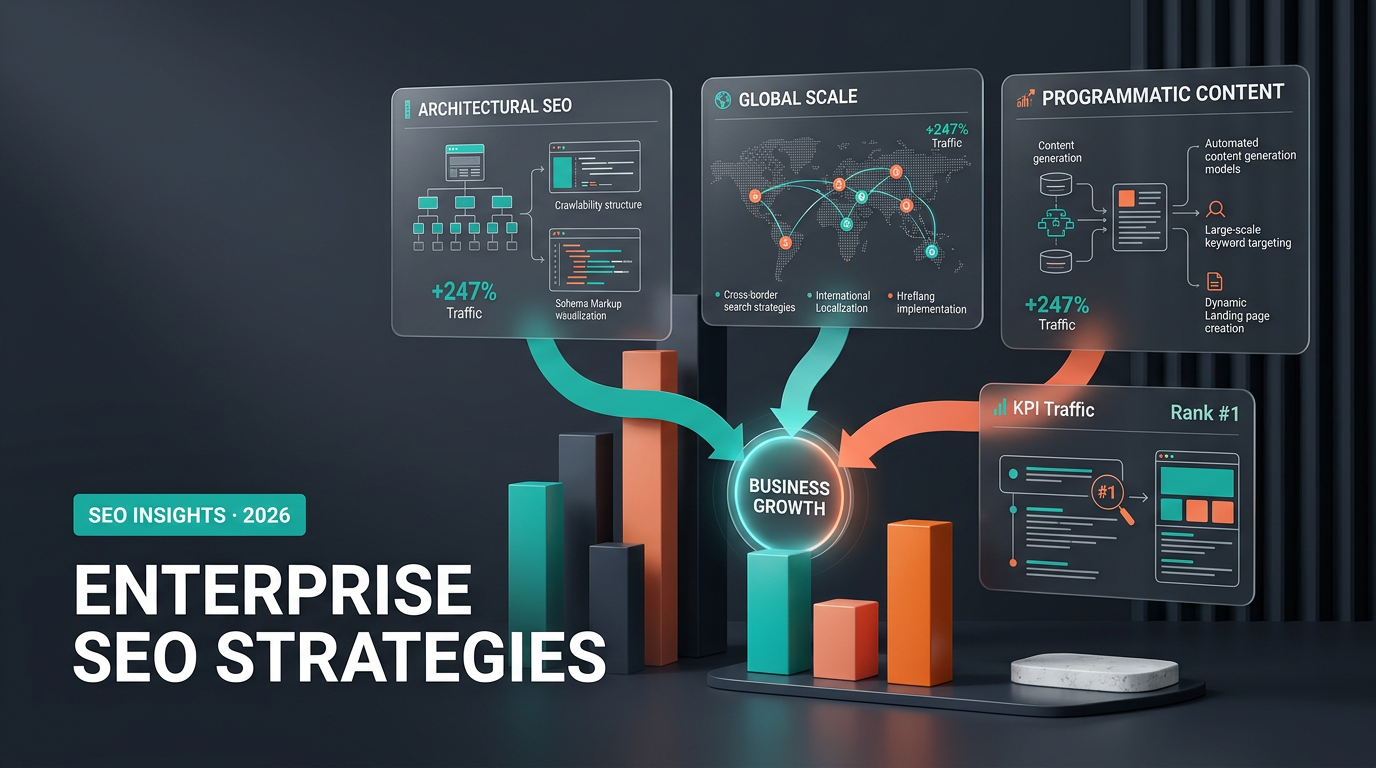
While the foundational principles of search remain, their application transforms entirely. This isn't just about doing more of the same; it's about operating on a different plane. Success in 2026 and beyond hinges on three pillars: architectural SEO that optimizes the entire system, international strategies that conquer global markets, and programmatic content engines that capture the long-tail at an impossible scale. It’s a transition from tactical execution to strategic governance, where SEO becomes a driver of product development, technology roadmaps, and global market expansion.
Architectural SEO: Engineering Visibility from the Code Up
At the enterprise level, “technical SEO” evolves into Architectural SEO. You’re no longer just fixing broken links; you’re influencing the very infrastructure the website is built on. A single flawed component in a page template can compromise millions of URLs, making template-first optimization the only viable path. The focus shifts from reactive fixes to proactive engineering to ensure crawlability, rendering, and indexation are flawless by design.
A core practice here is advanced crawl budget management, which goes beyond simple log file analysis. By feeding server logs and crawl data into machine learning models, teams can predict how code deployments will impact Googlebot’s behavior and prioritize resources on high-revenue sections of the site. Another critical frontier is Edge SEO, which involves using CDNs like Cloudflare Workers or Akamai EdgeWorkers to deploy SEO fixes—such as implementing redirects, modifying robots.txt, or adding hreflang tags—in minutes, bypassing lengthy developer backlogs.
Key Architectural SEO Priorities for 2026:
- Rendering Strategy Audits: Analyzing whether Server-Side Rendering (SSR), Incremental Static Regeneration (ISR), or client-side rendering is appropriate for different sections of a massive site to balance user experience with crawl efficiency.
- Edge SEO Implementation: Building a framework to deploy non-critical SEO changes directly at the CDN layer for rapid implementation and A/B testing of SEO hypotheses.
- Internal Tooling for Validation: Developing custom-built tools to automatically crawl and validate critical elements like canonicals, hreflang, and structured data across millions of pages before and after deployments.
- Platform-Level Core Web Vitals: Moving beyond page-level fixes to optimize CWV at the component and template level, ensuring performance is baked into the CMS and design system.
Global Domination: Mastering International SEO at Scale
For a global enterprise, an international SEO strategy is not optional—it's a prerequisite for market leadership. However, managing multiple languages, regions, and domains introduces immense complexity. A common failure point is the incorrect implementation of `hreflang` tags, which can lead to Google indexing the wrong country version of a page or consolidating signals incorrectly. At scale, manual `hreflang` management is impossible; it must be automated and built into the CMS, with robust monitoring to catch errors instantly.
The strategic choice between using ccTLDs (e.g., `piero.de`), subdomains (e.g., `de.piero.com`), or subfolders (e.g., `piero.com/de/`) has profound implications. While ccTLDs often provide the strongest local signal, they fragment domain authority and require a massive investment to build authority for each one. Subfolders consolidate authority on a single powerful domain but can present challenges with geo-targeting. As one agency notes, navigating these international SEO complexities is a hallmark of enterprise-level service.
Core Components of a Scalable International Strategy:
- Automated Hreflang Logic: Integrating `hreflang` generation directly into the CMS, where new pages automatically inherit the correct tags based on their position in the site architecture.
- Dynamic Content Personalization: Using a combination of geo-IP detection and user preferences to serve the correct language, currency, and product availability without relying on forced redirects, which can frustrate both users and search bots.
- Global vs. Local Keyword Strategy: Building a hybrid model where a central SEO team defines global priority themes, while in-market teams have the autonomy to target local-intent keywords and cultural nuances.
- Cross-Domain Authority Management: If using multiple ccTLDs, implementing a strategic internal linking and digital PR plan to ensure authority flows between regional properties, strengthening the entire portfolio.
The Content Engine: Programmatic SEO & Generative AI Hybrids
Manual content creation cannot keep pace with the thousands of long-tail search opportunities available to an enterprise. The solution is Programmatic SEO (pSEO), a systematic approach to creating pages at scale by combining structured data with well-designed templates. As Hallam points out, this is how giants like Amazon and Glassdoor built their SEO empires. A real estate site might combine a “homes for sale in [city]” template with a database of thousands of cities to instantly generate a massive footprint targeting local searches.
By 2026, the most effective pSEO strategies will be hybrids, blending programmatic structure with the creative power of Generative AI. Instead of using AI to write entire low-quality articles, leading enterprises will use LLMs to enrich programmatic pages. For example, an AI could generate unique FAQ sections for each product category page, summarize user reviews into a digestible paragraph, or create unique meta descriptions for 100,000 similar product pages, solving the duplicate content issues that often plague pSEO.
Building a Hybrid Programmatic SEO Engine:
- Identify Scalable Intent: Analyze search data to find patterns where user intent is structured around a core term plus a modifier (e.g., “best [product type] for [use case]”).
- Source Structured Data: Aggregate proprietary data (product specs, user data, locations) or utilize third-party APIs to build the database that will populate the templates.
- Design Modular Templates: Create highly-optimized page templates with clear placeholders for data and AI-generated content snippets. Ensure the core template is technically sound and fast.
- Integrate AI for Enrichment: Use APIs from models like GPT-4 or Claude to generate unique, value-add content elements (like summaries, pros/cons, or FAQs) for each page during the build process, governed by strict quality prompts.
- Implement Rigorous Quality Assurance: Develop automated checks to ensure generated pages are coherent, factually accurate, and provide genuine user value before they are published and indexed.
The Human Layer: Activating the SEO Center of Excellence (CoE)
The greatest barrier to enterprise SEO success is often organizational, not technical. In a large corporation, SEO recommendations compete for resources with product features, brand campaigns, and legal reviews. An SEO Center of Excellence (CoE) is the central nervous system that navigates this complexity. The CoE’s role is not to *do* all the SEO, but to empower the entire organization to make search-informed decisions.
This is achieved by embedding SEO specialists within product, engineering, and content teams, while the central CoE provides strategy, training, tooling, and governance. The CoE acts as an internal consultancy, helping a product team forecast the organic traffic potential of a new feature or providing the content team with a framework for creating topically authoritative content clusters. Using a RACI (Responsible, Accountable, Consulted, Informed) matrix is essential to clarify roles and prevent SEO from becoming a bottleneck.
In an enterprise, the SEO team's job is to make their job obsolete by baking SEO best practices into every team's standard operating procedure. Their goal is to build a self-sustaining SEO culture.
Measurement That Matters: Beyond Rankings to Business Impact
Vanity metrics like individual keyword rankings are largely irrelevant at the enterprise level. Executive leadership needs to see how SEO impacts revenue, market share, and profitability. Enterprise measurement connects organic search data to core business intelligence platforms, moving the conversation from “we ranked #1 for a keyword” to “our increased visibility for this product category drove a 15% increase in qualified leads, resulting in $3M of new pipeline.”
A critical metric for 2026 is Share of LLM (SoLLM). As AI-powered search answers (like Google’s SGE) become more prevalent, it’s not enough to rank in the ten blue links. Enterprises must measure how often their brand, data, and content are cited as a source within generative AI responses. This requires a new suite of tools and a strategy focused on becoming a definitive entity within Google’s Knowledge Graph through structured data, Wikipedia presence, and authoritative content.
Metrics for the Enterprise SEO Dashboard:
- Organic Market Share / Share of Voice (SoV): Tracking visibility across entire topic categories against key competitors, not just a small list of keywords.
- Share of LLM (SoLLM): Measuring brand and content citations within AI-generated search results and conversational assistants.
- SEO-Attributed Revenue: Connecting organic traffic and conversions to actual revenue figures via CRM and multi-touch attribution models.
- Indexation Rate & Crawl Efficiency: Monitoring the percentage of valuable pages that are successfully indexed and the ratio of crawls to indexed URLs.
Key Takeaways
- Shift from Tactical to Architectural: Focus on optimizing the underlying code, templates, and platform (Architectural SEO) rather than individual pages.
- Automate International Complexity: Use automated systems for `hreflang` management and a clear domain strategy to scale globally without creating technical chaos.
- Leverage AI-Hybrid Programmatic SEO: Use pSEO to create pages at scale and enrich them with unique, value-add content snippets generated by AI to avoid thin content penalties.
- Build a Center of Excellence (CoE): Establish a central SEO team to provide strategy, governance, and training, empowering the entire organization to make search-aware decisions.
- Measure Business Impact and SoLLM: Move beyond rankings to measure SEO's contribution to revenue, market share, and visibility within AI-generated search answers.