Scaling Enterprise SEO: Technical, International, and Programmatic Strategies
For enterprise organizations, the conversation around SEO has evolved. It’s no longer a question of *if* you should do SEO, but *how* you can do it at a scale that matches the complexity of your business. True enterprise SEO scaling isn't just about managing more keywords or pages; it’s about building a resilient, efficient, and intelligent program that grows predictably and delivers measurable impact on revenue across millions of assets.
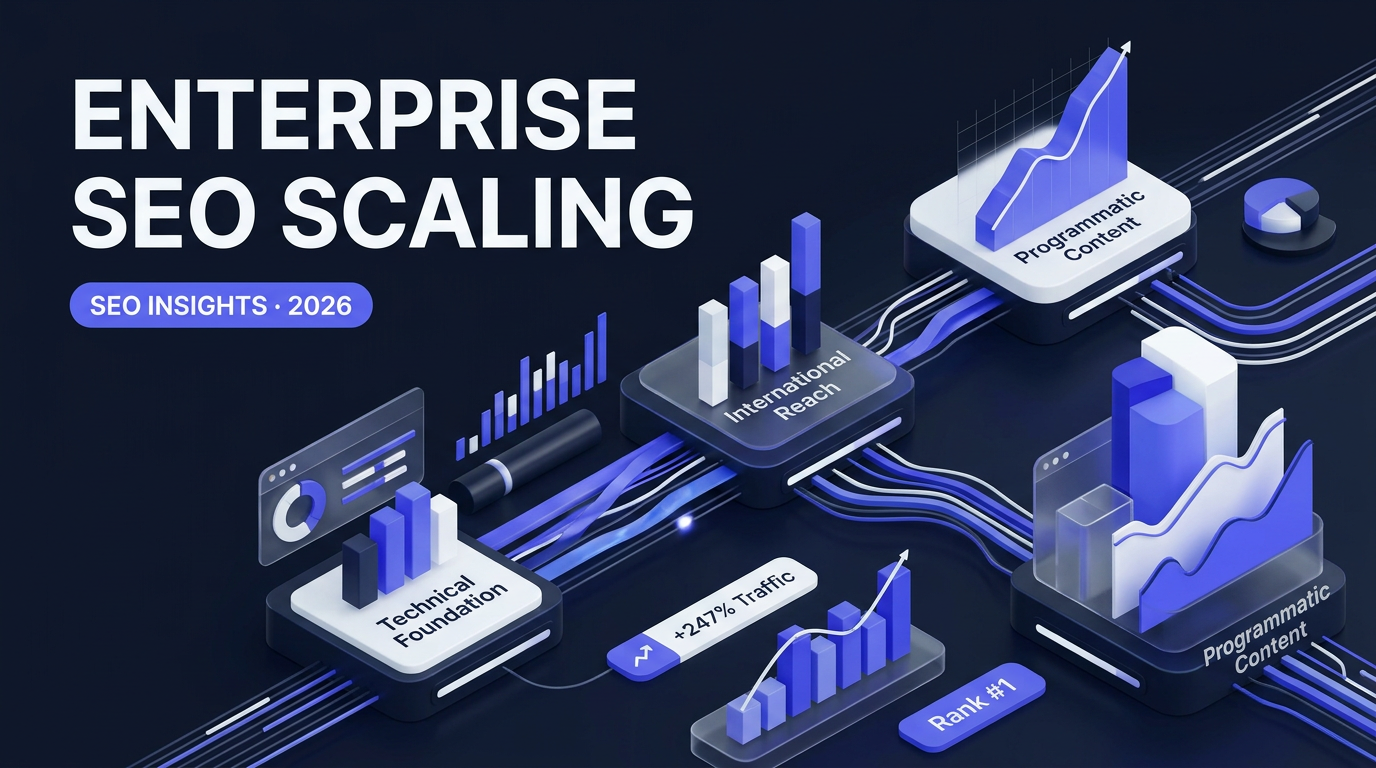
As we look toward 2026, the old playbook of manual audits and one-off content campaigns is officially obsolete. The new frontier is about creating systems—technical frameworks, international governance, and programmatic content engines—that amplify your efforts exponentially. This guide moves beyond the basics and dives into the strategic pillars required to scale your enterprise SEO program for sustainable, long-term dominance.
The Foundation: A Scalable Technical SEO Framework
At the enterprise level, technical SEO is not a project; it’s a continuous process of monitoring, diagnostics, and proactive optimization. A single misconfiguration in a `robots.txt` file or a faulty canonical deployment can impact millions of pages and erase millions in revenue overnight. Scaling requires moving from reactive fixes to a framework of automated oversight and modular architecture.
The core principle for 2026 is programmatic monitoring. This means leveraging technology to watch over your site's health 24/7. Instead of quarterly audits, you need real-time alerts for critical changes. Imagine getting an instant notification when a developer accidentally no-indexes a key product category or when Core Web Vitals scores for a primary page template drop below the acceptable threshold. This is the new standard of care for enterprise websites.
Building a scalable technical SEO program means engineering resilience. Your goal is to create a system where the default state is technically sound, and deviations are caught and corrected automatically before they cause damage.
A modern, scalable technical framework for an enterprise should include:
- Automated Log File Analysis: Don't just sample your log files; ingest and analyze them in their entirety. Use this data to get a true picture of how search engine bots are crawling your site, identify crawl budget waste on low-value URL parameters, and ensure your most important pages are being visited frequently.
- Template-Level Performance Monitoring: Don't just monitor the homepage. Track Core Web Vitals and other performance metrics across key page templates (e.g., product detail pages, category pages, articles). This allows you to identify systemic issues and prioritize fixes that will impact thousands of pages at once.
- Centralized Schema Management: Manually adding schema to individual pages is a recipe for errors and inconsistency. Implement a system, either through your CMS or a third-party tool, that dynamically generates and deploys schema markup based on page templates and data attributes. This ensures accuracy and makes updating your schema across the entire site a trivial task.
- Proactive Indexability Safeguards: Implement automated checks that monitor for critical changes to indexation signals. This includes monitoring `robots.txt`, meta robots tags, canonical tags, and HTTP status codes on key sections of your site, preventing catastrophic de-indexing events.
International SEO: Scaling Beyond Hreflang
For global enterprises, international SEO is often the biggest scaling challenge. While many teams get stuck on the technical implementation of `hreflang` (which is, admittedly, easy to break at scale), true international success goes much deeper. It’s about creating a governance model that balances global brand consistency with local market resonance.
The critical mistake most enterprises make is conflating translation with localization. Simply translating your English keywords and content into Spanish for the Mexican market is a failing strategy. You must invest in culturalization—understanding local search behavior, idioms, seasonal trends, and competitive landscapes. As defined by experts, enterprise SEO differs from other SEO precisely because this level of orchestration is required across diverse markets and product lines.
To scale your international SEO program effectively, focus on building a robust operational model:
- Establish a Global-Local Content Matrix: Define which content elements are “global” (brand messaging, core product specs) and must remain consistent, and which are “local” (case studies, regional promotions, blog topics) and can be adapted by local teams. This prevents brand dilution while empowering local marketers to be effective.
- Centralize Hreflang & Technical Signals: Manage your `hreflang` tags, ccTLD strategy, and other international technical signals from a central system. Use automated tools to continuously validate your implementation to catch breaks before they impact rankings.
- Invest in Local Market Intelligence: Do not rely on translated keyword data. Use in-market teams or consultants to perform genuine keyword research that uncovers how local customers actually search. This often reveals entirely different user intents and terminology.
- Adapt to Local Search Engines: Don't assume Google is the only player. If you're expanding into Russia, China, or South Korea, you need a dedicated strategy for Yandex, Baidu, and Naver, respectively. These engines have different algorithms, ranking factors, and technical requirements.
Programmatic SEO: The Content Scaling Engine
You cannot hire enough writers to manually create content for every long-tail opportunity an enterprise business has. This is where programmatic SEO becomes your most powerful lever for growth. Programmatic SEO is the strategic use of data and templates to generate thousands, or even millions, of high-quality, targeted pages at scale.
Forget the old stereotypes of low-quality, spun content. Modern programmatic SEO is about identifying a unique dataset and using it to create value for users. For example, a real estate marketplace can create pages for “average 2-bedroom apartment rent in [neighborhood],” or an e-commerce site can generate pages for “[product category] with [feature] under [price].” Each page is unique, serves a specific user intent, and would be impossible to create manually.
Building a Successful Programmatic SEO Project:
- Identify Your Data Moat: What unique data does your business possess? It could be product specifications, user-generated reviews, location data, market statistics, or pricing information. This data is the foundation of your programmatic strategy.
- Define Scalable Templates: Design page templates that are not only optimized for search but also provide a genuinely good user experience. The template should cleanly integrate your data, answer the user's core question, and include clear calls-to-action.
- Master Internal Linking: A critical, often-overlooked component of programmatic SEO is internal linking. You must develop a logical linking structure that connects your programmatic pages to each other and back to your core category and product pages. This distributes PageRank and helps search engines discover your millions of pages.
- Implement Rigorous QA: When you're creating pages at scale, small errors can multiply into huge problems. Before launching, implement a QA process that checks for thin content, broken templates, incorrect data, and poor usability. Launch in controlled batches to monitor performance and iterate.
The Human Element: Building an SEO Center of Excellence (CoE)
Tools and technology are only half the battle. To achieve true enterprise SEO scaling, you must scale your people and processes. The most effective way to do this is by establishing an SEO Center of Excellence (CoE). A CoE is a centralized team of SEO experts who act as internal consultants, strategists, and educators, rather than trying to execute every task themselves.
The CoE’s mission is to empower the entire organization—from developers to content creators to product managers—to make smarter decisions that positively impact organic search. This model shifts SEO from a siloed marketing function to an integrated business capability. The CoE is responsible for:
- Setting the Strategy & Standards: The CoE defines the organization-wide SEO strategy, sets KPIs, and creates the playbooks and documentation that other teams follow.
- Managing the SEO Tech Stack: They select, manage, and govern the enterprise SEO platforms and tools, ensuring the organization has a single source of truth for SEO data.
- Providing Training and Evangelism: The CoE trains other departments on SEO best practices and continuously evangelizes SEO's value by sharing success stories and tying performance to business outcomes like revenue and leads.
- Consulting on Major Initiatives: When a new product is launching or a site migration is planned, the CoE acts as the expert consultant to ensure SEO is baked into the project from the beginning, not bolted on at the end.
AI's Role in Scaling SEO for 2026
Artificial Intelligence is the ultimate accelerator for enterprise SEO scaling. Its true power isn't just in generating content drafts, but in processing and analyzing data at a scale no human team ever could. As we move toward 2026, AI is becoming essential for maintaining a competitive edge, especially with the rise of AI-driven search experiences like Google's AI Overviews, which demand a new level of content authority and structure. Preparing for what some call AEO (Answer Engine Optimization) is now a core part of enterprise strategy.
Integrate AI into your scaling strategy in these key areas:
- Opportunity Identification at Scale: Use AI to analyze millions of keywords, competitor pages, and SERP features to identify thematic content gaps and lucrative programmatic SEO opportunities that would be invisible to manual analysis.
- Advanced Technical SEO Diagnostics: Feed massive datasets (like full server logs) into AI models to detect subtle patterns in crawl behavior, identify hidden indexation issues, or predict crawl budget challenges before they occur.
- Automated Content QA and Optimization: Leverage AI to audit your content library at scale, checking for brand voice consistency, factual accuracy, internal linking opportunities, and outdated information. This automates a huge part of content maintenance.
- Intent Modeling and Forecasting: Use AI to move beyond simple keyword volume. Build models that understand the nuanced intent behind different query clusters and forecast the potential traffic and revenue impact of targeting those themes.
Key Takeaways
Scaling your enterprise SEO program for 2026 requires a fundamental shift in mindset from manual execution to building intelligent systems. To succeed, you must:
- Build a Resilient Technical Foundation: Move from one-off audits to continuous, automated monitoring to protect your site's health at scale.
- Think Globally, Act Locally: Develop a robust governance model for international SEO that balances global brand standards with deep, culturalized local market strategies.
- Leverage Programmatic SEO: Use your unique data to create thousands of valuable pages that capture the long tail of search intent, driving growth that’s impossible to achieve manually.
- Centralize Expertise with a CoE: Establish a Center of Excellence to scale SEO knowledge and best practices across the entire organization, turning SEO into a shared responsibility.
- Embrace AI as a Scaling Lever: Use AI not just for content creation, but for deep data analysis, opportunity identification, and automated QA to make your program more efficient and intelligent.