Beyond the Basics: Defining Your Enterprise SEO North Star for 2026
For a sprawling enterprise, thinking of SEO as a simple marketing checklist is a critical error. At this scale, you're not just optimizing a website; you're orchestrating a digital ecosystem with thousands, if not millions, of pages, multiple product lines, and diverse international markets. The most effective enterprise SEO strategies are not about chasing daily algorithm shifts but about building a resilient, scalable framework that aligns with core business objectives and drives sustainable long-term growth.
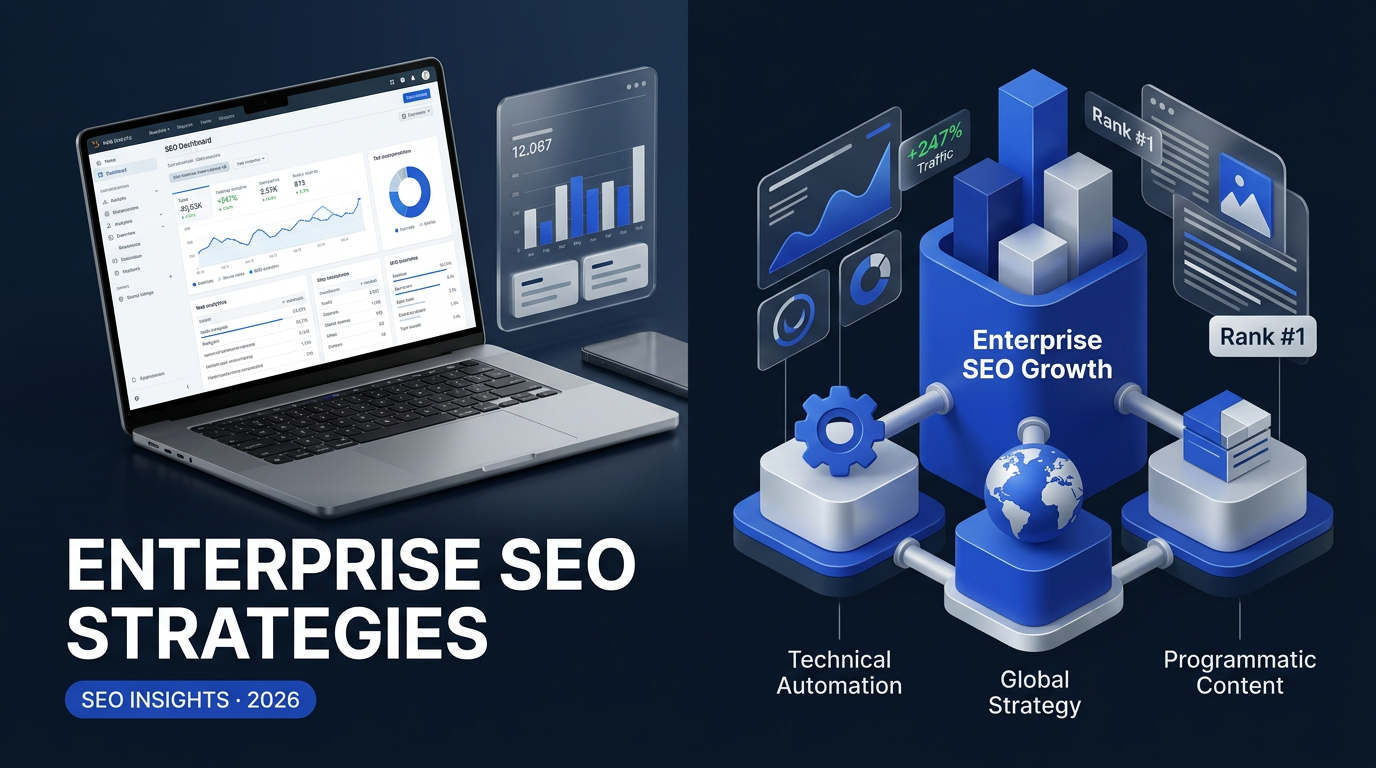
In 2026 and beyond, this framework must evolve. The challenges of managing massive sites are compounded by the rise of AI-driven search experiences and increasingly complex user journeys. A successful strategy rests on three core pillars: architecting a flawless technical foundation through automation, executing a nuanced global-local international strategy, and leveraging programmatic SEO to capture the long-tail at an unprecedented scale. This is your blueprint for moving beyond marketing tactics to establish SEO as a central driver of business intelligence and revenue.
Pillar 1: Architecting a Flawless Technical Foundation at Scale
While a strong technical foundation is SEO 101, for an enterprise, the stakes are exponentially higher. A single misconfigured canonical tag or a slow page template can impact tens of thousands of URLs, leading to massive losses in crawl budget and visibility. As one analysis points out, a well-planned enterprise SEO strategy combines technical excellence with scalability. In 2026, this means moving from reactive fixes to proactive, automated systems.
Instead of waiting for a quarterly audit to find problems, leverage automation to monitor site health continuously. This involves setting up automated log file analysis to understand exactly how search engine bots are crawling your site. By parsing logs daily, you can identify crawl budget waste, discover orphan pages that receive no internal links, and detect parameter-based duplicate content issues in near real-time. This allows your team to address systemic problems before they impact millions of pages.
Furthermore, the modern enterprise technical stack must include Edge SEO. Using platforms like Cloudflare Workers or Akamai EdgeWorkers, your SEO team can deploy critical fixes—like implementing redirects, modifying robots.txt, or updating title tags—directly at the CDN level. This decouples SEO execution from lengthy development sprints, giving you the agility to react to market changes or algorithm updates in hours, not months. This proactive and agile approach is the cornerstone of a resilient technical SEO program.
- Automated Log File Analysis: Use scripts (Python) or platforms like Splunk or Logz.io to automatically parse server logs, creating dashboards that visualize crawl frequency, status code errors (4xx/5xx), and crawl budget allocation by page type.
- Edge SEO Implementation: Deploy SEO changes via a Content Delivery Network (CDN) to bypass developer backlogs. This is ideal for A/B testing title tags, managing Hreflang tags at scale, or implementing security headers.
- Advanced Schema and Entity Building: Go beyond basic `Product` and `Article` schema. Build a comprehensive knowledge graph for your enterprise using interconnected `Organization`, `Service`, `Person`, and custom schema types to clearly define your entities for Google's Knowledge Graph and AI Overviews.
- Core Web Vitals Monitoring at Scale: Utilize Real User Monitoring (RUM) data alongside lab data (Lighthouse) to get a true picture of user experience across different countries, devices, and connection speeds. Set up alerts for when key templates fall below performance thresholds.
Pillar 2: Winning Globally with Advanced International SEO
For multinational enterprises, a one-size-fits-all approach to international SEO is a recipe for failure. Simply translating content and implementing `hreflang` tags is no longer sufficient. A winning global strategy requires a deep understanding of market-specific search behavior, cultural nuances, and the right technical architecture to serve users effectively.
The first major decision is your site architecture. While subdirectories (`example.com/de/`) are often easiest to manage, they may not instill the same level of local trust as a country code top-level domain (ccTLD) like `example.de`. A hybrid approach is often best for enterprises. Use ccTLDs for your primary, high-revenue markets where local brand identity is paramount. For smaller or emerging markets, use subdirectories on your main .com domain to consolidate authority while still providing a localized experience. This balances brand trust with SEO efficiency.
Next, you must move beyond direct translation to cultural adaptation. Keyword research must be conducted by native speakers or with tools that provide local search volume and cultural context. A term that drives commercial intent in one country might be purely informational in another. This extends to content formats, imagery, and calls-to-action. Your goal is to create an experience that feels genuinely local, not like a poorly translated version of your US site. This deep localization builds trust and significantly improves conversion rates.
- Choose a Hybrid Architecture: Deploy ccTLDs for top-tier markets (e.g., Germany, UK, Japan) to maximize local trust and targeting signals. Use subdirectories on a gTLD (e.g., .com/es/, .com/fr/) for secondary markets to consolidate domain authority.
- Conduct Culturally-Aware Keyword Mapping: Don't just translate keywords. Research local idioms, synonyms, and search intent. For example, a financial services company would target "checking account" in the US but "current account" in the UK.
- Implement SEO-Safe Geo-Selectors: Avoid automatic, IP-based redirects, which can confuse crawlers and frustrate users. Instead, use a prominent, non-intrusive banner on page load that suggests the correct local version, giving both users and search engines a clear choice.
- Localize More Than Just Language: Adapt currencies, payment methods, date formats, customer reviews, and featured case studies to reflect the local market. This demonstrates a genuine commitment to the region.
Pillar 3: Leveraging Programmatic SEO for Unrivaled Scale
What if you could create thousands of highly-specific, valuable landing pages without writing each one by hand? That is the power of Programmatic SEO (pSEO). It is a strategy for creating pages at scale by using a structured database and a consistent template. For enterprises with massive, proprietary datasets—product catalogs, location data, market statistics, service combinations—pSEO is the key to unlocking the vast, untapped potential of the long-tail.
Companies like Zillow (homes for sale in [city]), Zapier (how to connect [app A] to [app B]), and Tripadvisor (best hotels in [city]) are masters of this approach. They don't manually create millions of pages. Instead, they identify a user need that can be answered by combining data points. An enterprise B2B software company, for example, could create programmatic pages for every possible integration (`[Your Software] integration with [Competitor/Partner]`), every use case (`[Your Software] for [Industry]`), or every alternative (`[Competitor] alternative`).
A successful pSEO initiative requires more than just a database. The key is to create a template that provides unique value and a superb user experience. Each programmatic page should include not only the core data but also helpful surrounding content, user-generated reviews, internal links to relevant pillar pages, and clear calls-to-action. When done correctly, pSEO allows you to capture thousands of hyper-specific, high-intent queries that are impossible to target with a traditional content strategy.
- Identify Your Unique Dataset: What proprietary data does your company possess? This could be product specifications, location details, compatibility pairings, statistical data, or user-generated content.
- Define Keyword Modifiers: Determine the patterns users search for. Common modifiers include location (`in [city]`), comparisons (`[product A] vs [product B]`), integrations (`with [software]`), and use cases (`for [job role]`).
- Design a High-Value Template: Your template is crucial. It must be more than a thin data merge. Include unique H1s/titles, dynamic content blocks, FAQs, internal links, and imagery to create a genuinely useful page that satisfies search intent.
- Build a Robust Internal Linking Structure: Ensure your programmatic pages are discoverable. Link to them from relevant hub pages and, more importantly, create contextual links between the programmatic pages themselves (e.g., linking a page for "software for lawyers" to "software for paralegals").
Integrating AI into Your Enterprise Workflow (Beyond Content)
By 2026, leveraging AI in SEO has to mean more than prompting a language model to "write a blog post." For enterprises, the true value of AI lies in its ability to analyze massive datasets and automate complex tasks, helping you make smarter decisions faster. As search itself becomes increasingly powered by AI, from Google's AI Overviews to conversational assistants, enterprises that integrate AI into their workflows will gain a significant competitive edge.
Use AI for scaled intent analysis. Instead of manually categorizing a few hundred keywords, use Natural Language Processing (NLP) models to analyze and cluster tens of thousands of queries by their underlying intent—informational, commercial, navigational, or transactional. This allows you to map your entire keyword universe to your content strategy and identify gaps at a massive scale. This moves beyond simple keyword grouping to a deep understanding of your audience's needs at every stage of their journey.
Another powerful application is predictive SEO forecasting. By feeding historical performance data (rankings, traffic, conversions), seasonality, and competitor actions into a machine learning model, you can forecast the potential traffic and revenue impact of specific SEO initiatives. For instance, you could model the likely outcome of improving Core Web Vitals across 50,000 product pages. This transforms SEO conversations with the C-suite from a discussion about rankings to a data-backed projection of ROI, making it far easier to secure budget and buy-in.
- AI for Intent Analysis: Use tools with NLP capabilities or custom scripts to cluster large keyword sets by intent, allowing you to prioritize content creation based on business value (e.g., focusing on clusters with high commercial intent).
- AI-Powered Internal Linking: Employ tools like Sitebulb or custom solutions that use AI to crawl your site and suggest contextually relevant internal linking opportunities to distribute PageRank more effectively and improve content discoverability.
- Predictive SEO Forecasting: Leverage machine learning to build models that predict the outcome of SEO projects. This helps prioritize initiatives with the highest potential business impact and secures executive buy-in.
- Automated SERP Feature Analysis: Use AI to monitor SERP changes at scale, alerting you when competitors gain or lose featured snippets, AI Overviews, or People Also Ask boxes for your most important keyword clusters.
Key Takeaways
Transitioning to a true enterprise-level SEO mindset means shifting from isolated tasks to building interconnected, scalable systems. As you plan your strategy for 2026 and beyond, focus on these core principles to drive meaningful and sustainable growth.
- Build Systems, Not Checklists: Enterprise SEO success comes from creating repeatable, scalable, and often automated processes for technical health, content creation, and reporting.
- Automate Your Technical Foundation: Use log file analysis, Edge SEO, and automated monitoring to proactively manage site health instead of reactively fixing problems found in quarterly audits.
- Think Globally, Act Locally: An advanced international strategy requires a hybrid technical architecture and deep cultural adaptation, not just translation and `hreflang` tags.
- Unlock the Long-Tail with Programmatic SEO: Leverage your unique company data to create thousands of valuable pages at scale, capturing high-intent traffic that is impossible to target manually.
- Use AI for Analysis and Forecasting: Move beyond AI for content generation. Integrate AI to analyze user intent, audit internal links, and forecast the business impact of your SEO efforts.