Scaling Enterprise SEO: Technical, International, and Programmatic Strategies
For most businesses, SEO is a marketing channel. For an enterprise, it’s a complex system of technology, content, and process that underpins a significant portion of revenue. Traditional SEO tactics, built on manual changes and page-by-page analysis, don’t just become inefficient at this level—they break completely. This is the reality of enterprise SEO at scale, a discipline where success hinges on your ability to build robust, automated, and repeatable systems that drive growth across millions of pages and multiple markets.
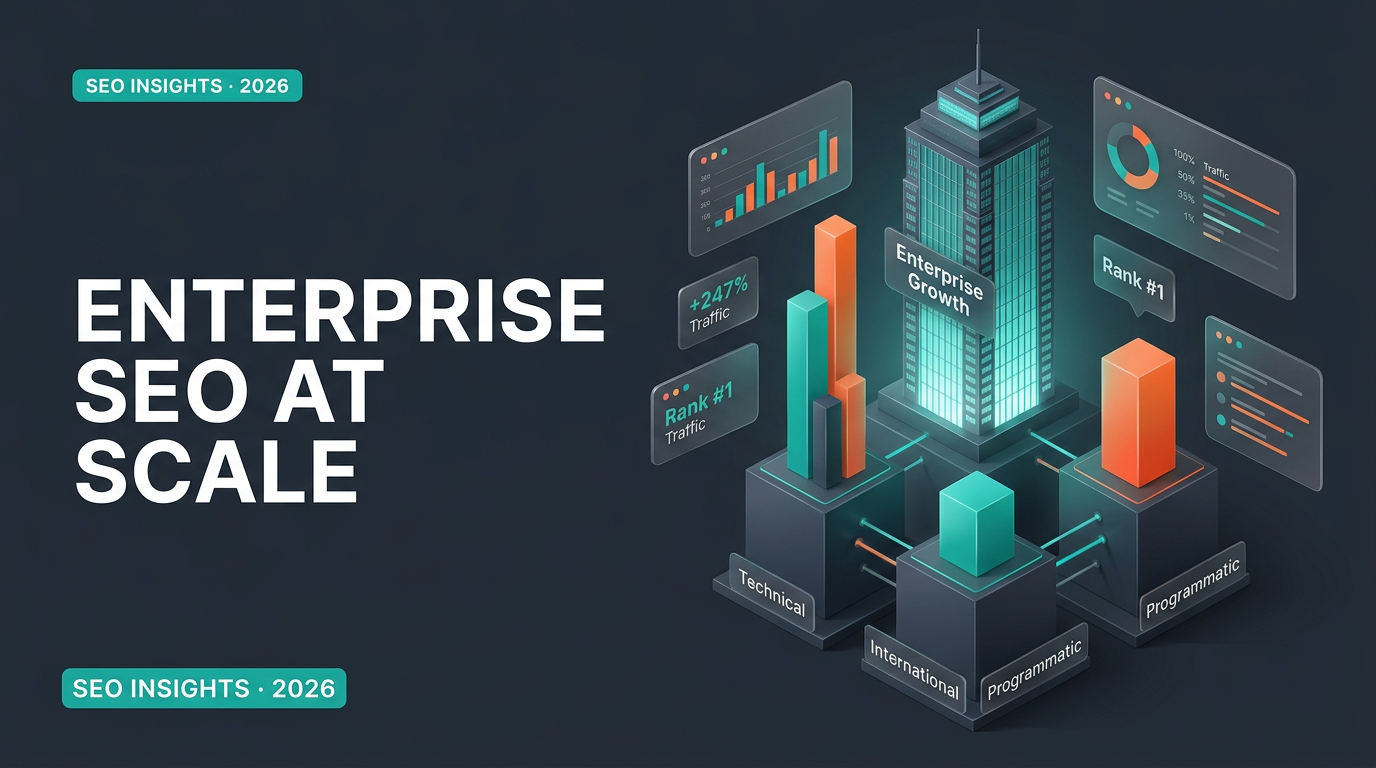
If you're stuck in a reactive loop of fixing crawl errors and struggling to prove ROI beyond a handful of hero pages, this playbook is for you. We'll move beyond the definitional basics of enterprise SEO and into the strategic frameworks that deliver compounding returns. In 2026, scaling SEO effectively requires mastering three interconnected pillars: technical automation, international precision, and programmatic content generation. Get these right, and you transform SEO from a marketing task into a core business driver.
The Foundational Shift: From Tasks to Systems
The core difference between standard and enterprise SEO isn't just the page count; it's a fundamental shift in mindset. You are no longer just optimizing web pages; you are optimizing the very systems that create and manage them. While smaller organizations focus on individual tasks, enterprise SEO success depends on coordinated efforts across development, content, product, and legal teams. This requires a higher level of orchestration and project management to create sustainable growth.
At this scale, manual processes become your biggest liability. A single developer pushing a change that blocks crawlers from a critical page template can erase millions in revenue overnight. A content team manually updating 500 product titles is a colossal waste of resources. The goal is to evolve from a reactive, task-based approach to a proactive, systems-based one. The cost of enterprise services reflects this complexity, covering everything from massive technical audits to automation and global market management.
This systemic approach manifests in several key transitions:
- From Page-Level to Template-Level Optimization: Instead of tweaking individual pages, you optimize the templates (e.g., Product Detail Page, Category Page, Article) that generate thousands or millions of instances.
- From Manual Audits to Automated Monitoring: Instead of running a quarterly site crawl, you have real-time alerts for SEO health issues like status code spikes, canonical conflicts, or Core Web Vitals regressions.
- From Siloed Execution to Cross-Functional Governance: Instead of the SEO team working in isolation, you establish an SEO Center of Excellence that embeds best practices directly into other departments' workflows.
- From One-Size-Fits-All to Market-Specific Strategies: Instead of just translating content, you build systems to manage localized intent, regional SERP features, and currency/legal requirements.
Pillar 1: Mastering Technical SEO at Scale
Technical SEO is the foundation upon which all other efforts are built. For an enterprise, this foundation is less like a simple house slab and more like the complex, deep-set pilings of a skyscraper. A single crack can compromise the entire structure. In 2026, managing this foundation relies on automation, proactive monitoring, and a deep understanding of how search engine crawlers interact with your specific architecture.
Forget manual spot-checks. Your primary tools are now log file analyzers, automated crawl platforms, and AI-driven anomaly detection systems. By analyzing log files, you see exactly how Googlebot uses its crawl budget on your site—are crawlers getting lost in faceted navigation, or are they efficiently finding your most important pages? This data is your ground truth, allowing you to make high-impact decisions like blocking low-value URL parameters or identifying orphan pages that are invisible to your internal linking structure.
To build a resilient technical SEO framework, focus on these scalable initiatives:
- Automated Health Dashboards: Integrate your crawl tools (e.g., Sitebulb, Screaming Frog) with data visualization platforms (e.g., Looker Studio, Power BI). Build dashboards that monitor critical metrics in real-time and trigger alerts for deviations, such as a sudden increase in 404 errors, a drop in indexable pages, or a negative shift in Core Web Vitals for a key page template.
- Algorithmic Internal Linking: Don't rely on editors manually adding links. Work with developers to build smart internal linking modules. For example, a product page template should automatically link to its parent category, relevant subcategories, and other products frequently bought with it. An article should programmatically link to related posts based on tags or semantic relevance.
- Template-Driven Schema Markup: Hard-coding schema on individual pages is a recipe for disaster. Define your schema (Product, Article, FAQPage, etc.) at the template level. Use variables to dynamically pull in data like price, availability, author, and publish date from your backend. This ensures 100% coverage and consistency with zero manual effort.
- Proactive Crawl Budget Management: Use log file analysis to identify URL parameters that create duplicate content and add no SEO value (e.g., tracking, filtering, sorting parameters). Systematically disallow these in your `robots.txt` file to focus Googlebot's resources on your canonical, high-value pages.
Pillar 2: Conquering International SEO with Precision
For global enterprises, international SEO is often the area with the most complexity and the highest potential for scalable growth. It’s far more than just translating your website; it's about creating a localized experience that respects cultural search behavior, technical requirements, and regional business goals. The most common point of failure is `hreflang` management. Manually maintaining `hreflang` tags across tens of thousands of pages and dozens of country/language combinations is impossible to do correctly.
The solution is programmatic `hreflang` management. This involves creating a centralized database or mapping file that defines the relationship between every equivalent page across all your international properties. This file becomes the single source of truth, used to automatically generate `hreflang` tags in your HTML `
` or XML sitemaps. This system ensures every new page is correctly mapped from day one and that any changes (like launching a new country site) are reflected everywhere instantly.Beyond `hreflang`, a winning international strategy for 2026 includes:
- A User-First Geo-Routing Strategy: Avoid aggressive, IP-based automatic redirects. They can frustrate users and prevent search engines from crawling all versions of your site. Instead, use a subtle banner or pop-up suggesting the correct local version to the user, giving them the choice. This is both user-friendly and SEO-safe.
- True Content Localization, Not Just Translation: A keyword that drives commercial intent in the US might be informational in Germany. Work with local market experts or native-speaking strategists to perform keyword research for each region. Adapt content, imagery, and calls-to-action to reflect cultural norms and local search intent. A/B test currency symbols, date formats, and payment options.
- Market-Specific Performance Monitoring: Your CDN might be lightning-fast in North America but slow in Southeast Asia. Track Core Web Vitals, rankings, and traffic trends separately for each key market. This allows you to identify and address region-specific performance bottlenecks that a global average would hide.
- Global Domain Strategy Governance: Whether you use ccTLDs (`.de`, `.fr`), subdomains (`de.example.com`), or subdirectories (`example.com/de/`), have a clear governance model. Document the strategy and ensure all teams understand the implications for content deployment, analytics tracking, and backlink acquisition.
Pillar 3: Driving Exponential Growth with Programmatic SEO
Programmatic SEO is the pinnacle of scaling. It is the practice of leveraging structured data to automatically generate thousands—or even millions—of unique, targeted landing pages that serve long-tail user intent. This is not about creating spammy, keyword-stuffed pages. When done right, it's about creating genuinely useful resources at a scale that would be impossible for human editors to replicate.
Think about sites like Zillow, TripAdvisor, or Zapier. Their dominance is built on programmatic SEO. Zillow combines a "location" dataset with a "property feature" dataset to create pages for queries like "3-bedroom houses for sale in Austin with a pool." Zapier programmatically creates a landing page for every possible app integration, capturing search traffic for "connect Gmail to Slack." The key is a unique, proprietary, or well-structured dataset and a template designed to present that data in a valuable way.
A successful programmatic SEO engine has several core components:
- Identify Your Core Data and Modifiers: Start by identifying your primary dataset (the "head term"), such as products, locations, or services. Then, identify the "modifiers" that users search for in combination with that head term, such as features, benefits, or comparisons. This forms the basis of the pages you'll create (e.g., `[Head] with [Modifier]`).
- Design a Value-Driven Page Template: This is the most critical step. Your template must do more than just combine keywords in a title. Each programmatic page needs to offer unique value. This can be achieved by including elements like aggregated user reviews, dynamic charts based on your data, unique photo galleries, or a Q&A section populated with relevant People Also Ask queries.
- Ensure Robust Internal Linking: Your programmatic pages shouldn't be orphans. The template should include logic to link related programmatic pages to each other (e.g., linking from "apartments in Brooklyn" to "apartments in Queens") and to link up to broader parent category pages. This creates powerful topic clusters that consolidate authority.
- Plan for Indexation and Content Quality: Generating millions of pages is easy; getting them indexed and ranked is hard. Implement a phased rollout strategy. Start with your most valuable page combinations and monitor their indexation and performance. Ensure your server can handle the increased crawl demand. Crucially, have a mechanism to noindex or remove thin pages that provide little user value.
The Unifying Layer: Governance and Cross-Functional Alignment
You can have the most brilliant technical, international, and programmatic strategies in the world, but they will fail without buy-in and collaboration from other departments. Enterprise SEO is a team sport. Your role as an SEO strategist is often that of an educator, diplomat, and project manager. The most effective way to manage this is by creating an SEO Center of Excellence (CoE).
A CoE isn't necessarily a formal team, but a governance framework that embeds SEO best practices across the organization. It's about shifting the culture from "the SEO team will fix it later" to "we all build for search from the start." This framework ensures that developers don't break the site, content creators target the right keywords, and the C-suite understands the direct link between SEO initiatives and revenue.
Your governance framework should include:
- SEO "Guardrails" in Development: Work with the engineering team to build SEO requirements directly into the development lifecycle. This could include automated checks in the CI/CD pipeline that prevent deployments with missing title tags, broken canonicals, or major performance regressions.
- Shared KPIs and Objectives: Tie SEO goals to departmental objectives. For the dev team, it's Core Web Vitals. For the content team, it's organic traffic to new articles. For the product team, it's the organic conversion rate on new features. When everyone is measured on a piece of the SEO pie, everyone cares.
- Education and Advocacy: Host regular workshops and lunch-and-learns. Create simple, accessible documentation. Translate complex SEO jargon into clear business impact. When a product manager understands that schema markup drives higher click-through rates, they will champion its implementation for you.
Key Takeaways
Scaling enterprise SEO in 2026 is about building resilient, automated systems that multiply your impact. Trying to apply small-scale tactics to a large-scale website will only lead to burnout and stagnant results. By focusing your efforts on these core principles, you can build a sustainable, predictable engine for organic growth.
- Systemize Everything: Move away from manual, reactive tasks and build automated, proactive systems for everything from technical monitoring to content creation.
- Automate Your Technical Foundation: Use log file analysis, automated alerts, and template-level optimizations to manage site health and crawlability at scale.
- Go Global with Precision: Manage `hreflang` programmatically and invest in true content localization to win in international markets.
- Leverage Programmatic SEO: Use structured data to create thousands of valuable, long-tail pages that humans could never build manually.
- Lead Through Governance: Your ultimate role is to build a cross-functional governance model that embeds SEO into the company's DNA, ensuring long-term, scalable success.