
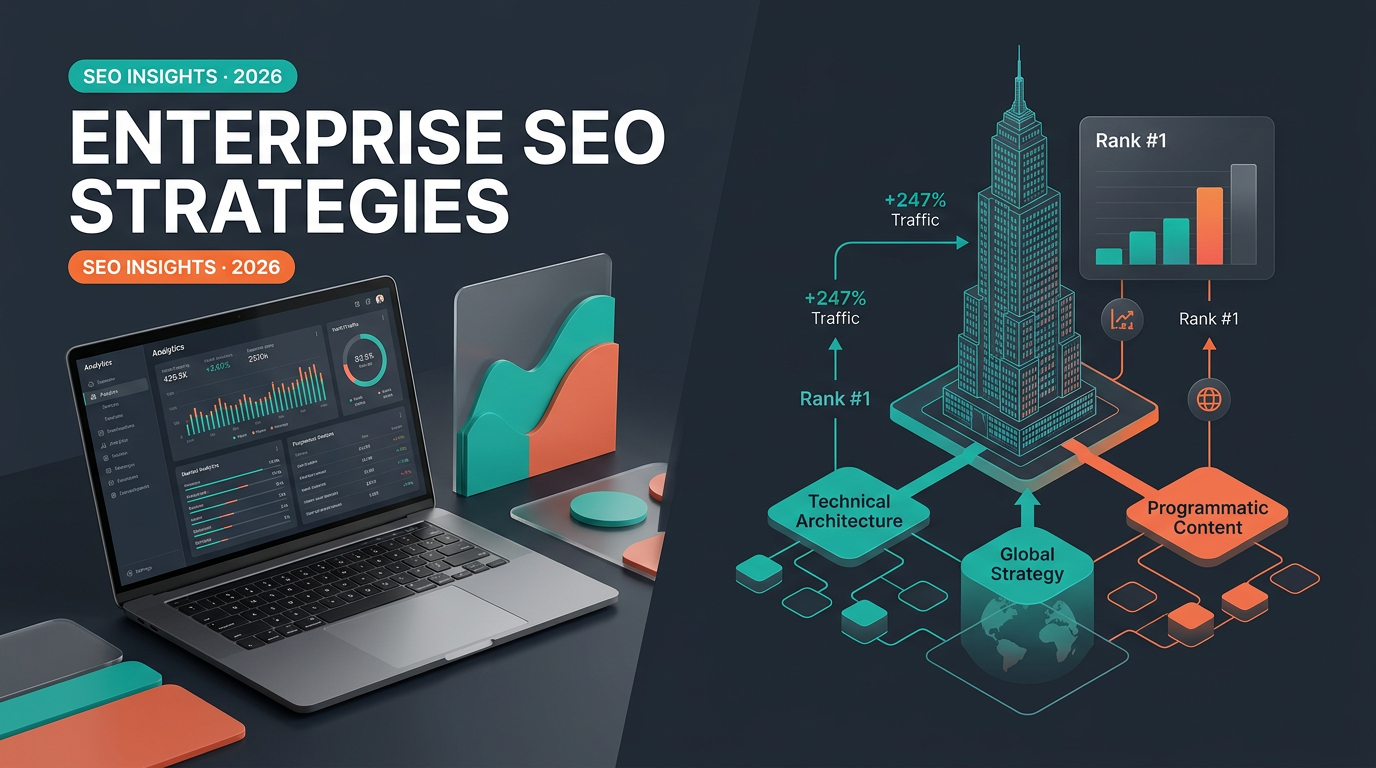
Beyond the Basics: Redefining the Enterprise SEO Mindset for 2026
For too long, SEO has been relegated to a marketing checklist: optimize titles, build links, write blogs. This approach fails catastrophically at the enterprise level. To succeed in 2026, you must stop thinking like a marketer applying tactics and start thinking like an architect designing systems. The most effective enterprise SEO strategies are not about fixing individual pages; they are about engineering a scalable, self-sustaining ecosystem for organic growth that integrates directly into the core of the business.
This fundamental shift is from tactical execution to strategic governance. While the foundational principles of SEO remain, the mechanisms required to manage millions of pages, multiple languages, and complex internal politics are entirely different. As one analysis notes, the transition from traditional SEO to the enterprise tier is a fundamental phase shift in how value is managed. Success is no longer measured in keyword rankings alone, but in durable authority, market share, and organizational alignment.
The goal is to build an SEO moat—an unassailable competitive advantage rooted in superior technology, scalable content models, and deep organizational integration. This requires a long-term vision where SEO is not a cost center, but a core product with its own roadmap, resources, and P&L impact. It’s about building a machine that generates predictable, compounding returns.
Mastering Technical SEO at Scale: From Crawl Budget to Edge Computing
At the enterprise level, technical SEO transcends on-page basics and becomes an exercise in large-scale systems engineering. With websites often exceeding millions of URLs, your primary constraint is not Google's ability to rank, but its ability to efficiently crawl and index your most valuable content. Wasting crawl budget on low-value parameter URLs, broken redirects, or inefficiently rendered pages is the silent killer of enterprise organic performance.
The starting point remains log file analysis to understand exactly how search engine bots interact with your infrastructure. However, the solutions in 2026 are far more sophisticated. Instead of waiting for developer backlogs, advanced teams are using Edge SEO. By leveraging Content Delivery Network (CDN) workers (like Cloudflare Workers or Akamai EdgeWorkers), SEO teams can implement critical fixes—such as redirects, hreflang tags, or security headers—in minutes, not months, without ever touching the core application code.
A modern enterprise technical SEO program must prioritize:
- Crawl Budget Optimization: Aggressively disallowing irrelevant URL parameters via robots.txt, using log files to identify and fix crawl traps, and ensuring a clean internal linking structure that prioritizes commercially valuable pages.
- Rendering Strategy: Implementing a hybrid rendering approach. Use Server-Side Rendering (SSR) for critical, static landing pages to ensure maximum crawlability and performance. Employ Dynamic Rendering for user-specific or highly interactive pages, serving a static HTML version to bots and a rich JavaScript version to users.
- Advanced Schema & Structured Data: Moving beyond basic product and article schema to build a comprehensive entity map of your entire business. Use `sameAs` to connect to authoritative sources like Wikipedia and implement nested schema to clearly define relationships between your products, services, and brand for both search engines and emerging AI answer engines.
- Core Web Vitals at Scale: Monitoring and improving CWV not on a page-by-page basis, but at the template level. Identify which content management system (CMS) templates are generating pages with poor Largest Contentful Paint (LCP) or Cumulative Layout Shift (CLS) and engineer performance improvements into the template itself to fix thousands of pages at once.
The Global Frontier: Architecting a Bulletproof International SEO Strategy
For global enterprises, international SEO is not an add-on; it is a critical pillar for market expansion. A poorly architected global web presence creates content duplication, keyword cannibalization, and a confusing user experience that erodes brand trust and search visibility. The key is to make a definitive structural decision early and enforce it with ruthless consistency.
The primary architectural choice is between ccTLDs (e.g., `yourbrand.de`), subdirectories (e.g., `yourbrand.com/de`), and subdomains (e.g., `de.yourbrand.com`). While ccTLDs send the strongest local signal, they are operationally expensive and fragment domain authority. For most enterprises, a subdirectory structure offers the best balance of localized targeting and consolidated authority, allowing the strength of the root domain to benefit all markets.
Executing this at scale requires automation and strict governance. Hreflang tags, which signal the language and geographic targeting of a page, are notoriously difficult to manage across millions of pages. An enterprise solution involves:
- Automated Hreflang Generation: Building rules into your CMS to automatically generate and insert correct hreflang tags on all relevant page templates. The tags should be self-referencing and include a link to every other equivalent version of the page.
- XML Sitemap Integration: Placing hreflang annotations within your XML sitemaps is a cleaner, more scalable method than in-page tags. This centralizes the logic and reduces HTML bloat on every page.
- Continuous Monitoring: Using enterprise-grade crawlers to constantly monitor for hreflang errors, such as incorrect language codes or broken return links, and trigger alerts for immediate remediation. As noted by experts evaluating the capabilities of top agencies, robust international and programmatic SEO are hallmarks of a mature practice.
Finally, go beyond simple translation. True localization involves adapting content, currency, imagery, and even user experience to meet local cultural expectations. This might mean creating a programmatic engine that populates templates with region-specific data, ensuring that a user in Germany sees different product highlights and customer testimonials than a user in Japan.
Programmatic SEO 2.0: Building Your Content Moat with Data and AI
Manual content creation cannot win at the enterprise scale. The only way to capture the immense “long tail” of search intent—highly specific, low-volume queries that collectively represent a massive traffic opportunity—is through Programmatic SEO (pSEO). This involves using a structured dataset and a dynamic template to automatically generate thousands, or even millions, of unique, optimized pages.
Think of Glassdoor’s “Salaries for [Job Title] in [City]” pages or Zillow’s pages for every address in the country. This is pSEO in action. However, the 2026 iteration, or pSEO 2.0, moves beyond simple mail-merge-style page creation and incorporates a higher degree of sophistication and quality control, often augmented by AI.
The pSEO 2.0 workflow looks like this:
- Strategic Opportunity Identification: Using data analysis tools to find repeatable query patterns (e.g., “best [product category] for [user need]”) where you have unique internal or third-party data to provide value.
- Data Sourcing and Structuring: Aggregating your proprietary data—product specs, user reviews, location details—into a clean, structured database or API. This data is the fuel for your pSEO engine.
- AI-Augmented Template Design: Creating highly modular page templates with placeholders for your data. In pSEO 2.0, AI can be used to generate dozens of unique headline and meta description variations for each page type to avoid duplication penalties and improve click-through rates.
- Human-in-the-Loop Quality Assurance: While generation is automated, a crucial step is human review. Editors and SEOs spot-check generated pages, refine the underlying templates, and ensure the final output is genuinely useful and not just spammy, low-quality content. This quality layer is what separates successful pSEO from failed projects.
- Automated Internal Linking: Building logic into your system that automatically adds contextual internal links between generated pages and to your core commercial pages, creating a powerful, interconnected site architecture that funnels authority effectively.
Governance and Growth: Embedding SEO into the Enterprise DNA
The single biggest obstacle to enterprise SEO success is not technical; it's organizational. Brilliant strategies die in ticketing queues, get vetoed by legal departments, or are undone by uninformed product updates. Without a framework for governance, your SEO program will be perpetually fighting fires instead of building assets. The most effective solution is to establish an SEO Center of Excellence (CoE).
A CoE is a centralized team of SEO experts who set the strategy, define standards, control the core toolset, and provide reporting. However, they don't do all the work themselves. Instead, they empower and educate “embedded” SEO champions within other departments—product, engineering, content, and brand. This hybrid model ensures that SEO expertise is present at the inception of a project, not bolted on at the end.
To manage these cross-functional dependencies, a RACI (Responsible, Accountable, Consulted, Informed) matrix is non-negotiable. It clarifies roles and prevents gridlock:
The product team is Responsible for building a new feature. The SEO CoE is Accountable for its organic search performance. The engineering team is Consulted on implementation, and the CMO is Informed of the progress.
This framework is supported by a shared roadmap that aligns SEO initiatives with business priorities and engineering sprints. Instead of filing ad-hoc tickets, the SEO team presents a business case for initiatives like “Improve Mobile Performance for Category Page Templates,” complete with a forecasted revenue impact. This reframes SEO from a technical chore into a measurable driver of business growth.
Measuring What Matters: From Share of Voice to Share of AI Answers
Legacy metrics like rank tracking for a few dozen head terms are woefully inadequate for measuring enterprise SEO. At scale, you must measure your visibility across the entire market. The gold standard for this has been Share of Voice (SoV), which calculates your brand’s visibility across thousands of important keywords compared to your key competitors. It is a direct proxy for organic market share.
But the landscape of 2026 demands a new, even more critical KPI: Share of AI Answers (SoAA), also known as Share of LLM. As users increasingly get answers directly from AI overviews and conversational search interfaces, simply ranking #1 is not enough. Your brand must be the source cited within these AI-generated results. Being the authoritative source in a Google AI Overview is the new #1 ranking.
Achieving a high SoAA is the goal of a new discipline: Generative Engine Optimization (GEO). Winning here requires a specific set of strategies:
- Authoritative, Factual Content: Creating demonstrably expert content that is well-researched and cites sources. AI models are trained to prioritize trustworthy information.
- Highly Structured Data: Using comprehensive schema markup to explicitly tell AI models what your content is about, who wrote it, and what facts it contains.
- Clear Sourcing and E-E-A-T: Ensuring your content demonstrates top-tier Experience, Expertise, Authoritativeness, and Trustworthiness. This includes clear author bios, robust “About Us” information, and easy-to-find contact details.
- Building a Knowledge Graph: Developing a rich internal network of content around your core topics, positioning your domain as a definitive resource that AI can confidently reference.
Your future reporting dashboards must track not only your SoV in traditional SERPs but also your SoAA within generative experiences. The brands that master this will own the next era of search.
Key Takeaways
- Adopt an Architect's Mindset: Shift from page-level tactics to designing scalable systems for technical SEO, content, and governance.
- Master Technical SEO at Scale: Prioritize crawl budget, implement an intelligent rendering strategy, and leverage Edge SEO to bypass developer backlogs.
- Build a Cohesive Global Presence: Choose a single URL structure (usually subdirectories) and automate hreflang implementation to effectively conquer international markets.
- Embrace Programmatic SEO 2.0: Use data and AI to generate thousands of high-quality pages at scale, but maintain a human-in-the-loop for quality assurance.
- Establish an SEO Center of Excellence: Create a centralized team to set strategy and standards, empowering embedded champions throughout the organization with a clear RACI matrix.
- Measure for the AI Era: Move beyond rank tracking to measure Share of Voice (SoV) and, most critically, your Share of AI Answers (SoAA) to win in generative search.