
Scaling Enterprise SEO: Technical, International, and Programmatic Strategies
For a growing enterprise, there comes a moment when your old SEO playbook becomes not just outdated, but a liability. The tactics that got you to your first million in organic traffic simply break when applied to a ten-million-page website spanning multiple countries and product lines. This isn't a failure of strategy; it's a failure of scale. The transition to enterprise-level thinking requires a fundamental phase shift, moving from hands-on tactics to scalable systems. Mastering modern enterprise SEO strategies is no longer about winning a few keywords; it's about building a durable, defensible organic growth engine.
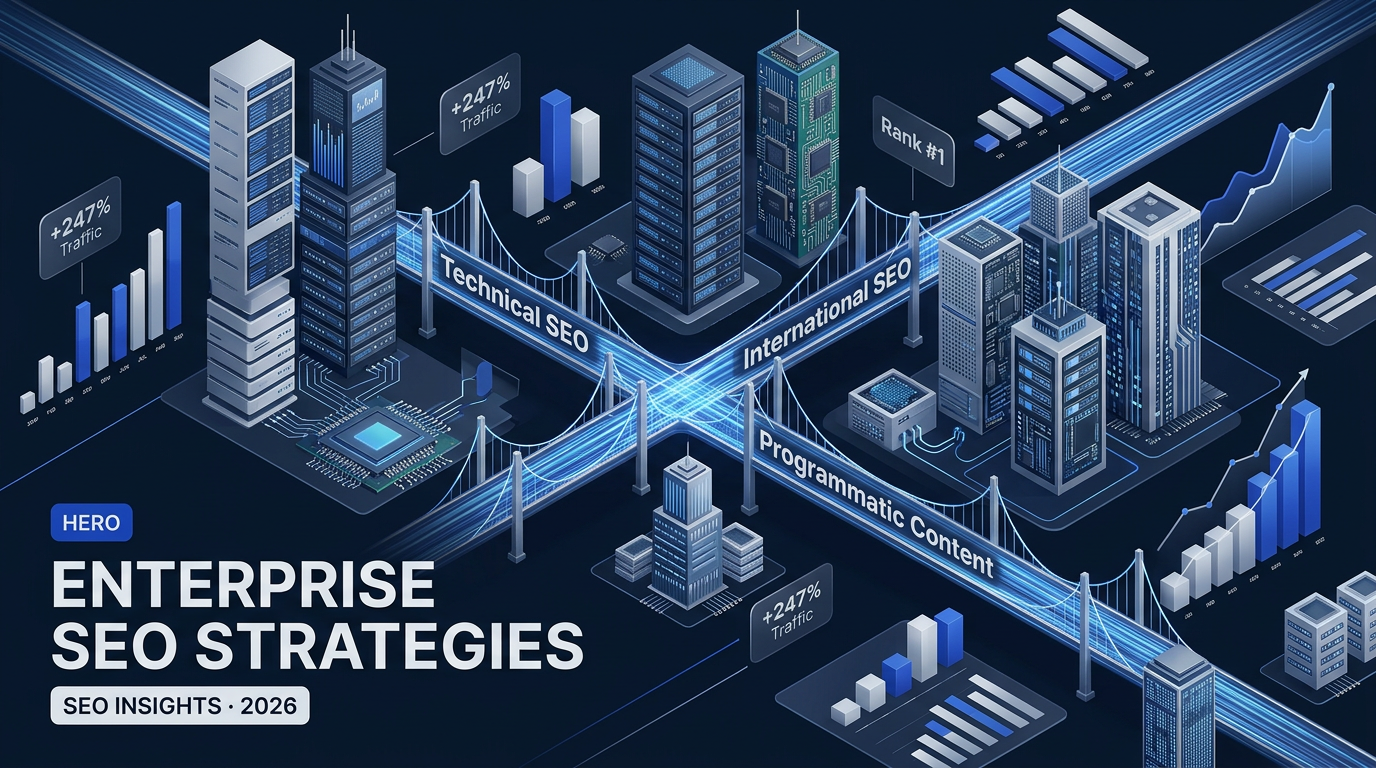
Forget manual page optimization and small-batch content creation. Success in 2026 is defined by your ability to manage three core pillars at immense scale: technical governance, international complexity, and programmatic content. This isn't just about doing more SEO; it’s about architecting an entirely new way of operating. It’s about building a system where growth is the default, not the exception, and where your website becomes a primary source of truth for both users and the AI models that now shape search.
Redefining SEO: The Enterprise Scale Gap
The core principles of SEO—crawling, indexing, and ranking—remain constant, but the mechanisms to manage them at an enterprise level are profoundly different. As one agency aptly notes, the game changes when you're managing millions of pages instead of hundreds. A small business obsesses over individual page rankings; an enterprise must obsess over the systems that enable thousands of pages to rank simultaneously.
This is the scale gap. It’s the chasm between manual work and automated governance. Attempting to apply small-business thinking to an enterprise-level domain leads to wasted resources, technical debt, and missed opportunities. The mindset must shift from one-off fixes to template-first optimization and from chasing keyword rankings to capturing market-wide share of voice.
- Focus Shift: From ranking for 100 head terms to dominating the SERPs for 100,000 long-tail variations.
- Execution Shift: From manual on-page tweaks to programmatic updates affecting thousands of pages via a single template change.
- Approval Shift: From a single stakeholder to a complex web of Legal, IT, Product, and Brand teams, necessitating frameworks like RACI (Responsible, Accountable, Consulted, Informed).
- Measurement Shift: From simple traffic and rank tracking to sophisticated ROI models based on Share of Voice (SoV) and even Share of LLM (SoLLM).
Mastering the Machine: Advanced Technical SEO Governance
At the enterprise level, technical SEO is not a one-time audit; it's a continuous process of governance. Your primary challenge is no longer getting Google to find your pages, but ensuring it doesn't waste its finite crawl budget on low-value URLs. With millions of potential pages, optimizing crawl efficiency is paramount.
This starts with advanced log file analysis. By analyzing raw server logs, you gain a direct view of how search engine bots interact with your site, identifying crawl traps, wasted resources on parameterized URLs, and inefficient internal linking paths. But in 2026, we take it a step further by automating this process. By piping log file data into a BI dashboard (like Looker or Tableau), you can create real-time monitoring for crawl behavior, setting alerts for anomalies before they impact performance. This moves log analysis from a reactive forensic tool to a proactive governance system.
Furthermore, managing JavaScript-heavy frameworks (React, Angular, Vue.js) is critical. The debate isn't just CSR vs. SSR anymore; it's about building a flexible rendering pipeline. A common enterprise strategy involves:
- Server-Side Rendering (SSR): For core, high-value pages like product categories and key landing pages to ensure fast, flawless indexing.
- Static Site Generation (SSG): For marketing pages and blogs that don't change often, providing maximum speed.
- Client-Side Rendering (CSR) with Dynamic Rendering: As a fallback for complex, user-gated sections, where a prerendered version is served to bots while users get the dynamic experience.
Conquering the Globe: Nuanced International SEO
For global enterprises, international SEO is a minefield of complexity that goes far beyond implementing `hreflang` tags. The biggest strategic decision is how to structure your global web presence, and the choice has massive long-term implications for budget, resources, and authority.
The three primary models are:
- ccTLDs (e.g., `yourbrand.de`, `yourbrand.fr`): The strongest signal for geo-targeting and perceived as local by users. However, it's the most expensive and resource-intensive, as each domain is a separate entity that needs to build its own authority from scratch.
- Subdomains (e.g., `de.yourbrand.com`, `fr.yourbrand.com`): A middle ground. Easier to set up than ccTLDs and allows for distinct server locations. Google is better at associating authority back to the main domain, but it's still a weaker signal than a subdirectory.
- Subdirectories (e.g., `yourbrand.com/de/`, `yourbrand.com/fr/`): The most common and SEO-efficient approach. All authority is consolidated on a single powerful domain, making it easier to rank new international sections. This is the recommended path unless there are strong legal or branding reasons to use ccTLDs.
Beyond structure, true international SEO requires culturalization, not just translation. This means adapting content, imagery, and even payment options to local expectations. A U.S.-centric site with translated text will fail in Japan. You need local market intelligence to inform everything from keyword research (understanding local colloquialisms) to content strategy, ensuring your brand resonates authentically in every market.
The Content Factory: Building a Programmatic SEO Engine
Manual content creation cannot keep pace with the scale of enterprise search opportunities. The solution is programmatic SEO (pSEO), the practice of using templates and data to automatically generate hundreds or thousands of unique, valuable pages. While companies like Zillow and Glassdoor are famous examples, the principles can be applied to any industry.
Consider a B2B SaaS company that offers integrations. Manually creating a page for every single integration is impossible. With pSEO, you can build a system to generate pages at scale.
The process involves:
- Identify the Pattern: The user need is "Does [Our SaaS] integrate with [Other Software]?"
- Source the Data: Create or tap into a database containing the name, logo, category, and a brief description of every integration partner.
- Design the Template: Create a page template with placeholders. This template should include dynamic elements like `
[Our SaaS] + [Integration Name] Integration
` and static elements explaining the benefits of integrating in general. - Ensure Uniqueness & Value: The key to successful pSEO is avoiding thin content. Each page must offer unique value. This can be achieved by pulling in unique data points for each partner, including user-generated reviews, or adding a unique paragraph of commentary for top partners.
- Automate Internal Linking: The template should automatically link to related integrations (e.g., other CRMs in the same category), creating a powerful, scalable internal linking structure.
This approach transforms your site from a collection of static articles into a dynamic resource that can capture the entire long-tail of search demand for your niche.
From Ranks to Revenue: The New ROI and AI's Impact
The rise of AI Overviews and generative search experiences has fundamentally changed the definition of SEO success. Ranking #1 is no longer the final goal. The new goal is to become a trusted, canonical source of information that AI models cite directly in their answers. This is measured by a new metric: Share of LLM (SoLLM).
SoLLM measures your brand's visibility within AI-generated responses. While direct measurement is still evolving, you can proxy it by tracking how often your domain is cited as a source in AI Overviews for your core topics. High SoLLM indicates that search engines view your content as authoritative, well-structured, and reliable. All the enterprise SEO strategies discussed—pristine technical health, scalable pSEO content, and strong domain authority—are prerequisites for winning in the age of AI.
To optimize for SoLLM and the future of search, enterprises must focus on:
- Entity-Based SEO: Clearly defining who you are and what you do with comprehensive Schema markup and a robust Google Business Profile and Knowledge Panel.
- Authoritativeness Signals: Building E-E-A-T not just through content, but through a web of citations, mentions from other authoritative sources, and links from industry peers.
- Structured Data at Scale: Using programmatic methods to apply precise Schema markup (e.g., `Product`, `FAQPage`, `HowTo`) across thousands of pages to make your data easily digestible for AI.
Key Takeaways
Transitioning to an enterprise mindset is the only way to build sustainable organic growth at scale. As you refine your enterprise SEO strategies for 2026 and beyond, focus on these core principles:
- Automate Governance: Shift from manual audits to automated, real-time monitoring of technical health and crawl efficiency.
- Think Systems, Not Pages: Build templates and programmatic workflows that scale improvements across thousands of assets with a single change.
- Structure for Global Domination: Make a deliberate choice on your international URL structure (likely subdirectories) and invest in culturalization, not just translation.
- Become a Data Source for AI: Focus on structured data, entity optimization, and building true authority to win Share of LLM and become a cited source in generative AI answers.
- Integrate SEO Cross-Functionally: Establish a Center of Excellence to embed SEO into product development, IT, and content workflows, ensuring it's a shared responsibility, not an isolated function.