The Unscalable Wall of Traditional Enterprise SEO
For global enterprises managing hundreds of thousands, if not millions, of pages across dozens of locales, the traditional approach to SEO is hitting an unscalable wall. The sheer volume of products, services, locations, and user-generated content makes manual optimization an exercise in futility. Prioritizing which pages to fix or which content to create becomes a guessing game, leaving immense long-tail opportunity on the table. In 2026, winning in organic search requires a fundamental shift in thinking.
This is where an enterprise SEO programmatic strategy becomes a non-negotiable competitive advantage. It’s not just about automating repetitive tasks; it's about building intelligent, scalable systems that create, optimize, and maintain vast ecosystems of landing pages with minimal ongoing human intervention. This is how you systematically capture hyper-specific user intent at a global scale, transforming your existing data assets into a powerful engine for organic growth.
What is Programmatic SEO (and Why It's Critical for Enterprise)
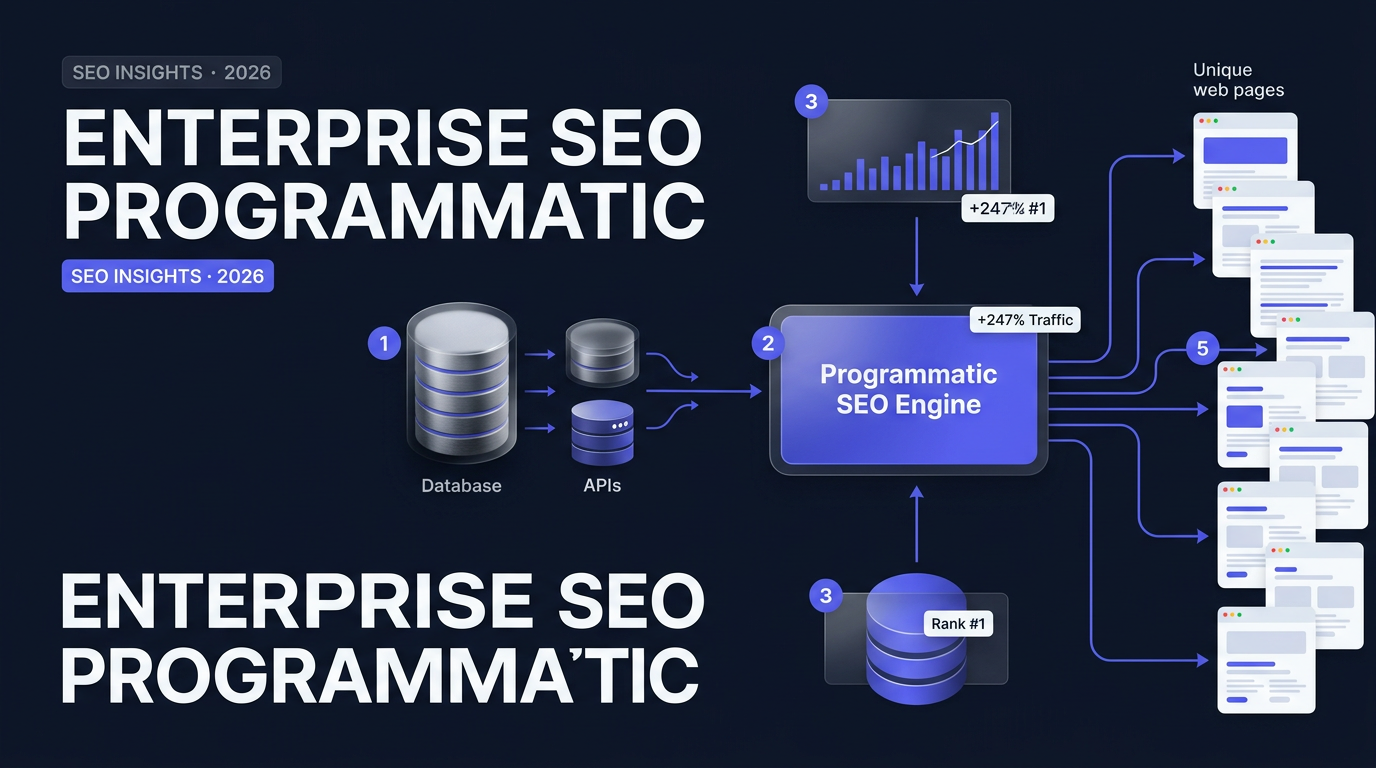
At its core, Programmatic SEO (pSEO) is the practice of systematically creating unique, targeted landing pages at scale by merging a structured database with modular page templates. Imagine your product database, location directory, or service matrix as the “brain,” and a master template as the “body.” Programmatic SEO combines them to generate thousands of unique pages, each perfectly tailored to a specific long-tail search query, such as “cloud data warehouse for financial services in germany” or “size 11 waterproof running shoes for men.”
While smaller businesses might leverage this for a few hundred pages, its true power is unlocked at the enterprise level. Large organizations sit on treasure troves of structured data—the very fuel for a pSEO engine. As noted by experts discussing the criteria for scalable SEO performance, the complexity of enterprise technical infrastructure and data management demands a more systematic approach. Programmatic execution is that approach, turning a scaling challenge into an unparalleled opportunity. It moves SEO from a reactive, page-by-page tactical function to a proactive, system-level strategic one.
This approach allows enterprises to address markets and queries that are impossible to target manually. Key enterprise use cases include:
- Global E-commerce: Generating a unique, optimized page for every product variant (color, size, material) available in each country.
- Marketplaces: Creating landing pages for every service category in every city and neighborhood served, like “plumbers in brooklyn ny” and “plumbers in park slope brooklyn.”
- SaaS & Tech: Building thousands of pages for every integration (“*your_brand* integration with salesforce”), competitor comparison (“*your_brand* vs *competitor*”), and industry use case (“*your_brand* for healthcare compliance”).
- Global B2B: Tailoring service offering pages to specific roles, industries, and countries, creating hyper-relevant entry points for valuable decision-makers.
The Three Pillars of a Programmatic SEO Engine
A successful enterprise programmatic SEO program isn't built with a single off-the-shelf tool; it’s an integrated system resting on three core pillars: Data, Templates, and Infrastructure. Neglecting any one of these leads to failure, either through low-quality content or catastrophic technical issues. The goal is to build a robust engine that can run, adapt, and scale with precision.
The first pillar is your Data and Head Terms. This is your proprietary asset. It could be a product information management (PIM) system, an internal services database, public APIs, or even legally scraped data. The data must be clean, structured, and comprehensive. Every data point—from product specs and pricing to location coordinates and user reviews—is a potential element for creating a unique, valuable page. The second pillar is the Page Template. This is far more than a visual layout. It’s a dynamic, component-based framework with logic to insert data, generate unique titles and meta descriptions, create internal links, and assemble content blocks. Sophisticated templates use variable logic to ensure generated content is unique, avoiding duplicate content penalties.
The final pillar is the Technical Infrastructure. This is the delivery mechanism that builds and serves pages to users and search engines. For optimal performance and indexability, modern pSEO programs rely on Server-Side Rendering (SSR) or Static Site Generation (SSG) using frameworks like Next.js or Astro. This ensures crawlers see fully-rendered HTML, not an empty JavaScript shell, while delivering lightning-fast speeds to users via a Content Delivery Network (CDN).
- Identify the Core Dataset: Pinpoint the primary entity you want to create pages for (e.g., products, locations, services). This is your set of “head” terms.
- Map Long-Tail Modifiers: Research and structure the secondary terms that users combine with your head terms (e.g., attributes, use cases, geo-locations).
- Design a Component-Based Template: Architect a flexible template with slots for dynamic data, unique content blocks, schema, and internal linking modules.
- Engineer a Smart Linking Schema: Define the rules for how programmatic pages will link to each other (e.g., parent-child relationships, sibling relationships) to distribute authority and guide users.
- Build and Deploy: Implement a generation pipeline that combines the data and templates to create the pages and deploys them efficiently.
Mastering Technical SEO at Programmatic Scale
The single greatest risk in an enterprise SEO programmatic initiative is inadvertently launching a technical disaster. When you’re creating millions of pages, a small mistake can have monumental consequences for your crawl budget, indexation, and overall domain authority. Governance and technical automation are your primary shields against this risk.
Crawl Budget Management becomes paramount. You cannot expect Googlebot to find all your valuable pages by chance. The solution is programmatic XML sitemap generation. This involves creating a sitemap index file that points to multiple sub-sitemaps, each containing up to 50,000 URLs and broken out by page type or creation date. This makes it easy for search engines to discover new content in digestible chunks. Furthermore, use your `robots.txt` file strategically to block crawlers from low-value, parameter-driven URLs (e.g., facets, filters, sorts) that offer no unique value and waste crawl budget.
Canonicalization and Duplication must be automated. Every programmatically generated page should have a self-referencing canonical tag by default. This simple rule prevents a host of duplicate content issues. For pages that are true variants (e.g., a page sorted by price vs. relevance), your system logic should identify the primary version and apply a canonical tag pointing all variants to that master URL. This consolidates ranking signals and keeps your index clean. For global sites, programmatic hreflang is a necessity. Your system should automatically generate the correct hreflang annotations. When a page like `/en-us/widgets/blue-widget` is published, the engine should automatically check for its equivalents in other markets (e.g., `/de-de/widgets/blaues-widget`) and inject the correct hreflang links into the `
` of all corresponding pages.- Automated Sitemaps: Dynamic generation of XML sitemap index files and their constituent sitemaps.
- Programmatic Schema Markup: Logic that populates structured data like Product, LocalBusiness, or FAQPage schema automatically from your database.
- Logical URL Structure: A clean, hierarchical URL pattern like `domain.com/{locale}/{category}/{item}` that is predictable and user-friendly.
- Forced Server-Side Rendering (SSR): Ensuring that all pages are fully rendered on the server so that search bots and users receive complete HTML.
- Automated Redirect Management: A system that automatically creates 301 redirects when a page's URL changes or it is unpublished, preserving link equity.
Enriching Content Programmatically (Beyond Simple Templates)
A common critique of programmatic SEO is that it produces thin, low-quality “Mad Libs” content. This is only true of poorly executed programs. For enterprises, the path to high-quality pSEO lies in leveraging unique data and intelligent enrichment to create pages that are genuinely more useful than a generic, manually created alternative. The goal is to create the *best* page on the internet for that hyper-specific query.
The most powerful technique is to leverage unique data points from your internal databases. Don’t just insert a product name; pull in its unique specifications, customer ratings, stock levels, number of colors available, or even a chart showing its price history. For a location page, you could dynamically insert the opening hours, the number of employees, photos of the local team, and testimonials from local clients. This proprietary data is your competitive moat and the key to creating truly unique content at scale.
In 2026, a hybrid AI + template model is the new frontier. Instead of having Large Language Models (LLMs) write entire articles (which often lack factual accuracy and brand voice), use them for strategic enrichment. An LLM API call can be used to: a) generate a unique 2-sentence summary from a list of technical specs, b) rephrase a standard company boilerplate in a unique way for each page, or c) generate a set of FAQs based on the page's core topic. This combines the consistency of templates with the uniqueness of generative AI. As experts behind guides on scalable SEO strategies emphasize, using existing assets is crucial for faster execution, and programmatic enrichment is the ultimate expression of that principle.
- Dynamic Data Visualizations: Programmatically generate charts or graphs comparing an item's specs to the category average.
- User-Generated Content (UGC) Integration: Automatically embed relevant customer reviews, photos, or Q&A content from your database onto the page.
- Programmatic Internal Linking: Create “Related Products” or “Nearby Locations” modules by using your database's taxonomy to build a logical, powerful internal linking graph that aids discovery and distributes authority.
- Calculated Fields: Display unique data points that are calculated on the fly, such as “This product is 15% more efficient than the previous model” or “35 other homes sold in this neighborhood last month.”
Measurement and Governance for Programmatic Success
How do you measure a program with a million pages? You don't. You measure the system that creates them. Traditional rank tracking and page-by-page analysis are impossible at this scale. Success requires a shift to systemic monitoring and strict governance to prevent errors and prove value.
Instead of tracking individual URLs, monitor performance by page template. In your analytics platform, create segments for each type of programmatic page (e.g., all `/locations/*` pages). Track the aggregate impressions, clicks, click-through rate, and conversions for each template cohort. A sudden drop in performance for the entire `/products/{category}/*` template signals a systemic issue with that template or data source, allowing you to investigate efficiently. This approach turns an overwhelming measurement problem into a manageable one.
To prevent disasters, you must establish automated SEO guardrails within your development process. Integrate automated SEO testing into your CI/CD pipeline. Before any new code or template change is deployed, a crawler should check a staging version of the site for critical errors like accidental `noindex` tags, broken canonicals, or large-scale 404s. Set up automated alerts that trigger if key metrics for a page template—like indexation count in Google Search Console or organic traffic from your analytics—drop below a certain threshold.
Finally, to secure ongoing investment, you must prove ROI in business terms. Work with your analytics team to connect conversions from programmatic page templates directly to pipeline and revenue goals. You can then report that “The ‘SaaS integrations’ pSEO template generated $1.2M in new pipeline last quarter,” a language that resonates far more with leadership than “we ranked for 50,000 new keywords.”
- Assign Ownership: Establish a clear owner for each core data source and each page template.
- Implement Pre-Deployment QA: Make automated SEO checks a mandatory step for deploying any changes that affect programmatic pages.
- Create Template Dashboards: Build and maintain dashboards that show the core health and business metrics for each page template.
- Conduct Spot-Check Audits: Schedule regular manual reviews of a small, random sample of live programmatic pages to check for qualitative issues that automated tools might miss.
- Tie to Revenue: Ensure your analytics setup can attribute leads and revenue back to the specific programmatic page templates that generated them.
Key takeaways
- Embrace Programmatic Thinking: Programmatic SEO is the only viable method for scaling organic search to millions of pages and capturing the long-tail opportunity at an enterprise level.
- Build on the Three Pillars: A successful program requires a solid foundation of clean data, flexible page templates, and a robust technical infrastructure (SSR/SSG).
- Automate Technical SEO: Mitigate risk by systematically generating XML sitemaps, canonical tags, schema markup, and hreflang annotations. Technical governance is not optional.
- Elevate Content with Data: Go beyond simple templates by programmatically integrating unique data points, UGC, and strategic AI enrichment to create genuinely valuable content.
- Measure by System, Not by Page: Track performance and ROI by aggregating data for each page template. Implement automated QA guardrails to prevent large-scale errors.