Scaling Organic Traffic: A B2B Mid-Market Playbook
You’re stuck in the middle. Your B2B company is too large to pivot on a dime like a startup, but you lack the gargantuan marketing budgets of enterprise behemoths. Paid channel costs are soaring, and the pressure is on to deliver sustainable, cost-effective pipeline. You know the answer lies in organic search, but generic advice about “writing good content” isn’t cutting it anymore.
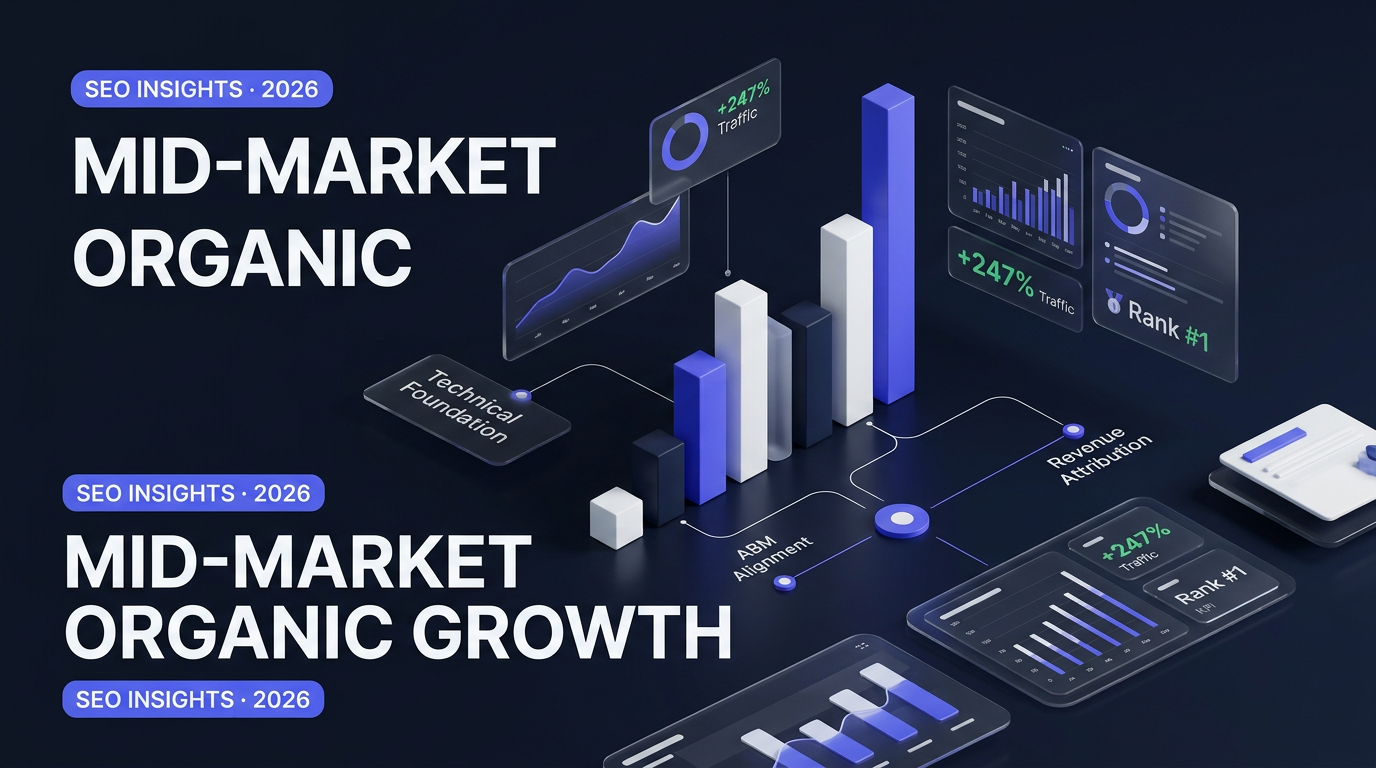
This isn't another list of beginner tips. This is a playbook for achieving scalable mid-market organic growth by building a sophisticated, revenue-driven SEO system. As AI continues to reshape search, with AI Overviews appearing for over 13% of queries, mid-market businesses need a focused strategy that moves beyond chasing vanity metrics and instead builds a predictable engine for attracting and converting high-value customers.
Beyond Keywords: Build a Scalable Content Operating System
For many mid-market teams, content creation is chaotic and reactive. A sales request here, a competitor’s blog post there—it's a recipe for wasted effort and inconsistent results. To scale effectively, you need a Content Operating System (OS): a documented, repeatable framework for planning, creating, optimizing, and measuring every piece of content, ensuring each asset serves a distinct business purpose.
A well-oiled Content OS transforms your marketing from a cost center into a strategic growth asset. It ensures that every blog post, case study, and landing page is not an island, but part of a larger architecture designed to build authority and guide prospects through the buying journey. This approach prioritizes long-term value over short-term wins and creates a compounding effect on your organic presence.
- Master the Hub-and-Spoke Model: Don't just write blog posts. Build comprehensive pillar pages around your core solutions (“What is Supply Chain Automation?”). Then, create a cluster of “spoke” articles that target specific, long-tail questions (“supply chain automation for retail inventory,” “best supply chain automation software”). This structure signals your deep expertise to Google and users alike.
- Implement Programmatic SEO for Bottom-Funnel Intent: Identify templated search queries your customers use and build pages at scale. Think “{Your Product} vs {Competitor},” “{Your Product} Alternatives,” and “{Your Product} Integration with {Software}.” These pages capture buyers at the final stages of their decision-making process and are prime candidates for driving high-quality demos and trials.
- Systematize SME Collaboration: Your internal subject matter experts (SMEs) are your greatest content asset, but they're not writers. Create a structured process using questionnaires, recorded interviews, and transcription services to extract their knowledge efficiently. This ensures content is authentic and authoritative without bogging down your experts.
The New Technical SEO: Prioritize for Pipeline, Not Just PageSpeed
A 100-page technical audit full of low-impact “errors” is a fast track to overwhelming your development team and accomplishing nothing. In the mid-market, resources are finite. Your technical SEO efforts must be ruthlessly prioritized around actions that directly protect and enhance your ability to generate revenue. This means focusing on how search engines crawl, understand, and rank your most valuable commercial pages.
This surgical approach to technical SEO ensures that your limited developer resources are spent on updates that move the needle. Instead of chasing a perfect 100/100 performance score, you’ll focus on strengthening the technical foundation of the pages that prospects visit just before they request a demo or visit your pricing page. It's about optimizing for business outcomes, not just technical purity.
- Conduct a Revenue-Focused Crawl Budget Analysis: Use log file analysis tools to see where Googlebot is *actually* spending its time on your site. Is it wasting crawls on old press releases, paginated archives, or filter combinations in your resource center? Ensure your most valuable solution, product, and pricing pages are being crawled frequently by strategically using `noindex` tags and `robots.txt` disallows on low-value sections.
- Deploy Advanced Schema for the Buying Journey: Go beyond basic `Article` schema. Use `Product` schema on your solution pages with `aggregateRating`, `offers`, and `review` properties. Implement `FAQPage` schema on commercial pages to answer bottom-funnel questions directly in the SERPs. Most importantly, use `VideoObject` schema for your product demos and case study videos to dominate search results and increase engagement.
- Architect Intentional Internal Linking: Stop linking haphazardly. Create a deliberate internal linking architecture that channels authority from your high-traffic, top-of-funnel blog posts to your high-intent, bottom-of-funnel commercial pages. Use tools to visualize your site's structure and identify “orphan” commercial pages that have few internal links pointing to them.
Aligning SEO with ABM: From Broad Traffic to Target Accounts
One of the biggest disconnects in B2B marketing is the gap between SEO’s broad reach and sales’ targeted Account-Based Marketing (ABM) list. Organic growth strategy in the mid-market thrives when these two functions are deeply integrated. Your goal is not just to attract *any* traffic, but to attract, engage, and identify traffic from the specific companies you want to sell to.
By treating SEO as an air-cover strategy for ABM, you surround your target accounts with helpful, authoritative content that addresses their unique challenges. This warms them up before a salesperson ever makes contact, shortening sales cycles and increasing win rates. This synergy turns your website from a passive brochure into an active intelligence-gathering tool for your sales team.
- Map Keywords to ICP Pain Points: Move beyond generic industry keywords. Brainstorm and research the specific queries and pain points of the key personas within your Ideal Customer Profile (ICP). If you sell to VPs of Finance in the manufacturing sector, create content that answers their questions about “improving factory floor ROI,” “capex amortization software,” or “manufacturing compliance reporting.”
- Use Reverse-IP Lookup to Unmask Visitors: Integrate a tool like HubSpot, 6sense, or Leadfeeder with your website. These platforms can identify the companies visiting your site from organic search, even if they don’t fill out a form. Create dashboards that show which of your target accounts are browsing your site, which pages they’re viewing, and for how long. This is pure gold for your sales development reps (SDRs).
- Create High-Value, Gated Assets for Sales Enablement: Develop a cornerstone asset like a “State of the Industry” report, a benchmark study, or an ROI calculator. While the landing page should be optimized for organic search, the asset itself can be used by the sales team as a powerful, high-value outreach tool to start conversations with key accounts.
Measurement That Matters: Tying Organic Growth to Revenue
“Organic traffic is up 20%” means nothing to your CEO or CFO. To secure budget and prove your worth, you must speak their language: pipeline and revenue. Mid-market success depends on moving beyond vanity metrics and building a measurement framework that clearly connects SEO activities to bottom-line business results.
For B2B brands, success isn't about traffic volume; it's about the business impact of that traffic. A focus on qualified MOFU and BOFU traffic is essential for driving leads that convert.
A robust measurement system allows you to demonstrate the tangible return on your content and SEO investment. It provides the data needed to justify headcount, advocate for more resources, and make smarter decisions about where to focus your efforts next. This transforms the SEO function from a mysterious black box into a transparent and accountable driver of growth.
- Track Commercial-Intent Conversions: In your analytics platform (e.g., GA4), go beyond tracking a single “Contact Us” form fill. Set up distinct conversion events for “Demo Request,” “Pricing Page Visit,” “Trial Signup,” and “Gated Asset Download.” Assigning different values to these actions helps you understand the quality of traffic from different channels.
- Integrate Your CRM for Full-Funnel Visibility: Connect your website analytics to your CRM (like Salesforce). This is non-negotiable. This integration allows you to track a user's journey from their first organic visit to becoming a Marketing Qualified Lead (MQL), a Sales Qualified Lead (SQL), and ultimately, to a closed-won deal with a specific contract value.
- Report on Content-Influenced Revenue: Build dashboards that answer key business questions: What is our total organic-sourced revenue this quarter? Which blog posts have influenced the most pipeline? What is the average ROI of our pillar page content over 12 months? This is the data that earns you a seat at the table.
Key Takeaways
- Systematize Content: Move from reactive, ad-hoc content creation to a scalable Content Operating System focused on hub-and-spoke models and programmatic SEO.
- Prioritize Technical SEO: Focus limited developer resources on high-impact technical optimizations like crawl budget management and advanced schema for your most valuable commercial pages.
- Integrate with Sales: Align your SEO strategy with ABM by creating content for ICP pain points and using reverse-IP lookup tools to identify target accounts on your site.
- Become the Source: In the age of AI, focus on producing original research, data, and expert-led content that Google’s AI is compelled to cite, securing your visibility.
- Measure What Matters: Ditch vanity metrics. Connect your SEO efforts directly to pipeline and revenue by integrating your analytics with your CRM and reporting on business outcomes.