Scaling Organic Traffic: A Blueprint for Mid-Market B2B Brands
Your B2B brand has done the hard work. You’ve moved past the startup scramble, found product-market fit, and your organic traffic isn’t zero. But it’s stuck. You’re seeing incremental gains, maybe 5-10% year-over-year, while your revenue goals demand exponential growth. You’re caught in the mid-market maze: too big for simple tactics, but without the enterprise budget to brute-force your way to the top.
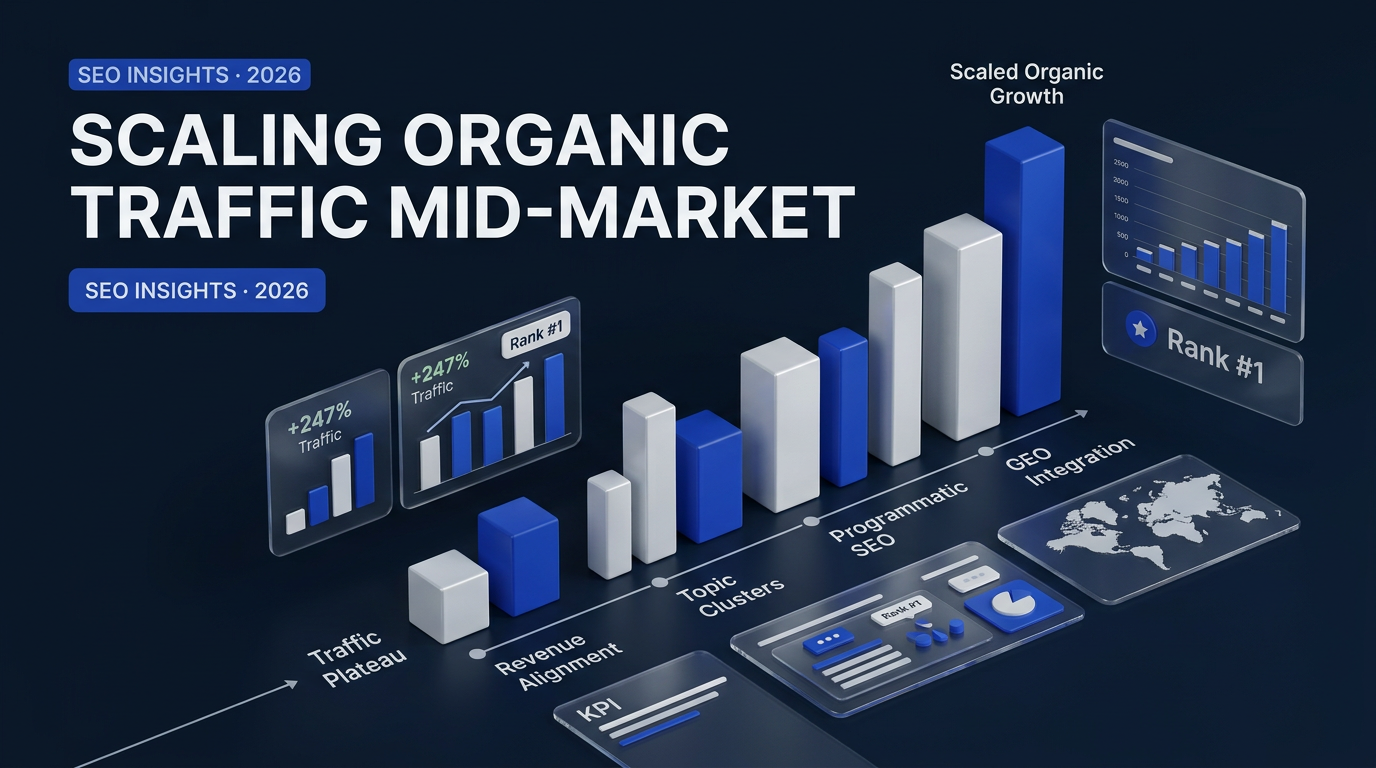
This isn't just about publishing more blog posts or chasing random keywords. This is about building a system. For 2026 and beyond, scaling organic traffic for mid-market brands requires a strategic blueprint that transforms your SEO from a simple marketing channel into a predictable revenue engine. This guide lays out that exact blueprint, moving from foundational alignment to advanced, scalable growth levers.
Phase 1: Solidify the Foundation with Revenue Alignment
Before you can scale, you must have a stable foundation. For a mid-market B2B company, this means ditching vanity metrics like raw traffic and focusing on what drives the bottom line: qualified leads, sales opportunities, and closed-won deals. Many teams operate with a disconnect between the content they create and the revenue it generates. Closing this gap is the first critical step.
Start by conducting a content-to-revenue audit. Dive into your CRM and analytics platforms (like HubSpot, Salesforce, and Google Analytics) to connect the dots. Which blog posts, guides, or landing pages are consistently on the conversion path for your most valuable customers? As experts at Cognism note, shifting to intent-based optimization is key for mid-market growth. This audit is how you find that intent in your own data.
Your audit should identify:
- High-Traffic, Low-Conversion Pages: These are your biggest opportunities. They are successfully attracting an audience but failing to convert them. Can you add stronger calls-to-action (CTAs), embed a demo video, or add an interactive calculator?
- High-Conversion, Low-Traffic Pages: These pages are resonating deeply with a small audience. This is your green light to build a topic cluster around this subject and drive more qualified traffic to a proven winner.
- Top Performing Bottom-of-Funnel (BOFU) Keywords: Identify the keywords that are already generating demos and trials. Double down on these by optimizing the corresponding pages, building internal links to them, and creating new content variations targeting adjacent terms.
This process aligns your SEO efforts directly with sales outcomes. From now on, every content decision should be weighed against its potential to attract high-value prospects, not just any visitor.
Phase 2: Build the Flywheel with Topic Clusters
The one-off blog post strategy is dead. To scale authority and traffic, you need to own topics, not just rank for keywords. The hub-and-spoke model, or topic cluster, is the most effective framework for this. It’s a self-reinforcing system that builds topical authority, improves internal linking, and creates a superior user experience—all strong signals for Google and other search engines.
Here’s how it works:
- The Pillar Page (Hub): This is a long-form, comprehensive resource covering a broad topic central to your business. For a project management software, this might be a 5,000-word ultimate guide to “Agile Project Management.” It should be the best, most authoritative piece of content on the internet for that query.
- The Cluster Content (Spokes): These are shorter, more specific articles that address a niche question or subtopic related to the pillar. Examples could be “How to Run a Sprint Retrospective,” “Kanban vs. Scrum,” or “Best Agile Certifications.” Each of these spoke articles links up to the pillar page.
- The Internal Linking: The magic is in the links. Each spoke links up to the hub, and the hub links back down to the relevant spokes. This creates a tightly knit web of content that tells search engines you are an expert on the entire topic of Agile Project Management.
For a mid-market team, this approach is highly scalable. Instead of brainstorming ideas randomly, your content plan is now structured. Use keyword research tools like Ahrefs or Semrush to map out your core topics and all the long-tail questions your audience is asking. One pillar topic can generate dozens of spoke articles, creating a roadmap for months or even years of high-impact content.
Phase 3: Accelerate with Programmatic SEO
Once your topic cluster flywheel is spinning, programmatic SEO is how you achieve a step-change in growth. This tactic involves using a template and a database to generate hundreds or even thousands of unique, optimized pages that target highly specific, long-tail search queries. It’s perfect for mid-market B2B companies that have structured data, like integration partners, service locations, or use cases across different industries.
Think of it as scaling niche expertise. Instead of manually writing a page for every single permutation, you build a robust template and let your data do the work. Common B2B applications include:
- Integration Pages: “[Your Product] + [Integration Partner]” (e.g., “PieroSEO + HubSpot Integration”)
- Comparison Pages: “[Your Product] vs. [Competitor]” or “Best [Product Category] for [Industry]” (e.g., “Best CRM for Mid-Market Construction Firms”)
- Alternatives Pages: “[Competitor] Alternatives” (e.g., “Salesforce Alternatives”)
- Use Case Pages: “[Your Service] for [Job Title]” (e.g., “Cybersecurity Solutions for CFOs”)
The key to successful programmatic SEO in 2026 is quality. This is not about creating low-value, spammy pages. Each programmatically generated page must be genuinely useful, unique, and provide a clear answer to the user's query. Invest time in building a best-in-class template with unique data points, customer testimonials, and clear next steps. When done right, programmatic SEO allows you to capture an enormous volume of high-intent traffic that is impossible to target manually.
Phase 4: Future-Proof with Generative Engine Optimization (GEO)
The search landscape is undergoing its most significant shift in a decade. AI Overviews (SGE) and conversational AI tools like ChatGPT and Perplexity are becoming primary search interfaces. Ranking #1 is no longer the only goal; being the cited source in an AI-generated answer is the new frontier. This is Generative Engine Optimization (GEO).
Unlike traditional SEO, which focuses on pleasing a crawling algorithm, GEO focuses on making your brand’s knowledge citable, verifiable, and authoritative. As the team at Obility highlights, SEO, AEO (Answer Engine Optimization), and GEO work together to cover the entire modern search journey. Mid-market brands can get ahead by integrating GEO principles now.
Key GEO tactics for 2026 include:
- Publish Original Research and Data: Create proprietary industry reports, surveys, and data studies. AI models are hungry for unique, citable statistics. Phrases like “A 2026 study by [Your Company] found that...” are gold for GEO.
- Prioritize Factual Accuracy and E-E-A-T: Ensure your content is factually correct, well-sourced, and demonstrates clear Experience, Expertise, Authoritativeness, and Trustworthiness. Have experts review and author content.
- Use Clear, Declarative Language: Structure content to provide direct answers. AI models look for concise, confident statements to construct their answers. Use FAQ sections to answer questions directly.
- Build Brand Mentions Everywhere: GEO is influenced by your brand's overall digital footprint. Encourage mentions on Reddit, industry forums, review sites, and in expert interviews. AI models use this widespread discussion as a signal of relevance and authority.
Phase 5: Create a Link-Earning Engine
Finally, no scaling strategy is complete without a scalable approach to building authority through backlinks. Manual, one-to-one email outreach for guest posts simply won’t cut it when you need to grow exponentially. You must shift your mindset from “building” links to creating assets that “earn” links passively and at scale.
This means creating content and resources so valuable that other sites *want* to link to them. This creates a sustainable, long-term flow of authority back to your domain. For mid-market teams, this is far more efficient than hiring an army of outreach specialists.
Focus your efforts on building a link-earning engine through:
- Digital PR: Package your original research and data studies from your GEO efforts into compelling stories and pitch them to journalists and industry publications. A single successful placement in a major outlet can yield dozens of high-authority links.
- Free Tools and Templates: Build simple, interactive tools that solve a real problem for your audience. Think calculators, checklists, or simple generators. These assets are powerful link magnets because they provide tangible utility.
- Strategic Partnerships: Collaborate with non-competing companies in your ecosystem on co-branded webinars, whitepapers, or research. This exposes you to their audience and naturally generates links from their websites and promotional materials.
Key Takeaways
Scaling organic traffic as a mid-market B2B brand isn't about finding a single silver bullet. It's about implementing a multi-layered, systematic blueprint. To recap, the path to exponential growth in 2026 involves:
- Align with Revenue: Connect your SEO efforts directly to pipeline and sales data.
- Build Topic Clusters: Own entire topics, not just keywords, to build sustainable authority.
- Leverage Programmatic SEO: Scale the creation of pages for high-intent, long-tail queries.
- Integrate GEO: Optimize your content to be the source for AI-driven search answers.
- Develop a Link-Earning Engine: Create assets that attract high-quality links passively and at scale.