Beyond the Blog: The Mid-Market Growth Plateau
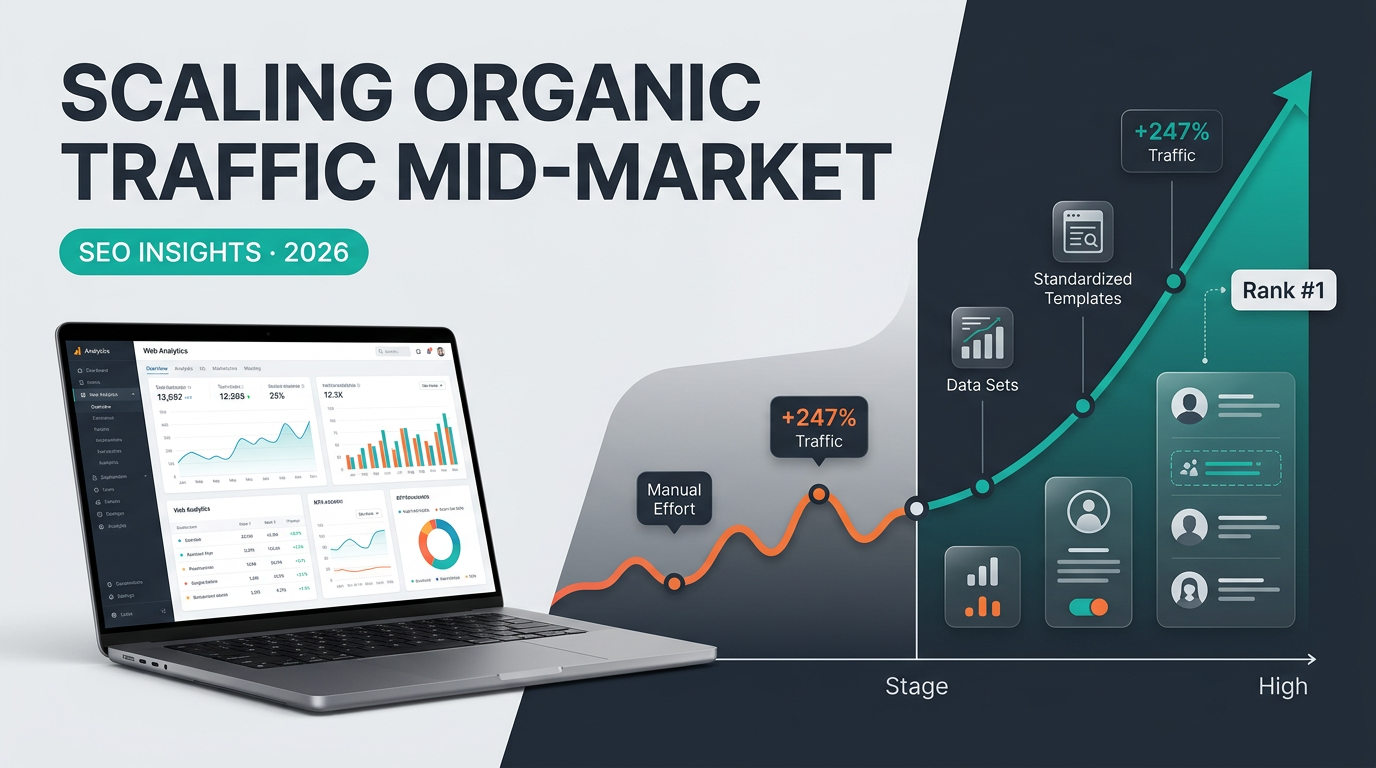
You’ve done everything right. You built a solid content strategy, captured the low-hanging keyword fruit, and established a steady stream of organic traffic. But now, you’ve hit a wall. Each new blog post yields diminishing returns, and the needle on your analytics dashboard is barely twitching. This is the mid-market growth plateau, a common challenge for brands that have outgrown basic SEO tactics but lack the infinite resources of an enterprise giant. Continuing to rely solely on manually-written articles is like trying to fill an ocean with a bucket—the effort is immense, and the impact is negligible.
The path forward isn't about writing more; it's about thinking bigger. It's time to evolve your strategy from manual content creation to building a scalable asset that generates traffic on its own. For ambitious brands, the key to scaling organic traffic mid-market lies in shifting from a content-first to a product-led or programmatic SEO mindset. This means turning your website from a simple brochure into a dynamic resource that solves user problems at scale, creating a durable competitive advantage that’s difficult for others to replicate.
From Manual to Programmatic: Your Scalable Content Engine
Programmatic SEO is not about using AI to write generic articles. It's a strategic approach where you identify a large group of similar user queries, create a high-quality page template, and then programmatically generate unique pages by populating that template with your data. Think of it as creating a system that builds valuable pages for you, rather than building each page by hand. While enterprise examples like Zillow’s home listings or CXL’s breakdown of Quora’s scalable “Spaces” feature are inspiring, the principles are perfectly adaptable for the mid-market.
Instead of creating thousands of property listings, a mid-market B2B SaaS company might create hundreds of pages targeting specific integration queries or competitor comparisons. This approach transforms your existing assets—be it product data, customer use cases, or integration partners—into a traffic-generating machine. It allows you to target thousands of long-tail keywords with high commercial intent that are impossible to address with a traditional blog-based strategy. The goal is to build an evergreen asset that grows in value over time.
- Integration Pages: Create a dedicated page for every tool your product integrates with (e.g., “Your App + Salesforce Integration”).
- Alternative Pages: Target users searching for alternatives to your competitors (e.g., “Best [Competitor] Alternative for [Industry]”).
- Use-Case Pages: Develop pages targeting specific industry or role-based use cases (e.g., “Project Management Templates for Marketing Agencies”).
- Geographic Pages: If you serve specific locations, create templated pages for each city or region (e.g., “[Your Service] in Dallas”).
Unlock Opportunities with the “Jobs-to-be-Done” Framework
The fuel for any successful programmatic strategy is a deep understanding of user intent. The most effective way to uncover this is through the “Jobs-to-be-Done” (JTBD) framework. Instead of asking “what are our users searching for?” JTBD asks “what ‘job’ is the user ‘hiring’ our product or content to do?” This shift in perspective helps you move beyond simple keywords to identify the underlying problems and motivations driving search behavior. When a user searches for “Mailchimp alternative,” the job isn’t just to find a list; it’s to find a better, cheaper, or more powerful email marketing tool that solves a specific frustration they have with their current solution.
For mid-market teams, uncovering these “jobs” doesn’t require massive research budgets. It requires cross-functional collaboration and a bit of data sleuthing. By systemizing this discovery process, you can build a backlog of programmatic opportunities that align perfectly with your customers' needs.
- Interview Your Frontline Teams: Your sales and customer support teams are a goldmine of JTBD insights. What are the most common questions they answer? What pain points do prospects mention? What features do customers request most often? Each of these is a potential programmatic page template.
- Analyze Internal Site Search: What are users already looking for on your website? The queries in your site search report are direct expressions of user intent. Look for patterns and repeated terms that can be grouped into a template.
- Find Query Patterns: Use your favorite SEO tool to find keywords with a shared structure, or what one expert calls a “shared syntax.” Look for patterns like “[your tool] vs [competitor],” “[your service] for [industry],” or “how to do [task] with [your tool].”
- Map Jobs to Page Templates: Once you identify a recurring “job” and its corresponding query pattern, you can design a page template specifically to solve it. This template becomes the blueprint for your scalable content engine.
The Mid-Market Playbook: 3 Scalable SEO Strategies for 2026
Theory is great, but execution is what drives growth. Here are three proven, actionable programmatic SEO plays perfectly suited for mid-market brands to implement in 2026. Each focuses on capturing high-intent traffic by creating a genuinely useful resource, not just thin, repetitive content.
1. The “Alternative To” Hub
This is a classic for a reason. Users actively looking for alternatives to your competitors are high-value, bottom-of-the-funnel prospects. Instead of one-off blog posts, build a scalable hub. Start with a main “Best [Competitor Category] Alternatives” page that acts as a pillar. Then, create dozens of spoke pages for each individual competitor (e.g., “Why [Your Brand] is the Best [Competitor A] Alternative”).
- Template Essentials: Your page template must be more than a sales pitch. Include a detailed feature comparison table, customer testimonials (especially from those who switched), pricing comparisons, and a clear explanation of why your solution is a better fit for a specific job or user type.
2. The Integration Marketplace
For B2B SaaS, your product’s value is magnified by the ecosystem it connects to. An integration marketplace is a powerful SEO asset that captures searchers looking to connect your tool with others in their stack (e.g., “[Your Brand] and Slack integration”). Each integration deserves its own dedicated, templated page.
- Template Essentials: Each page should detail the benefits of the integration, include a step-by-step “how-to” guide for connecting the tools (with screenshots or a video), highlight specific use cases it enables, and feature a strong CTA to sign up or learn more. This adds immense value and builds user confidence.
3. The Resource & Template Library
Go beyond blog posts and create a library of actionable resources. These could be calculators, checklists, project templates, or industry benchmark reports. Trello’s template library is a fantastic example of this at scale. A mid-market accounting firm could create templated budget spreadsheets for different small business types. A project management tool could offer pre-built project plans for various industries.
- Template Essentials: Each resource page needs a clear title explaining the benefit, a preview of the resource (e.g., an image of the template), a bulleted list of what’s included, and a simple way to access it (e.g., direct download or copy to account). This positions you as a helpful expert and captures top-of-funnel interest.
Technical SEO: The Bedrock of Scalable Content
A brilliant programmatic strategy will crumble without a flawless technical SEO foundation. When you’re creating hundreds or thousands of pages, small technical issues can multiply into catastrophic ranking problems. Before you launch any scalable content initiative, your technical house must be in pristine order. This is non-negotiable for sustainable growth and is what separates professional execution from amateur attempts that result in spammy, low-value sites.
Getting this right ensures that search engines can efficiently crawl, understand, and index your new pages, and that users have a fast, seamless experience. It’s the invisible framework that makes the entire system work. Prioritize these four key areas with your development team.
- Strategic Internal Linking: Your templated pages can't be orphans. Implement an automated internal linking logic. For example, all “alternative to” pages should link to each other and back to the main hub page. This distributes PageRank and helps Google understand the topical relationships between your pages.
- Bulletproof Canonicalization: Programmatic sites often use URL parameters for sorting and filtering, creating a high risk of duplicate content. Use `rel="canonical"` tags aggressively to point all variations of a URL to the single, definitive version you want indexed.
- Rich Schema Markup: Give Google the context it needs to understand your pages. Use `SoftwareApplication` schema for your product pages, `HowTo` schema for integration guides, and `FAQPage` schema for question-and-answer sections. This can help you win rich snippets in the SERPs.
- Core Web Vitals & Page Speed: Your page template must be lightweight and fast. With potentially thousands of pages built on it, every kilobyte matters. Optimize images, minify CSS and JavaScript, and ensure your server can handle the crawl demand. A slow experience at scale will kill your rankings.
Key Takeaways
Scaling organic traffic as a mid-market brand requires a strategic shift away from the content hamster wheel. To achieve sustainable, exponential growth in 2026 and beyond, you must think like a product owner, not just a content creator. Here’s how to start:
- Embrace a Scalable Mindset: Move beyond one-off blog posts and focus on building systems that generate valuable pages programmatically.
- Use JTBD to Find Opportunities: Understand the “job” a user is hiring your content to do. Talk to sales and support, and look for patterns in search data to identify repeatable user needs.
- Execute Proven Plays: Implement focused, scalable strategies like “Alternative To” hubs, Integration Marketplaces, or Resource Libraries that capture high-intent traffic.
- Prioritize Technical Excellence: Ensure your technical SEO—especially internal linking, canonicalization, schema, and page speed—is flawless to support growth at scale.
- Build an Asset, Not Just Content: The goal is to create a durable, traffic-generating asset that becomes a core part of your marketing and product ecosystem, providing value for years to come.