Scaling Organic Traffic: A Mid-Market Brand Playbook for Sustainable Growth
If you're leading marketing for a mid-market company, you likely feel caught in the middle. You've outgrown the scrappy tactics of a startup, but you don't have the colossal budgets of an enterprise. Your challenge is to generate scalable, predictable growth, yet the old rules for increasing mid-market organic traffic seem to be failing. Your team is creating content and building links, but the traffic needle isn’t moving like it used to.
This isn't just a feeling; it's the new reality of search in 2026. The rise of AI-powered search results means the playbook that got you here won't get you to the next level. Sustainable growth is no longer about simply writing more blog posts. It’s about becoming an undeniable authority and building scalable SEO assets that Google’s AI is compelled to cite. This playbook outlines that new strategy, designed specifically for the unique position of mid-market brands.
The New Reality: Why Flat Rankings Don't Equal Growth
For years, the contract was simple: rank high, get clicks. In 2026, that contract is broken. You might see your keyword rankings holding steady, or even improving, while your website sessions crater. This isn't a failure of your team; it's a structural shift in how search engines deliver information. AI Overviews now answer a huge volume of informational queries directly on the results page, eliminating the need for a user to click through to a website.
The numbers are stark. Research has shown that when an AI summary appears, the likelihood of a user clicking on a traditional organic link can drop by nearly 50%. As one report notes, this has led to some major publishers and brands seeing organic traffic declines of 30% to 70%, even while their rankings remained stable. The click is being intercepted before it ever has a chance to reach your site. However, there's a powerful silver lining: the clicks that do make it through are now gold. Studies indicate that visitors arriving from a citation within an AI Overview are far more qualified, with conversion rates anywhere from 2x to over 20x higher than typical organic visitors.
This forces a critical shift in how we measure success. The goal is no longer just to rank; it's to be cited. Your new key performance indicators must reflect this reality and focus on the quality and intent of the traffic you do earn.
- Citation Share: What percentage of relevant AI Overviews mention your brand or link to your content?
- Conversion Per Session: Are the users who do click through converting at a higher rate? This measures click quality.
- Assisted Pipeline Value: How much revenue is organic search influencing, even if it's not the last touchpoint?
- Brand Mentions & Co-occurrences: Is your brand being mentioned alongside key topics and entities, signaling authority to search engines?
The Mid-Market Advantage: Unlocking Your Data "Inventory"
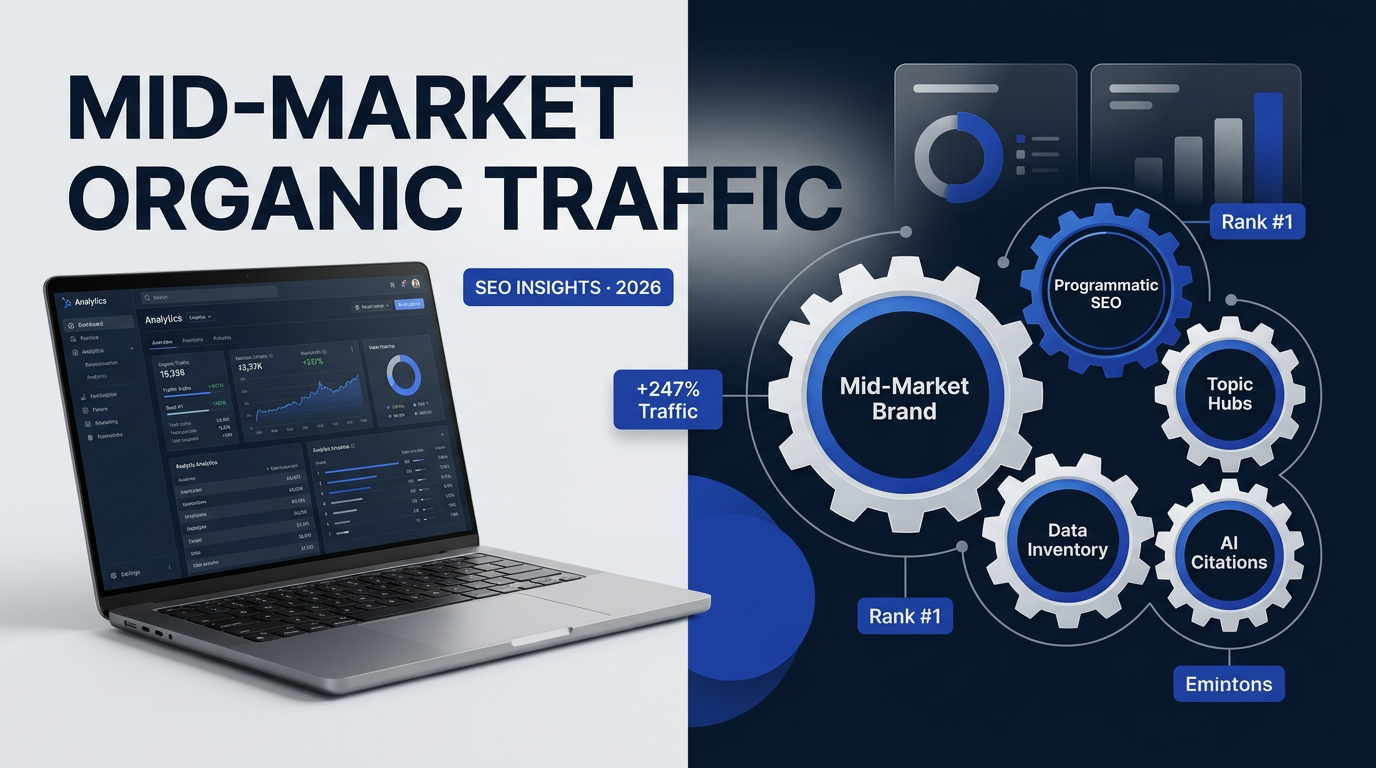
While enterprises have massive content teams, mid-market brands have a different, more powerful advantage: agility and unique, structured data. You have an "inventory" that can be scaled into thousands of valuable pages, a concept that powers the growth of huge sites like Zillow, Quora, and Amazon. For them, SEO growth comes from shipping new, indexable product features, not just writing articles. For a mid-market brand, this "inventory" is the proprietary data and structured information that makes your business unique.
Think beyond blog posts. Your inventory is the asset that competitors can't easily replicate and that AI models need to provide specific, valuable answers. It’s the raw material for building a moat around your organic presence. The key is to identify this data, structure it, and present it in a way that serves a specific user need that people are actively searching for.
What does this inventory look like for a mid-market brand?
- For a B2B SaaS Company: A database of all your integrations, with dedicated pages for each one explaining the use case, setup, and benefits.
- For a Regional Service Business: Your list of service areas, turned into hyper-local pages with specific testimonials, project examples, and contact information for each town or neighborhood.
- For an E-commerce Brand: Detailed specification data that can be used to generate pages for every product variation, or comparison pages that pit your products against competitors on key features.
- For a Consulting Firm: A structured library of case studies, filterable by industry, service, and outcome, with a unique page for each combination.
Playbook I: Programmatic SEO for Scalable Landing Pages
Programmatic SEO is the engine you'll use to turn your data inventory into thousands of traffic-driving pages. It is the practice of using code to automatically generate unique landing pages from a structured dataset, all built around a high-quality template. This is how you scale beyond the physical limitations of your content team and create pages that target highly specific, long-tail search queries—the kind that AI Overviews often struggle to answer comprehensively.
Implementing a programmatic project requires collaboration between marketing and development, but the payoff in sustainable traffic is immense. By creating a thousand pages that each get 10 visits a month, you've built an asset that delivers 10,000 monthly sessions with minimal ongoing effort. The process can be broken down into clear, manageable steps.
- Identify the Core Dataset: Pinpoint the structured data you own. This could be product SKUs, office locations, software features, industry statistics, or user-generated reviews.
- Research Query Patterns: Discover how users search for this information. Look for common syntax, like "[service] in [city]" or "[product a] vs [product b]". SEO tools can help you find these patterns, known as head terms and modifiers.
- Design a High-Value Page Template: This is the most critical step. Your template must be more than a thin database entry. It should combine your unique data with valuable static content like FAQs, how-to guides, customer testimonials, images, and clear calls-to-action. The goal is to create the best possible answer for the user's query.
- Build, Test, and Deploy: Work with your development team to build the logic that generates the pages. Start with a small, representative sample of your data to test the concept, measure initial results, and refine the template before launching at scale. Ensure every page has a unique title, meta description, and URL, and is part of a logical internal linking structure.
Playbook II: Building Topic Authority with Content Hubs
Programmatic SEO is perfect for targeting transactional and specific informational queries, but you still need to compete for broader topics. In the age of AI search, winning these queries means proving deep, indisputable expertise. Scattered, one-off blog posts are no longer sufficient. To become a source that Google's AI trusts and cites, you must organize your content into comprehensive Topic Hubs.
A Topic Hub consists of a central "pillar" page that provides a broad overview of a core subject, which then links out to a cluster of detailed "spoke" pages that cover specific sub-topics in depth. This structure creates a dense web of internal links that signals to search engines that you have covered a topic from every angle. It makes your site a one-stop-shop for a user's entire learning journey on a subject, increasing your chances of earning both citations and qualified clicks.
Building an effective Topic Hub is a strategic content initiative that pays long-term dividends.
- Choose Your Pillars: Identify 3-5 core topics that are fundamental to your business and that you want to be known for. These should align directly with the problems your customers face and the solutions you provide.
- Map the Cluster: For each pillar, brainstorm every possible sub-topic, user question, and related keyword. Use tools like AnswerThePublic, Ahrefs, or Semrush to find what people are actually asking. Each of these becomes a potential spoke page.
- Create the Pillar Content: Write a comprehensive, long-form guide (2,500+ words) for the pillar page. It should cover the main topic broadly and serve as a directory, linking out to all of your spoke pages.
- Write the Spoke Content: Create focused, in-depth articles for each sub-topic in your cluster. Each spoke page should answer a specific question thoroughly and link back to the main pillar page. This closed-loop system is key.
Beyond Google: Diversifying to De-Risk Your Growth
Even with a world-class SEO strategy, relying 100% on Google for your traffic is a risky proposition in 2026. The ground can and will shift again. True sustainable growth comes from a diversified marketing mix where your channels support and amplify one another. The good news is that the insights you gain from your SEO efforts are rocket fuel for your other marketing channels.
Think of your SEO program as your company's R&D department for customer intent. The keywords people search for, the questions they ask, and the content that performs best are all direct signals of what your audience cares about. Use this data to de-risk your investments in other channels and create a more resilient growth engine. This creates a flywheel effect where success in one area builds momentum in others.
- Fuel Paid Media: Use your top-performing organic keywords and ad copy snippets from your meta descriptions to inform your Google Ads and paid social campaigns.
- Repurpose Content Hubs: Turn your comprehensive Topic Hubs into webinars, email courses, video series for YouTube, or slide decks for LinkedIn. You've already validated the demand for the topic.
- Activate First-Party Data: Use the lead magnets and contact forms within your content to build your first-party data list. As Source 1 notes, this is the asset that holds value when search clicks erode, allowing you to reach your audience directly via email and retargeting campaigns.
- Explore Niche Search Engines: Don't forget that search happens everywhere. Depending on your audience, platforms like YouTube, TikTok, Reddit, and industry-specific forums have their own powerful search functions. Optimize your presence there.
Key Takeaways
- The rise of AI Overviews means high rankings no longer guarantee clicks. Success in 2026 is measured by getting cited and driving high-quality, high-converting traffic.
- Stop relying solely on manual content creation to scale. The path to sustainable growth for mid-market organic traffic is through building scalable SEO assets.
- Identify your company's unique, structured data—your "inventory"—and use programmatic SEO to create thousands of valuable pages targeting long-tail queries.
- Organize your expertise into comprehensive Topic Hubs, not just scattered blog posts, to establish the authority needed to be cited by AI search.
- Use the insights from your SEO program to inform and strengthen other marketing channels, creating a diversified and more resilient growth strategy.