Scaling Organic Traffic: A Mid-Market Playbook for Sustainable Growth
Your business has cleared the startup hurdles. You have product-market fit, a solid customer base, and revenue between $30M and $250M. Yet, growth feels... expensive. Your pipeline expands only when you pour more money into paid ads, and it stalls the moment you pull back. If this sounds familiar, you’ve hit the mid-market plateau, where scaling becomes a brute-force exercise in budget allocation. The escape route isn't more ad spend; it's a strategic investment in sustainable mid-market organic growth.
This isn't about chasing vanity metrics or publishing a few more blog posts. It's about re-architecting your approach to SEO, transforming your website from a digital brochure into a revenue-generating asset, and building systems that create a compounding competitive advantage. For 2026 and beyond, winning in search means thinking like a product manager, not just a content creator. This playbook outlines how to do just that.
The Mid-Market Growth Trap: Why Your SEO Has Stalled
Many mid-market companies find themselves in an awkward position: the scrappy tactics that fueled early growth no longer work at scale, but they lack the massive budgets of enterprise competitors. This often leads to an over-reliance on paid channels, which provides predictable but linear returns. As one industry analysis points out, this dependency is a primary reason why mid-market companies struggle with organic growth; their growth engine is rented, not owned.
This reliance on paid acquisition is often a symptom of a deeper issue: a static and underdeveloped organic strategy. The website is treated as a cost center, a project that was “completed” 18 months ago. The content strategy, if one exists, is often limited to a few top-of-funnel blog posts per month with no clear connection to revenue. Marketing, sales, and customer success operate in silos, meaning valuable customer insights never inform the SEO strategy.
Does your organization show these symptoms?
- Traffic Plateaus: Organic traffic has been flat for more than two quarters, despite content efforts.
- Rising Customer Acquisition Costs (CAC): Your blended CAC is climbing as paid channels become more saturated and expensive.
- Low Search Visibility for High-Intent Keywords: Competitors consistently outrank you for bottom-of-funnel terms that signal purchase intent.
- Marketing-Sourced Pipeline is Underwhelming: The leads generated from organic search are low quality or don't convert.
If you checked any of these boxes, it's time to graduate from random acts of SEO and implement a scalable system.
Beyond the Blog: Shifting to a Programmatic SEO Mindset
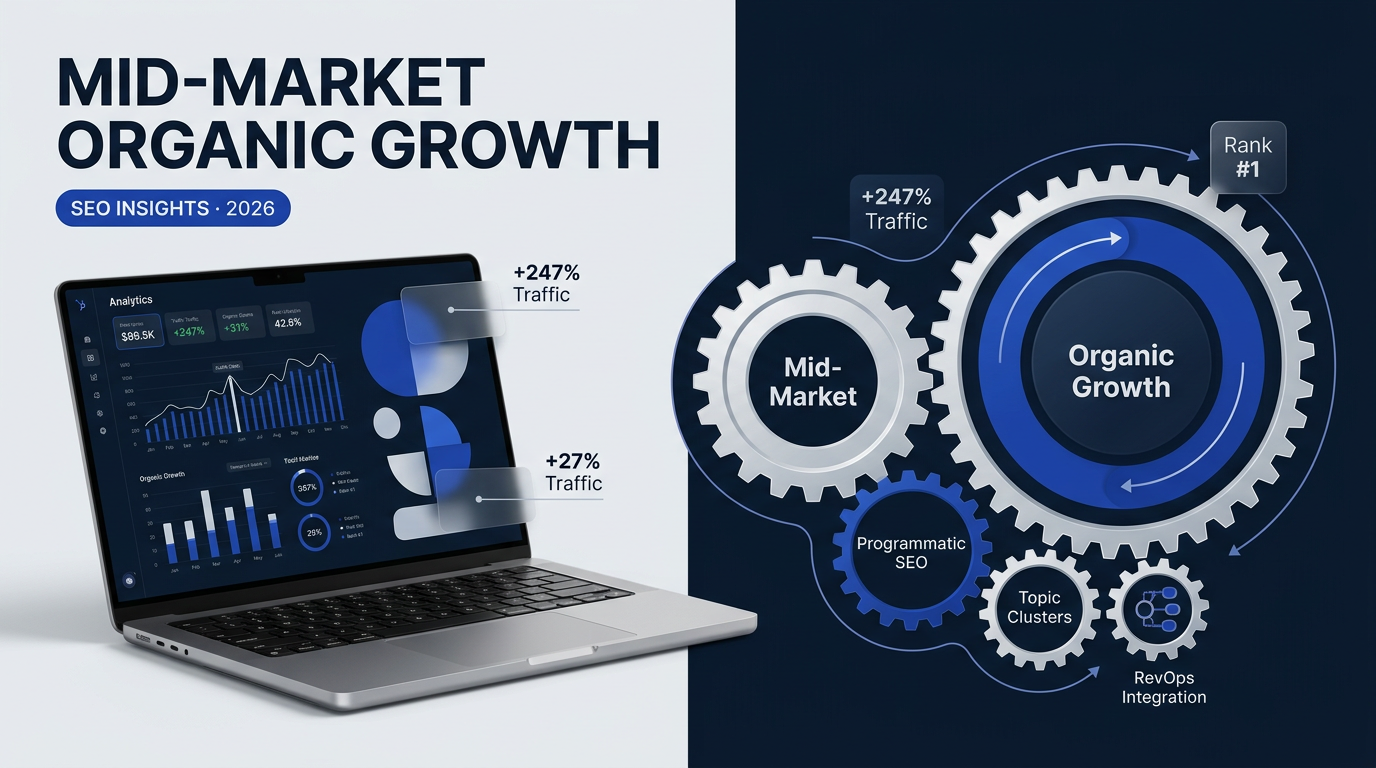
The single most powerful lever for mid-market organic growth is shifting from a purely manual content process to a programmatic one. Programmatic SEO isn't just for giants like Zillow or Quora. At its core, it's about identifying large groups of user queries with a similar structure and building a system to create pages targeting them at scale. As CXL notes, new product features and page templates are the most underrated driver of SEO growth for sites that move beyond manual article creation.
Instead of writing one blog post about “the benefits of our software,” you build templates that can generate hundreds of highly specific, long-tail pages. These pages attract users with much higher intent, resulting in better conversion rates and a more qualified pipeline. This is how you build a wide moat that’s incredibly difficult for competitors to replicate manually.
Programmatic SEO opportunities for mid-market companies include:
- SaaS & Tech: Create pages for every possible integration (“[Your Software] + [Other Tool] Integration”), comparison (“[Your Software] vs. [Competitor]”), and alternative (“[Competitor] Alternative”). Each of these is a template that can be populated with data.
- Multi-Location Services: Generate a unique, optimized page for every city or service area you cover (“[Service] in [City, State]”), populated with local testimonials, case studies, team members, and address details.
- B2B Distributors & E-commerce: Build out pages that combine product categories with use cases or industries (“[Product Category] for the [Industry] Industry”) or technical specifications (“[Part Number] Spec Sheet”).
To start, your team should be identifying query patterns with shared syntax (e.g., “how to integrate X with Y,” “best X for Y”), mapping them to a page template, and identifying the unique data points needed to make each page valuable.
Your Website as a Revenue Engine, Not a Cost Center
A programmatic content strategy requires a platform built for scale. The typical mid-market website—a WordPress theme last updated during the 100-day plan post-acquisition—is a revenue leak, not a revenue engine. To support true organic growth in 2026, your website must be treated as a core piece of your company's revenue infrastructure, with a technical architecture to match.
This goes far beyond just passing Core Web Vitals. While site speed is table stakes, a growth-oriented architecture is about flexibility, scalability, and data integration. Consider a headless CMS, which decouples your front-end presentation layer from your back-end content management. This allows your marketing team to create and deploy new programmatic templates (like the ones mentioned above) without lengthy development cycles.
Your website is the front end of your revenue engine. It should feed intelligence into your CRM and use data from your CRM to create a more personalized experience.
Key components of a revenue-driving website architecture:
- Scalable CMS: A headless CMS (like Contentful or Strapi) or a highly-optimized, enterprise-grade WordPress setup that can handle thousands of templatized pages without performance degradation.
- Automated Structured Data: Systems that automatically apply the correct Schema markup (e.g., `Product`, `LocalBusiness`, `FAQPage`) to programmatic pages, enhancing their visibility in search results.
- Automated Internal Linking: Logic that automatically identifies and creates contextual internal links between your new programmatic pages and your core topic cluster pages, distributing authority and improving user navigation.
- Deep CRM Integration: The ability to capture detailed lead data, track user behavior across multiple sessions, and personalize on-site content based on a visitor's lifecycle stage in your CRM.
The Content Moat: Building Authority with Topic Clusters and AI
While programmatic SEO builds the breadth of your search presence, topic clusters build its depth. Google's algorithms have evolved to favor sites that demonstrate comprehensive expertise on a subject. A topic cluster strategy moves you away from targeting disconnected keywords and toward owning entire conversations relevant to your customers.
A cluster consists of a central “pillar” page, which provides a broad overview of a high-value topic (e.g., “Revenue Operations”), and numerous “cluster” pages that delve into specific subtopics (e.g., “RevOps KPIs,” “how to hire a RevOps leader,” “best RevOps software”). All these pages are tightly interlinked, signaling to search engines that you are an authority on the overarching topic.
In 2026, AI's role here is not to replace writers but to supercharge strategists. Modern AI tools can analyze the entire search landscape for a topic, identify content gaps your competitors have missed, and even suggest an optimal internal linking structure for your cluster. Use AI to do the heavy lifting of analysis so your subject matter experts can focus on creating truly insightful content.
Building Your First Topic Cluster:
- Identify a Core Business Topic: Choose a broad subject that is central to the problem your product solves.
- Map Out the Subtopics: Use keyword research and AI analysis tools to find all the questions, problems, and related terms your audience searches for around that topic.
- Create the Pillar and Cluster Content: Write a comprehensive pillar page covering the topic broadly. Then, create detailed articles, landing pages, or programmatic page sets for each subtopic.
- Establish a Smart Linking Structure: Link from the pillar page out to every cluster page, and ensure every cluster page links back to the pillar.
Activating Your Data: Integrating SEO with RevOps
For mid-market organic growth to be truly sustainable, it must be accountable to the bottom line. Traffic and rankings are leading indicators, but the metrics that matter to your CEO and board are pipeline, revenue, and CAC. This is where integrating SEO with your Revenue Operations (RevOps) function becomes a game-changer.
A tight SEO-RevOps alignment transforms your strategy from traffic acquisition to customer acquisition. By tracking organic visitors through their entire journey in your CRM, you can finally answer critical questions: Which content clusters generate the most sales-qualified leads? What is the actual ROI of our programmatic SEO investment? Which blog posts have influenced the most closed-won deals?
This data flow is a two-way street. Your RevOps team can feed insights from sales calls, support tickets, and customer feedback directly to the SEO team. Imagine your sales team reporting that prospects consistently ask about a specific competitor integration. That's a clear signal to spin up a new programmatic comparison page, capturing high-intent prospects before they even talk to sales.
- Shared Dashboard: Create a dashboard that tracks organic traffic, leads, MQLs, SQLs, and organic-influenced pipeline all in one place.
- Feedback Loops: Establish a formal process (e.g., a shared Slack channel or monthly meeting) for the sales team to share customer language and pain points with the marketing team.
- Full-Funnel Tracking: Configure your analytics and CRM to move beyond last-click attribution, using models that show how organic touchpoints influence deals even when they aren't the final conversion point.
Key Takeaways
Scaling past the mid-market plateau requires a fundamental shift in how you approach organic growth. Success in 2026 and beyond depends on building durable, scalable systems, not just executing a series of one-off tactics.
- Embrace a Programmatic Mindset: Stop writing content one piece at a time. Identify query patterns and build templates to capture long-tail traffic at scale.
- Treat Your Website as a Revenue Asset: Invest in a modern, scalable technical architecture (like a headless CMS) designed to support programmatic content and deep data integration.
- Build a Content Moat with Topic Clusters: Go deep on the topics that matter most to your business to establish undeniable authority and expertise in the eyes of Google and your customers.
- Integrate SEO with RevOps: Connect your SEO efforts directly to pipeline and revenue to prove ROI, justify investment, and create a powerful feedback loop between marketing and sales.