Scaling Organic Traffic: A Mid-Market Playbook for Sustainable Growth
You’re past the startup grind. You have a solid product, a growing team, and established revenue streams. Yet, when it comes to your website’s growth, you’re stuck in the awkward middle. The scrappy SEO tactics that got you here have stopped working, but you don’t have the nine-figure budget for an enterprise-level overhaul. Your traffic has plateaued, and the pressure to deliver measurable results is mounting.
This is the classic growth trap for ambitious companies. The good news is that scaling mid-market organic traffic isn’t about spending more; it’s about thinking differently. It requires shifting from random acts of SEO to building a sophisticated, scalable growth engine. This playbook provides the strategic framework and actionable 2026 tactics to do just that.
The Mid-Market SEO Gap: Moving Beyond Foundational Tactics
Most mid-market companies have the basics down: you’ve done some keyword research, optimized your title tags, and maybe even published a regular blog post. But as you grow, you hit a ceiling. Competitors are fiercer, your site becomes more complex with technical debt, and internal teams may operate in silos. As one analysis points out, mid-market companies often struggle because they’re caught between small business agility and enterprise resources.
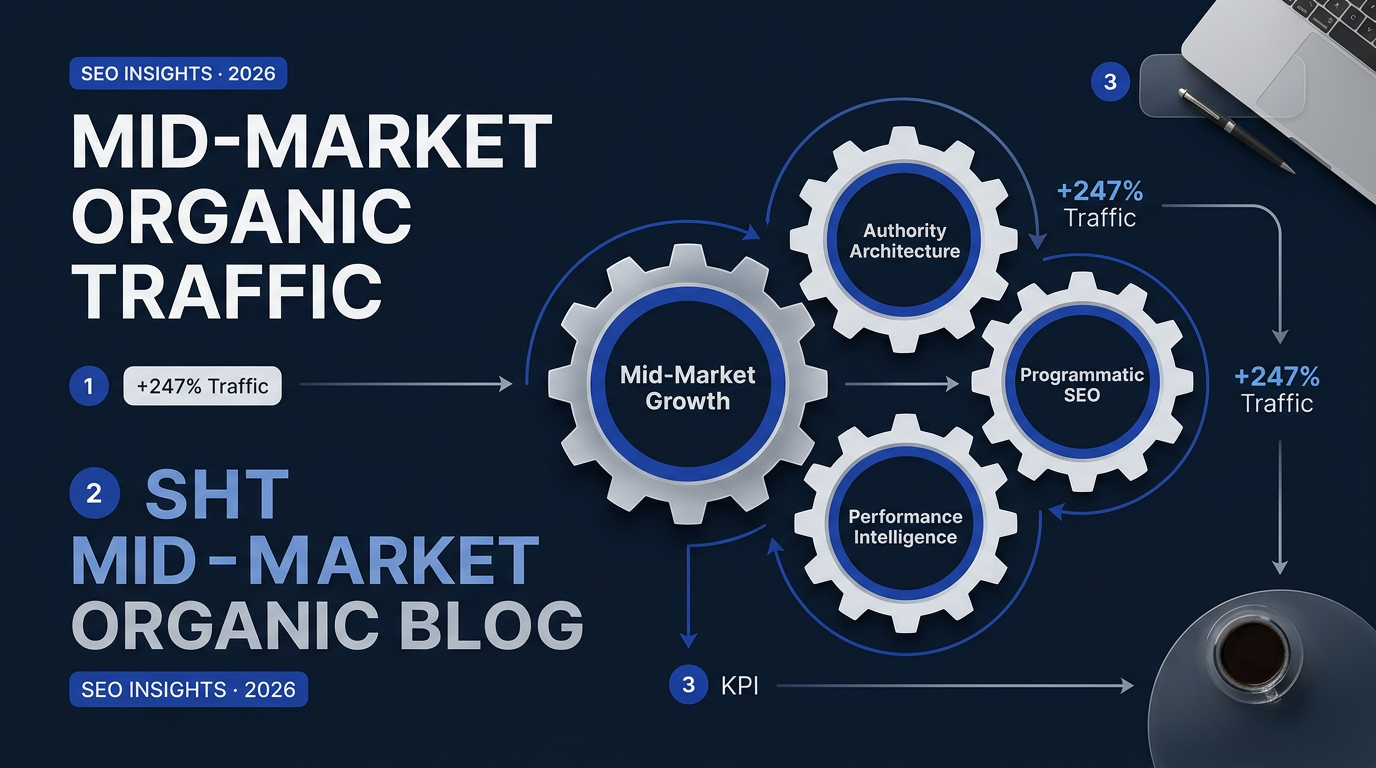
To break through, you need to evolve your approach from one-off campaigns to integrated systems. Forget simply “doing SEO.” It’s time to build a machine that consistently generates traffic and, more importantly, revenue. This playbook is built on three core pillars designed for sustainable scale:
- Authority Architecture: Systematically structuring your content to dominate entire topics, not just keywords.
- Programmatic & AI-Assisted SEO: Scaling content creation intelligently to capture long-tail opportunities without sacrificing quality.
- Performance Intelligence: Moving beyond vanity metrics to connect organic traffic directly to business outcomes like pipeline and revenue.
Pillar 1: Build Your Authority Architecture
Your company’s expertise is likely scattered across dozens or even hundreds of blog posts, landing pages, and help docs. To Google and your users, this looks disjointed. An Authority Architecture organizes this expertise into logical topic clusters (or “hub and spoke” models), signaling to search engines that you are a definitive resource on a subject. The “hub” is a broad, comprehensive pillar page on a core topic, while the “spokes” are detailed articles that cover specific sub-topics and link back to the hub.
For 2026, building this architecture requires more than just manual internal linking. It demands a systematic process:
- Strategic Content Audits: Use a tool like Semrush or Ahrefs to conduct a content audit. Don't just look for low traffic pages. Instead, group all your existing content by topic. Identify keyword cannibalization issues where multiple pages compete for the same term. This is your blueprint for consolidation.
- Pillar Page Consolidation: Merge your weaker, overlapping articles into a single, authoritative pillar page (the hub). For example, combine “5 Tips for Invoicing,” “Best Invoicing Software,” and “How to Create an Invoice” into one ultimate guide to invoicing. Use 301 redirects from the old URLs to the new hub to preserve link equity.
- Systematic Internal Linking: Enforce your cluster structure. Every time you publish a new spoke article, ensure it links up to its parent hub page. For WordPress sites, plugins can help suggest these links. For other platforms, create a clear internal linking SOP for your content team to follow, ensuring link equity flows correctly within the cluster.
This model transforms your site from a simple blog into a structured knowledge base. It allows you to rank for broad, high-volume head terms with your hub pages while capturing thousands of long-tail variations with your spoke articles, creating a powerful moat around your core business topics.
Pillar 2: Implement Programmatic & AI-Assisted SEO
You can't manually write 10,000 hyper-specific landing pages. This is where Programmatic SEO (pSEO) comes in. pSEO is the practice of using a database and templates to generate unique, valuable pages at scale. Think of Zillow's pages for every city and zip code, or Zapier's landing pages for every possible app integration. For a mid-market company, this is your secret weapon for capturing high-intent, long-tail search traffic.
To implement pSEO effectively in 2026, the focus is on quality and value, not just quantity. AI can be a powerful assistant, but not a replacement for strategy.
- Identify Your Unique Data Set: The foundation of good pSEO is a structured database. As many marketing guides suggest, having actionable data is fundamental. This could be proprietary data (e.g., your product features, customer locations, industry stats) or a public dataset you can enrich (e.g., government data, industry directories). For example, a B2B software company could create pages for “[Your Software] vs. [Competitor]” or “[Your Software] for [Industry].”
- Develop Dynamic Page Templates: Design a page template that pulls in variables from your database. The key is to include multiple unique data points to ensure each page is valuable. A template for “[Service] in [City]” shouldn't just swap the city name. It could also pull in local statistics, customer testimonials from that area, or a map of relevant service points.
- Leverage AI for Augmentation, Not Creation: Use AI (like GPT-4 via its API) for scalable tasks that support your pSEO strategy. Instead of asking it to “write a page about X,” use it to:
- Generate unique meta descriptions for thousands of pages based on a template and variables.
- Create FAQ schema markup for each page by slightly rephrasing a core set of questions.
- Summarize user reviews or technical specs to create unique snippets of content for each page.
This AI-assisted programmatic approach allows you to scale your digital footprint dramatically, targeting high-intent searchers at the bottom of the funnel with pages perfectly tailored to their needs.
Pillar 3: Adopt Performance Intelligence Over Reporting
Many mid-market marketing teams are stuck in a reporting loop: they present charts on traffic, keywords, and bounce rates, but struggle to answer the C-suite’s most important question: “How is SEO contributing to revenue?” Performance Intelligence is the shift from reporting *what* happened to explaining *why* it happened and modeling *what to do next*.
This requires a deeper integration of your sales and marketing data to build a full-funnel view of your organic performance.
- Unify Your Data Sources: Your Google Analytics data is only half the story. The real insights come when you connect it to your CRM (like Salesforce or HubSpot). Implement a robust tracking setup (ideally server-side to combat ad blockers and cookie restrictions) to pass user-level data between your website and your CRM. This allows you to track a user's entire journey, from their first organic visit to becoming a qualified lead and a closed-won deal.
- Build a Content ROI Model: With unified data, you can move beyond last-click attribution. Use a data visualization tool like Looker Studio or Tableau to build dashboards that track metrics like “Organic-Sourced Pipeline” and “Content-Assisted Revenue.” Assign a dollar value to different conversion types (e.g., a demo request is worth more than a newsletter signup) to calculate the ROI of specific topic clusters and prove the business case for further investment.
- Implement Predictive Forecasting: Stop relying solely on historical search volume. Use the forecasting features in advanced SEO tools or build simple models in spreadsheets to predict the potential traffic, leads, and revenue from targeting new topic clusters. By layering your site’s historical conversion rates onto keyword volume and difficulty, you can prioritize SEO initiatives based on potential business impact, not just traffic.
The Tech & Team Stack for Mid-Market Scale
Scaling your organic traffic program requires evolving your team and your tools. The generalist marketer who does a bit of everything is no longer sufficient. You need specialists who can execute on a more sophisticated strategy. While you may not need a full enterprise-level team, investing in a few key areas is crucial.
The Core In-House & Freelance Team:
- SEO Strategist: The architect of your program. This person owns the roadmap, manages the topic cluster strategy, and analyzes performance intelligence to guide decisions.
- Content Lead/SME: A subject-matter expert who can create or manage the creation of high-quality, in-depth hub and spoke content that your audience trusts.
- Data Analyst / SEO Analyst: The owner of your performance intelligence stack. This person manages the data integration, builds the dashboards, and surfaces insights for the strategist.
- Technical Support: A developer (in-house or freelance) who can implement schema, manage redirects, build pSEO templates, and fix technical site issues.
The Essential Tech Stack:
- SEO Platform: Ahrefs or Semrush (Pro or Business plan for access to content audits, historical data, and API).
- Data & Visualization: Google Analytics 4, a CRM (HubSpot, Salesforce), and a visualization tool (Looker Studio is a great free start).
- Programmatic Tools: Airtable or Google Sheets for the database, paired with a tool like Whalesync or Zapier/n8n to connect it to your CMS.
- AI Augmentation: An OpenAI API key for programmatic tasks, and potentially a tool like Jasper for brainstorming and first drafts.
Key Takeaways
Scaling organic traffic in the mid-market is about maturing your SEO program from a series of tactics into a strategic, repeatable system. To escape the growth plateau and build a sustainable engine for acquiring customers, you must:
- Move beyond basic on-page SEO and build a comprehensive Authority Architecture using topic clusters.
- Leverage Programmatic SEO and AI-assistance to intelligently scale your content footprint and capture high-intent traffic.
- Graduate from simple reporting to Performance Intelligence by connecting your SEO data to CRM data to prove and improve ROI.
- Invest in a specialized team and tech stack that can support a more sophisticated, data-driven strategy.