Beyond the Basics: Evolving from Startup SEO to Mid-Market Maturity
You’ve made it past the startup grind. You have product-market fit, a growing team, and revenue that’s starting to look serious. But your SEO strategy feels… stuck. The tactics that got you here—chasing long-tail keywords, writing one-off blog posts, and manually emailing for links—are no longer delivering the exponential growth you need. This is the classic challenge of mid-market organic growth: your resources haven’t caught up to your ambitions, and you're caught between scrappy startup tactics and enterprise-level complexity.
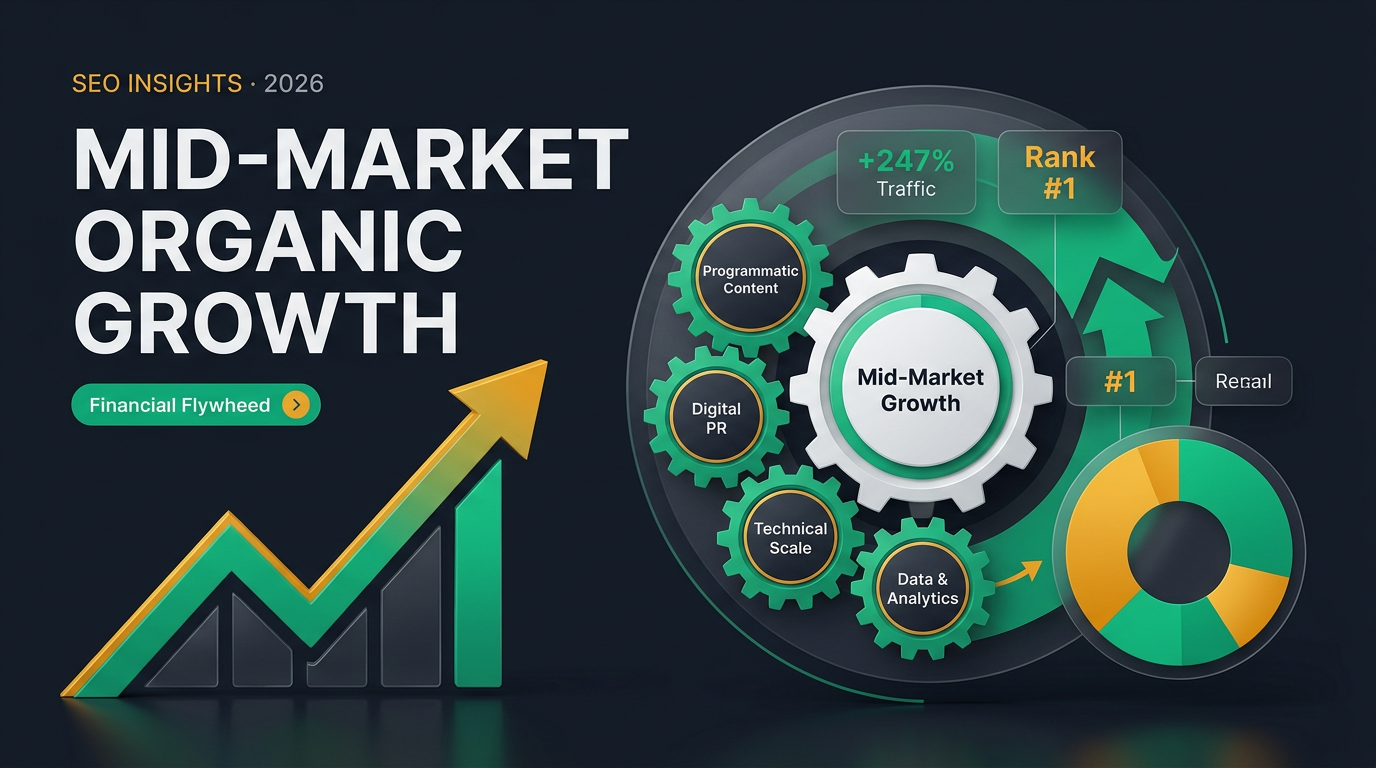
Scaling in the mid-market isn't about doing more of the same; it's about doing things differently. It requires a fundamental shift from an activity-based approach to a system-based one. You need to build engines for growth, not just complete a checklist of tasks. This means prioritizing scalability, efficiency, and ROI above all else. By 2026, the companies that win are those that can build sustainable, compounding organic traffic machines.
- From Manual to Systemic: Instead of writing individual articles, you'll be building content templates that can generate hundreds of pages.
- From Begging to Earning: Instead of asking for links, you'll be creating assets so valuable that high-authority sites want to link to them.
- From Reactive to Proactive: Instead of fixing technical issues as they arise, you'll be implementing automated monitoring and building processes to prevent them at the source.
- From Vanity Metrics to Business Impact: Instead of just tracking rankings and traffic, you'll be measuring SEO's contribution to pipeline, revenue, and customer lifetime value.
The Programmatic SEO Play: Scaling Content Creation Systematically
Programmatic SEO is arguably the single most powerful lever for mid-market companies. It’s the process of using data and templates to create high-quality landing pages at scale, targeting thousands of specific, purchase-intent queries that are impossible to address manually. Think of how Zillow creates a page for every address, Zapier for every app integration, or G2 for every software comparison. That’s programmatic SEO in action.
This isn't about churning out low-quality, auto-generated spam. It's about identifying a user need that can be answered with a consistent structure and a unique data source. Your company's internal data—product specs, location data, pricing tiers, user-generated reviews—is often a goldmine for this. The goal is to create the best possible page for a very specific, underserved query, and do it thousands of times over.
How do you get started in 2026?
- Identify Your Data Source & Modifiers: What unique data do you have? This could be products, services, locations, features, or integrations. Then, identify the modifiers users search with, like “reviews,” “pricing,” “alternatives,” or “vs.” For example: [Your Software] + vs + [Competitor].
- Design a High-Value Template: Your page template is crucial. It must be more helpful than a standard blog post. Include structured data (Schema markup), unique data points, comparison tables, user-generated content like reviews, and clear calls-to-action.
- Engineer the Solution: This is where you bring in development resources. You need to connect your data source to your template to generate pages dynamically or as static HTML. Prioritize a clean URL structure (e.g., `domain.com/integrations/salesforce`) and ensure every page has a unique, valuable element.
- Launch, Monitor, and Iterate: Don't launch all 10,000 pages at once. Start with a small, high-quality batch. Monitor their indexation and performance in Google Search Console. Use the data to refine your template before scaling up the program.
Building Your Authority Flywheel: From Link Building to Digital PR
As a mid-market player, you can’t afford to trade links or write endless guest posts. Your time is too valuable. The new currency of authority is Digital PR—the art of creating stories and assets that journalists and high-authority publications genuinely want to cover. This approach builds your brand and earns top-tier, needle-moving links simultaneously. Instead of chasing a DA 40 blog, you’re aiming for coverage in Forbes, TechCrunch, or a leading industry trade journal.
The core of a Digital PR strategy is the “linkable asset.” This is a piece of content—a tool, a study, a data visualization—that serves as the focal point for your outreach. It provides unique value and gives journalists a compelling reason to write about your company. A single successful asset can generate dozens of high-authority links, doing the work of an entire year of manual link building.
Examples of powerful linkable assets for mid-market companies include:
- Proprietary Data Studies: Survey your customers or analyze your own anonymized user data to reveal a new industry trend. Package it into a compelling report.
- Free, High-Value Tools: Create a simple calculator, generator, or checklist that solves a common pain point for your target audience. For example, a “Total Cost of Ownership Calculator” for a SaaS product.
- Expert Roundups with a Unique Angle: Instead of another generic “20 experts say…” article, create a data-backed piece. For example, analyzing the LinkedIn profiles of 100 VPs of Marketing to find common career paths.
- Definitive Guides with Unique Visuals: Create the undisputed best resource on a core topic in your industry, but invest heavily in custom infographics and interactive elements that others will want to embed and cite. A great resource on this is the Ahrefs blog on link building strategies.
Technical SEO at Scale: Audits, Automation, and Internal Linking
With a site that could have tens of thousands of pages (especially after a programmatic push), you can't rely on manual technical audits. Technical SEO for mid-market organic growth is about building resilient systems. Your goal is to fix problems at the template level and use automation to monitor site health proactively.
A critical, often-overlooked area is internal linking. With a large site, how does Google know which pages are most important? How do you pass authority from your high-level pages to your deeper product or programmatic pages? The answer is automated, rule-based internal linking. For example, you can create rules to automatically link from any blog post that mentions a certain keyword to its corresponding service page. Or you can ensure every programmatic page links up to its parent category and links to 3-5 related sibling pages.
Key technical focus areas for mid-market sites in 2026:
- Template-Level Core Web Vitals: Don't optimize pages one by one. Analyze your core page templates (blog post, service page, programmatic page) and optimize them for LCP, INP, and CLS. A fix on one template can improve thousands of pages.
- Automated Health Monitoring: Use scripts or third-party tools to automatically monitor for 404 errors, broken internal links, indexation issues, and schema validation errors. Get alerts so you can fix issues before they impact rankings.
- Log File Analysis: For larger sites, analyzing your server logs is non-negotiable. It tells you exactly how Googlebot is crawling your site, how much crawl budget is being wasted on unimportant pages, and whether your most important pages are being crawled frequently.
- Programmatic Internal Linking: Develop a clear, automated strategy for how new pages will be linked into your existing site architecture to ensure proper authority flow and discoverability.
The "Helpful Content" Mandate of 2026: Integrating E-E-A-T and AI
Google’s Helpful Content System and its focus on Experience, Expertise, Authoritativeness, and Trust (E-E-A-T) are no longer suggestions; they are the table stakes for ranking. For mid-market companies, this means you can't just use AI to generate soulless, generic content. You will lose.
The winning strategy in 2026 is using AI as a powerful assistant, not a replacement for human expertise. Your subject matter experts—your product managers, sales engineers, and customer success leads—are your greatest SEO asset. Their unique experience and insights are what create truly helpful content that satisfies E-E-A-T. AI can help you scale their knowledge, but it can't create it from scratch.
The role of AI in content is to handle the 80% of grunt work—research, outlines, first drafts—so your human experts can focus on the 20% that provides unique value: personal anecdotes, novel insights, and strategic perspective.
Here’s how to put this into practice:
- Author Bios and Schema: Showcase your experts. Give them detailed author pages linked from every article they write. Use `SameAs` schema to connect them to their social profiles (like LinkedIn) and other publications. This sends clear E-E-A-T signals to Google, as detailed in their own documentation on helpful content.
- Incorporate First-Hand Experience: Edit all content to include phrases that signal experience, like “In my 10 years as a project manager…,” “When we tested this with customers…,” or “A common mistake I see is…”
- Use AI for Research, Not Writing: Use AI tools to analyze top-ranking articles, identify common questions, and structure an outline. Then, have your expert write or heavily edit the content to inject their unique knowledge.
Measuring What Matters: Advanced Analytics and SEO Forecasting
As you scale your SEO efforts, you need to scale your measurement capabilities. Reporting on keyword rankings and overall organic traffic is no longer sufficient to justify investment. You need to connect your SEO efforts directly to business outcomes. This means working closely with your RevOps or data teams to track organic traffic's journey down the funnel.
SEO forecasting is another hallmark of a mature mid-market program. Instead of just hoping for growth, you can use historical data and your strategic plan to model potential outcomes. A simple model might take your target keyword set, their search volumes, and estimated click-through rates at different ranking positions to project future traffic and conversions. This transforms SEO from a cost center into a predictable revenue driver.
Key metrics to track beyond traffic:
- Organic-Sourced Pipeline/Revenue: The ultimate metric. How much revenue is being generated from customers who originally found you through organic search?
- Traffic by Content Cluster: Don't just look at overall traffic. Measure the growth of specific topic clusters to see which strategic bets are paying off.
- Non-Branded vs. Branded Traffic Growth: Is your growth coming from people who already know you, or are you successfully capturing new audiences?
- SERP Feature Ownership: Track how often you appear in Featured Snippets, People Also Ask boxes, and other SERP features, as this is a key indicator of topical authority.
Key Takeaways
- Systemize Everything: Shift from one-off tasks to building scalable engines for content (Programmatic SEO), links (Digital PR), and technical health (Automation).
- Leverage Your Data: Your internal data is a unique asset for creating thousands of valuable pages with Programmatic SEO.
- Build Authority, Don't Beg for Links: Create high-value linkable assets (tools, data studies) to earn top-tier media coverage and links.
- Use AI as a Co-Pilot, Not an Autopilot: Combine AI's efficiency with your team's deep human expertise to create content that satisfies Google's E-E-A-T requirements.
- Measure Business Impact: Move beyond vanity metrics. Track SEO's contribution to pipeline and revenue to prove its value and secure future investment.