Beyond the Blog: Why Mid-Market SEO Stagnates
You’re in the messy middle. The scrappy startup tactics that ignited your initial growth have sputtered out, but you don’t have the nine-figure budget of an enterprise giant. Your team is creating content, hitting publish, and seeing linear, predictable, and frankly, underwhelming results. This is the classic mid-market plateau, a place where the strategies that got you here will not get you to the next level of sustainable, scalable mid-market organic traffic.
The fundamental problem is a reliance on the “content treadmill.” For many, SEO strategy is simply a cycle of manual keyword research followed by one-off blog post creation. This approach inevitably collides with the law of diminishing returns. You’re forced to compete on hyper-competitive head terms or produce endless articles for long-tail keywords that only deliver a trickle of traffic. It's a strategy of addition, not multiplication. To truly scale, we must shift from creating content to creating systems.
- Manual Content Bottlenecks: Relying solely on human writers for every single page is a linear, unscalable growth model.
- Resource Misalignment: SEO needs often lose priority battles for scarce developer time, stalling crucial technical and structural projects.
- Enterprise Competition: Larger competitors with massive backlink profiles and content budgets can out-muscle you on broad, high-value keywords.
- Difficulty Proving ROI: It becomes harder to justify budget when traffic growth is incremental, not exponential, making it difficult to fund more ambitious SEO initiatives.
The Scalability Flywheel: Programmatic & Product-Led SEO
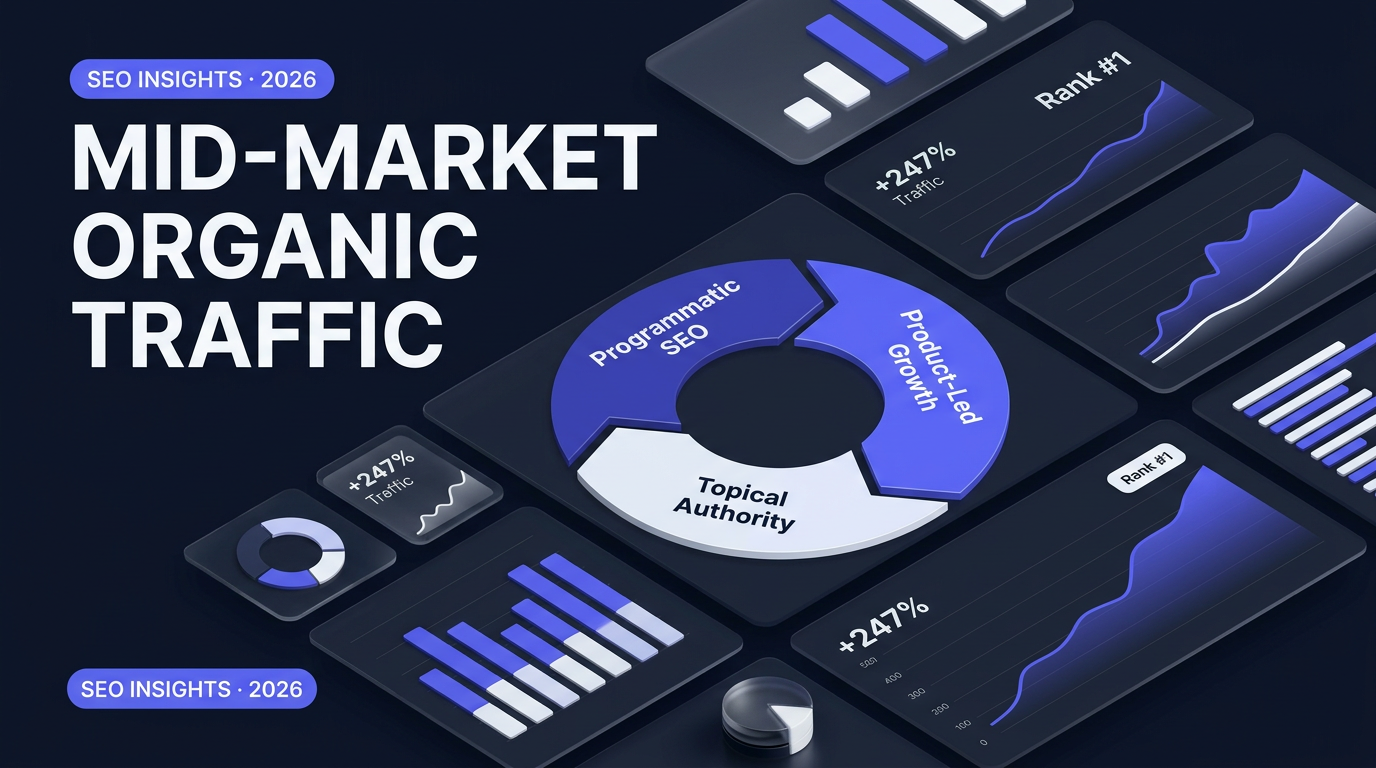
The solution is to evolve beyond the article. The most successful mid-market growth stories in 2026 are built on two core principles: Programmatic SEO and Product-Led SEO. This isn’t about replacing your blog; it’s about supplementing it with assets that scale non-linearly. Think of it as building a traffic-generating machine rather than hand-crafting every single widget.
Programmatic SEO is the art of creating pages at scale by combining a consistent template with a unique data set. Think of Zapier’s thousands of “Connect [App A] to [App B]” pages or the city-specific landing pages of a real estate marketplace. Each page is programmatically generated but serves a unique, specific user intent. Product-Led SEO, a concept highlighted by forward-thinkers at CXL, involves turning your own product's features or data into publicly accessible, indexable content. Think of Trello’s template gallery or HubSpot’s free Website Grader tool. These aren't blog posts; they are valuable, scalable assets that attract highly qualified users.
- Comparison Engines: Programmatically generate `[Your Product] vs. [Competitor]` pages using structured feature data.
- Integrations Marketplaces: If your product integrates with others, create a unique page for each integration, detailing its benefits and use cases.
- Interactive Tools & Calculators: Build and optimize free tools like an ROI calculator, a project cost estimator, or a data visualizer that solve a problem for your target audience.
- Data-Driven Landing Pages: Create pages targeting long-tail patterns like `[Your Service] for [Industry] in [City]` by combining templates with location and industry data.
- Glossaries & Templates: Develop a comprehensive glossary of industry terms or a library of downloadable templates that users can browse and search.
Identifying Your Scalable Opportunity: The “JTBD” Framework
Great ideas for programmatic SEO don't come from a keyword tool; they come from your customers. The “Jobs-to-be-Done” (JTBD) framework is the perfect lens for this discovery process. Instead of asking “what do people search for?” ask “what ‘job’ are people hiring our product to do?” The search queries are simply the language they use to describe that job. Your goal is to find patterns in that language.
For example, a customer doesn't just “buy project management software.” They hire it to “improve team collaboration on complex projects” or to “get a clear view of project profitability.” These jobs spawn dozens of specific search queries: `best software for creative agency projects`, `how to track budget in asana`, `trello alternatives for developers`. When you see a recurring query structure—a shared syntax—you’ve likely found a programmatic opportunity. You can create a single, powerful template to answer thousands of variations of that question.
- Define the “Jobs”: Interview your sales team, read support tickets, and talk to your best customers. What tangible outcomes are they trying to achieve with your product or service?
- Find the Query Patterns: Use a tool like Semrush or Ahrefs to explore the keywords your customers and competitors rank for. Look for recurring structures like `[tool] alternatives`, `how to integrate [x] with [y]`, or `best [solution] for [persona]`.
- Analyze the SERPs: Search for these query patterns. If Google is already rewarding competitors who use templated pages (e.g., G2, Capterra, Zapier), that’s a massive signal that the intent is suited for a programmatic approach.
- Design Your Template: Based on the SERP analysis, design a page template that serves the user’s intent better than anyone else. It must be more comprehensive, easier to use, or contain more unique data than the competition.
The Mid-Market Tech Stack for SEO Scalability (2026 Edition)
Executing a programmatic project requires the right tools, but you don't need an enterprise budget. The modern no-code and API-first ecosystem has made scalable SEO more accessible than ever. The key is assembling a stack that allows you to source data, build pages, and link them together efficiently.
This isn't about fully automated, low-quality content. The 2026 approach uses technology for assembly and scale, while a human-in-the-loop ensures quality, accuracy, and adherence to Google's E-E-A-T (Experience, Expertise, Authoritativeness, Trustworthiness) principles. AI can help structure your data into prose, but a human expert must review and refine it.
- Data Sourcing & Management: Start with your own internal product data. Augment it with third-party APIs or use web scraping tools (ethically!) to collect public data. Store and manage it all in a tool like Airtable or even Google Sheets for an MVP.
- Page Building & CMS: A headless CMS (like Strapi, Sanity, or Contentful) is ideal, as it separates your content from the presentation layer, giving you flexibility. For leaner teams, Webflow’s CMS is an incredibly powerful no-code option for building and launching programmatic projects.
- Content Assembly (AI-Assisted): Use AI tools like GPT-4 to help turn structured data points (e.g., features, prices, specs) into descriptive paragraphs for your templates. This is an *assistive* role to speed up population, not a replacement for human oversight and editing.
- Internal Linking Automation: Once your pages are live, use scripts or specialized tools to automatically build a smart internal linking structure. For example, every `[City]` page should link back to its `[State]` page and the main service page, creating a logical, crawlable hierarchy.
Building the Business Case: From SEO Project to Business Initiative
The final hurdle for mid-market SEOs is often internal. As some have noted, mid-market companies can struggle to align resources for growth. A programmatic project can seem complex and expensive compared to writing another blog post. To get buy-in, you must stop talking like an SEO and start talking like a business owner. Frame your proposal around revenue, market share, and building a long-term competitive asset, not just rankings and traffic.
Instead of pitching “a 5,000-page programmatic SEO project,” pitch “a plan to build a scalable client acquisition channel that will capture the entire long-tail market for our service.” Use conservative financial models to show the potential return on investment. Most importantly, propose a pilot program to de-risk the investment. This proves you are thinking strategically about managing resources and proving value before scaling.
- Quantify the Total Addressable Market (TAM): Use your keyword research to calculate the total monthly search volume for the entire query pattern you're targeting. This is your traffic universe.
- Forecast Traffic & Conversions: Create a simple model. Project capturing a conservative 2-5% of that search volume within 12 months. Then, multiply that traffic by your website's average conversion rate to forecast leads or sign-ups.
- Model the ROI: Multiply your projected conversions by the average lifetime value (LTV) of a customer. Compare this potential revenue against the projected cost of the project (developer time, content resources) to calculate a clear ROI.
- Propose a Lean MVP (Minimum Viable Product): Suggest launching a small, 25- to 50-page pilot. This allows you to test your template, gather initial performance data, and prove the concept to stakeholders before requesting the full budget to scale.
Key Takeaways
Scaling organic traffic in the mid-market requires a fundamental shift in strategy. The path to exponential growth isn't paved with more blog posts; it's built with scalable systems that multiply your efforts. To win in 2026 and beyond, you must move from being a content creator to being an architect of traffic-generating machines.
- Stop the content treadmill. Linear effort yields linear results. Embrace strategies that offer exponential returns.
- Build a scalability flywheel with Programmatic SEO and Product-Led SEO to create assets that grow in value over time.
- Use the Jobs-to-be-Done (JTBD) framework to uncover user needs that can be served with templated pages at scale.
- Assemble a modern, accessible tech stack using headless CMS, no-code tools, and AI-assistants to build efficiently.
- Secure buy-in by framing your projects in terms of business ROI and de-risking the investment with a small pilot program.