
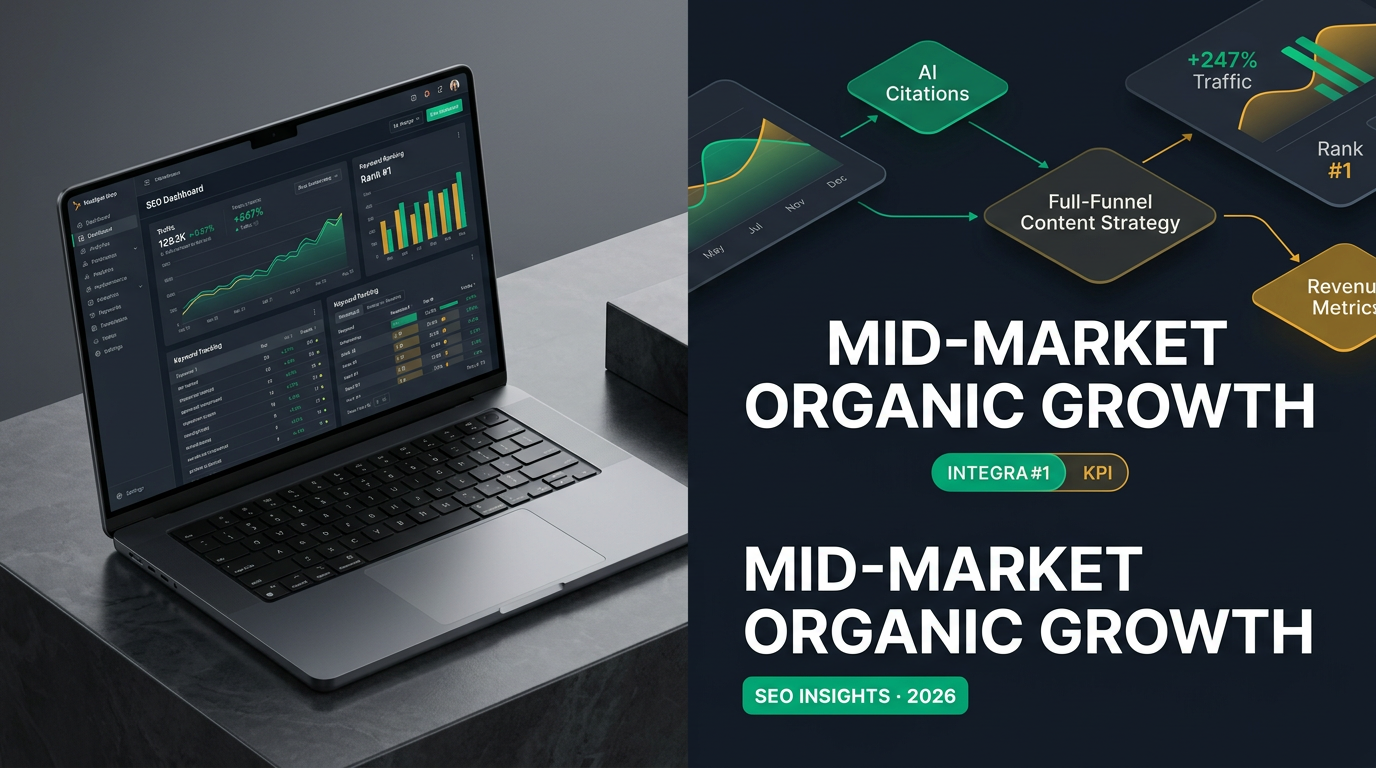
The New Reality: Why Your Mid-Market Organic Growth Has Stalled
For years, the SEO playbook was straightforward: rank high, get clicks, grow traffic. But in 2026, mid-market leadership is staring at a frustrating paradox. Your keyword rankings are stable, maybe even improving. Your team is executing flawlessly. Yet, your organic traffic is flat or, worse, declining. If this sounds familiar, you’re not alone. This isn’t a sign of failure; it's a signal of a fundamental, structural shift in how search engines deliver value.
The culprit is the rapid evolution of AI in search. Generative AI summaries now answer user questions directly on the results page, intercepting the click that once belonged to you. As one Pew Research study highlighted, users are nearly 50% less likely to click an organic link when an AI overview is present. This means the old metrics are broken. It’s time for a new playbook—one designed specifically for the unique challenges and advantages of a company your size. This is the playbook for sustainable mid-market organic growth.
Your Mid-Market Advantage: Agility, Data, and Focus
While enterprises wrestle with bureaucracy and startups struggle for resources, mid-market companies are in the operational sweet spot. You have the agility to pivot your strategy without a six-month approval process, but you also possess a critical asset most startups lack: a meaningful amount of first-party data and a well-defined customer base. This is your unfair advantage in the new era of SEO.
Unlike enterprises with sprawling, disconnected business units, your teams are nimbler. As one agency notes, the most successful companies are adopting a full-funnel, cross-functional approach, aligning marketing, sales, and product around shared revenue goals. You can implement this model faster. Your Ideal Customer Profile (ICP) isn't a theoretical guess; it's backed by years of sales data in your CRM. You know their pain points, their language, and the questions they ask before signing a contract.
This unique position allows you to move beyond the high-volume, low-intent keywords that AI is consuming. You can focus your efforts on creating high-value, specific content that attracts not just any traffic, but the *right* traffic—the kind that converts. You have the data to know what that looks like and the agility to build a content engine that serves it.
Pillar 1: Architecting Your Content for AI Citations and High-Intent Clicks
If AI is answering the questions, the primary goal of top-funnel content shifts from earning a click to earning a *citation* within the AI-generated answer. This is the core of Generative Engine Optimization (GEO). Being cited positions your brand as an authority and, crucially, captures the attention of the most engaged users who still click through for deeper information. Traffic from AI citations is proving to be incredibly valuable, with some studies showing conversion rates up to 4.4 times higher than traditional organic traffic.
Simultaneously, you must double down on content where AI can't provide a complete, satisfying answer. This is the commercial-intent content that drives revenue. Your mid-market playbook for content must therefore operate on two parallel tracks: one for authority-building citations and one for conversion-focused clicks.
Your 2026 Content Action Plan:
- Embrace Entity-Based SEO: Move beyond simple keywords. Build comprehensive topic clusters around the core “entities” (your products, key personnel, proprietary methodologies) that define your business. Create a rich, interconnected web of content that establishes your domain as the definitive source for these concepts.
- Master Structured Data: Go beyond basic schema. Implement detailed `Product`, `HowTo`, `FAQPage`, and even `VideoObject` schema on every relevant page. The goal is to make your content perfectly machine-readable, spoon-feeding AI models the exact facts, features, and steps you want them to cite.
- Weaponize Your Expertise (E-E-A-T): Showcase your first-hand experience. Publish content under the bylines of your actual experts, with detailed author bios linking to their professional profiles. Create proprietary data reports, case studies with real numbers, and opinionated takes that a generic AI cannot replicate.
- Dominate Bottom-of-Funnel Keywords: Shift resources to creating best-in-class content for “alternative to,” “- vs -,” pricing, and implementation-focused queries. These users are deep in the buying cycle, and their complex, nuanced needs are less likely to be fully satisfied by an AI summary.
Pillar 2: Integrating SEO into a Full-Funnel Growth Engine
In the mid-market, SEO can no longer be a siloed function focused solely on acquisition. To drive sustainable growth, it must be woven into the entire customer lifecycle. This growth marketing mindset transforms SEO from a traffic-generation tactic into a strategic revenue engine that supports sales, activates new users, and retains existing customers.
Your advantage is that your sales and customer success teams are accessible. You can sit down with them quarterly and ask: “What are the top 10 questions you get on sales calls?” and “What’s the number one feature customers struggle to adopt?” The answers to these questions are your new content roadmap. By turning internal knowledge into public-facing content, you create a powerful feedback loop that serves both prospects and customers.
How to Operationalize Full-Funnel SEO:
- Sales Enablement Content: Partner with your sales lead to turn common customer objections and late-stage questions into detailed blog posts, guides, and landing pages. This content not only attracts high-intent organic traffic but also serves as a valuable asset your AEs can share to move deals forward.
- Customer Activation Content: Work with the product and customer success teams to create a robust library of onboarding tutorials, use-case guides, and best-practice articles. This content reduces support tickets and increases product adoption. More importantly, it signals to search engines that you are a true expert in your domain.
- Expansion and Retention Content: Develop content specifically for your existing customers. Think about advanced strategy guides, integration walkthroughs, and articles that help them get more value from your product. This builds loyalty and creates organic opportunities for upselling and cross-selling.
Pillar 3: A 2026 Measurement Framework That Speaks to the C-Suite
If you keep reporting on session counts and rankings, you will eventually lose the budget conversation. As we've established, those metrics no longer reflect the full value of a modern organic presence. The catastrophic traffic losses seen by even massive players like HubSpot prove that the old dashboard is obsolete. You must shift your reporting to focus on business outcomes and the new realities of AI search.
Your goal is to reframe the conversation from “How much traffic did we get?” to “How much high-quality pipeline and revenue did organic influence?” This requires closer integration with your CRM and a willingness to adopt new, more sophisticated metrics. For mid-market leaders, this is how you prove the ROI of your program and secure investment for future growth.
The New KPIs for Mid-Market Organic Growth:
- Citation Share in AI Overviews: For your most important informational topics, track what percentage of AI-generated answers cite your brand as a source. Tools are emerging to monitor this, but manual tracking for a core set of terms is a powerful starting point.
- Lead Quality & Conversion Rate Per Session: Instead of focusing on the raw volume of sessions, measure the quality. Is the traffic that *does* click through converting at a higher rate? Are these leads a better fit for your ICP? A 30% drop in traffic is irrelevant if your qualified demo requests from organic double.
- Organic-Influenced Pipeline: Use your CRM and attribution tools to track how many deals were touched by organic content at any point in their journey. Present this as “Organic-Sourced Pipeline” to connect your team’s work directly to the number that matters most: revenue.
- Ranking for Commercial-Intent Keywords: While general rankings are less important, rankings for bottom-of-funnel terms (e.g., brand comparisons, pricing, alternatives) are more critical than ever. Report on your visibility for the keywords that signal immediate purchase intent.
Key Takeaways
The rules for organic growth have changed, but for savvy mid-market companies, the opportunity is immense. The generic, high-volume playbook is being commoditized by AI, clearing the way for brands that can demonstrate true expertise and connect with customers across the entire funnel. To win in 2026 and beyond, you must adapt your strategy and your measurement.
- Acknowledge the Shift: Organic traffic declines are a structural reality of AI search, not a failure of execution. Clicks are fewer but more valuable.
- Leverage Your Advantage: Use your mid-market agility and rich customer data to focus on high-value, specific content that enterprises are too slow to create and startups don't have the data for.
- Architect for AI and Intent: Build content to earn citations in AI Overviews while simultaneously dominating the bottom-of-funnel keywords that AI can't fully answer.
- Integrate SEO Across the Funnel: Transform SEO from an acquisition channel into a revenue engine that supports sales, activates users, and drives retention by turning internal knowledge into public content.
- Measure What Matters: Abandon outdated vanity metrics. Report on citation share, lead quality, and organic-influenced pipeline to prove the true business impact of your program.